Dispersion Analysis Cause & Effect Diagram Template |Download Excel Format

Dispersion Analysis Cause & Effect Diagram Template

Dispersion Analysis & Process Classification Cause & Effect Diagram Template

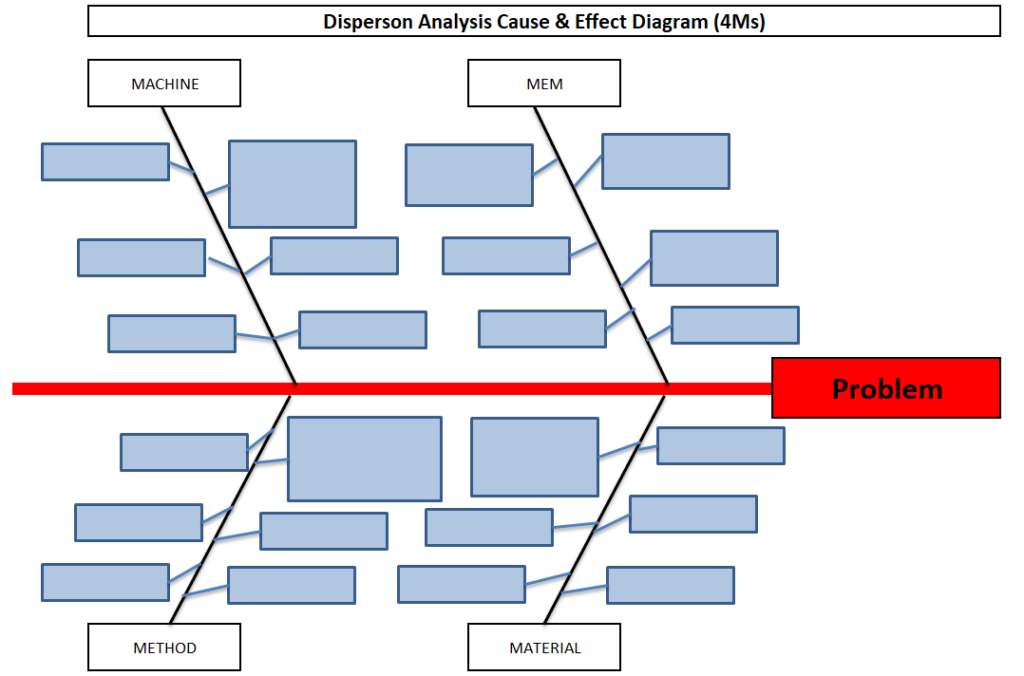
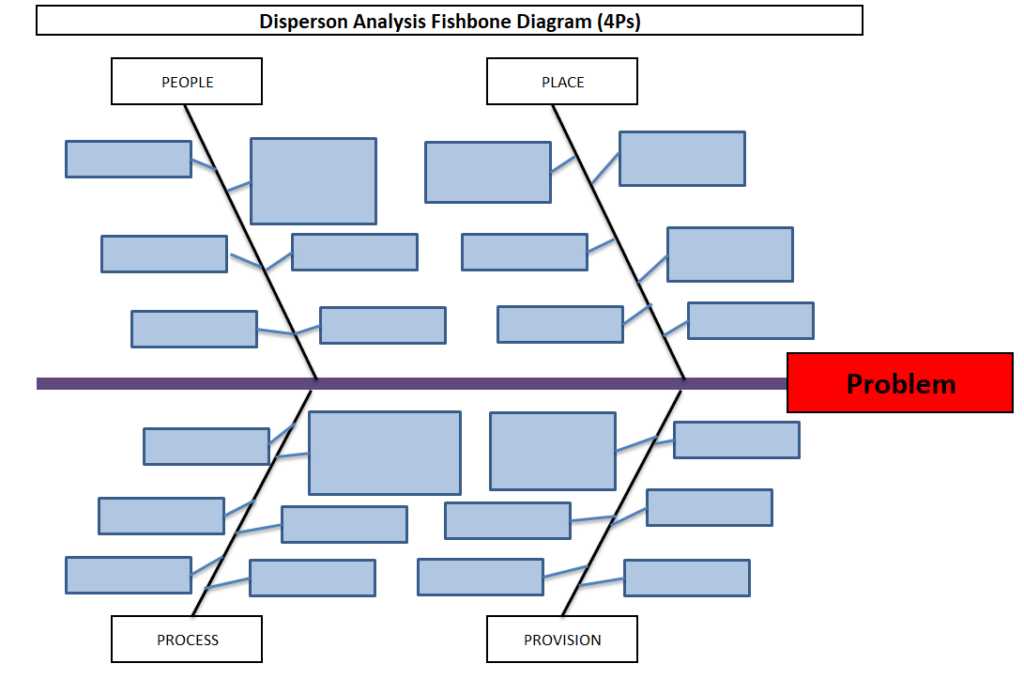
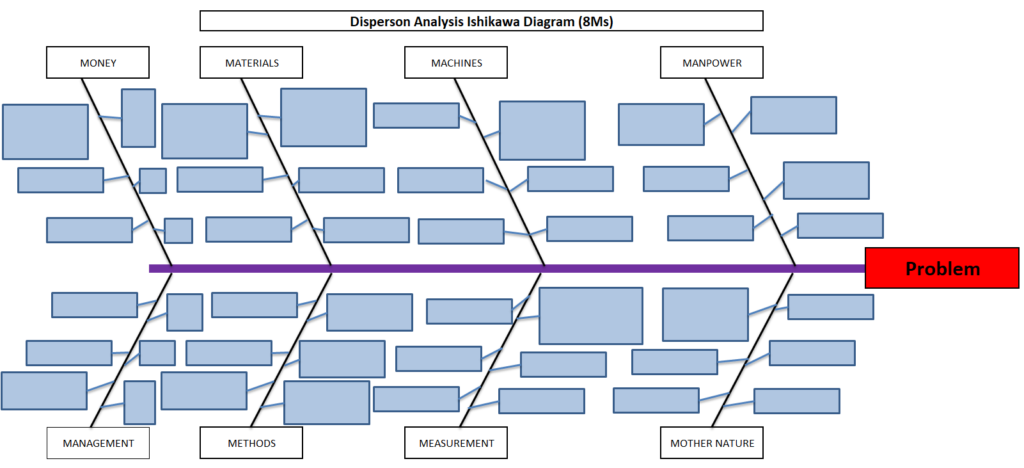
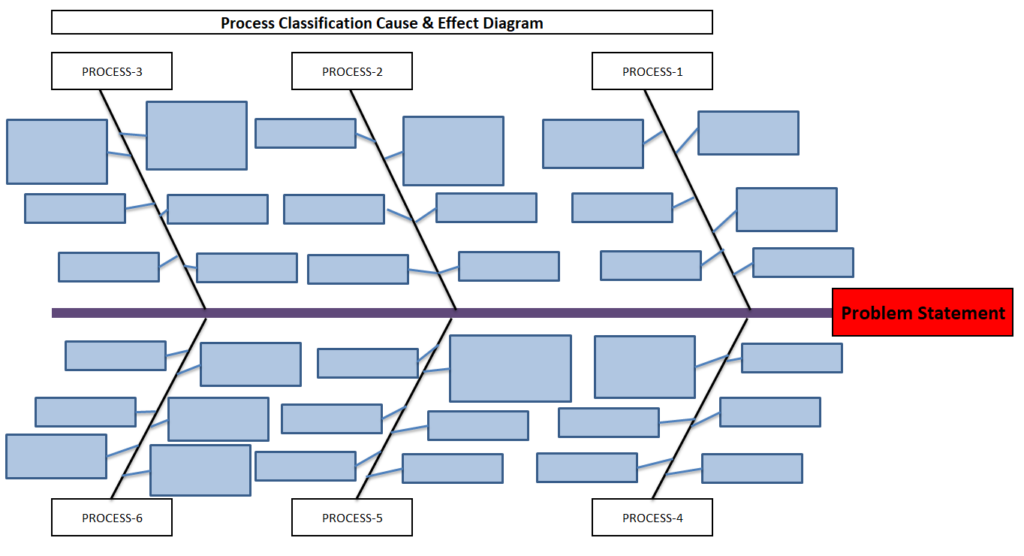
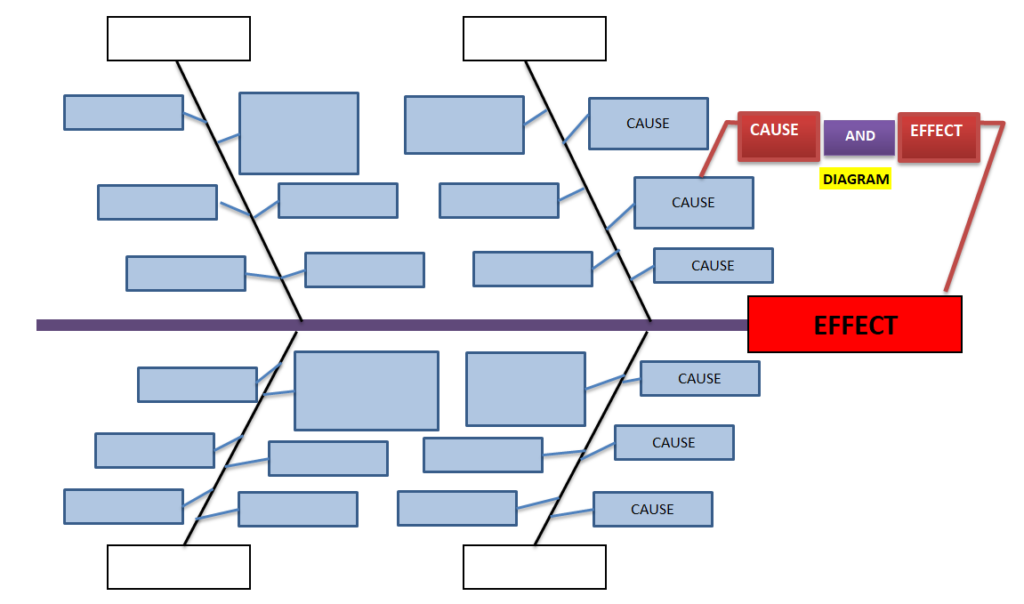
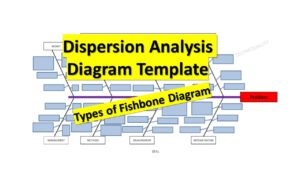
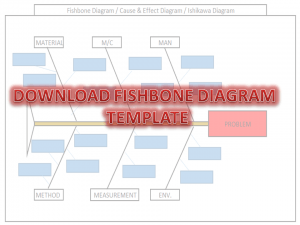
Hi readers! Today we will discuss on types of Cause & Effect Diagram/Fishbone diagram. The cause and effect diagram is the most popular and frequently used tool among the seven QC tools. Basically Fishbone diagram is classified into mainly two types as [1] Dispersion Analysis Cause and Effect diagram, and [2] Process Classification Fishbone diagram. The Dispersion analysis fishbone diagram involves identifying the potential cause for a specific quality problem. However, a Process classification cause & effect diagram involves establishing causes related to the Process. In the manufacturing industry, both types of diagrams are used but Dispersion types are most frequently used to identify the potential causes of the quality-related problems.  If you are interested in downloading the Dispersion Analysis Cause & Effect Diagram Template & Process Classification fishbone diagram, then click on the given below links.

DOWNLOAD– Dispersion analysis cause & effect diagram template. (4Ms).

Dispersion Analysis Cause & Effect Diagram Template
4Ms

Dispersion analysis Fishbone Diagram Excel Template. (4Ps)-DOWNLOAD.

Dispersion Analysis Cause & Effect Diagram Template
4Ps

DOWNLOAD– Dispersion analysis cause & effect diagram format. (8Ms).

Dispersion Analysis Cause & Effect Diagram Template
8Ms

Process Classification cause & effect diagram excel format-DOWNLOAD.

Dispersion Analysis Cause & Effect Diagram Template
Process Classification

Steps for construction of Cause & Effect Diagram:

  • Form a CFT- Team with a multifunctional experienced workforce.
  • The facilitator will listen carefully to the member’s potential causes to represent it in a diagram.
  • Draw a backbone line from left to right, terminating at the Head, and write the Problem statement.
  • Draw the small bone and write the potential cause.
Dispersion Analysis Cause & Effect Diagram Template

Advantages:

  • It helps to identify the potential cause to improve the process.
  • Helps in the root cause identification of the problem.
  • C&E diagram is easily constructed & understood.
  • It is an effective tool for the diagnosis of the various causes of the problem and helping to solve the problem.

Disadvantages:

  • Waste of time to identify the other causes that are not critical to the Problem.
  • It’s a time-consuming methodology.

Dispersion Analysis Cause & Effect diagram V/S Process Classification Fishbone diagram:

ishikawa Template
fishbone  Template

Useful Links:

Strategies for Manufacturing Process Improvement |11+ Strategies

7QC Tools for Problem Solving | What are 7 QC Tools

Fishbone Diagram Template With Example

Root Cause Analysis | 8 Steps of RCA

More on TECHIEQUALITY

Thanks for Reading…Keep visiting Techiequality.Com

Popular Post

5W1H Analysis Example |Download Template

5W1H Analysis Example

5W1H Analysis Example |Download Template:

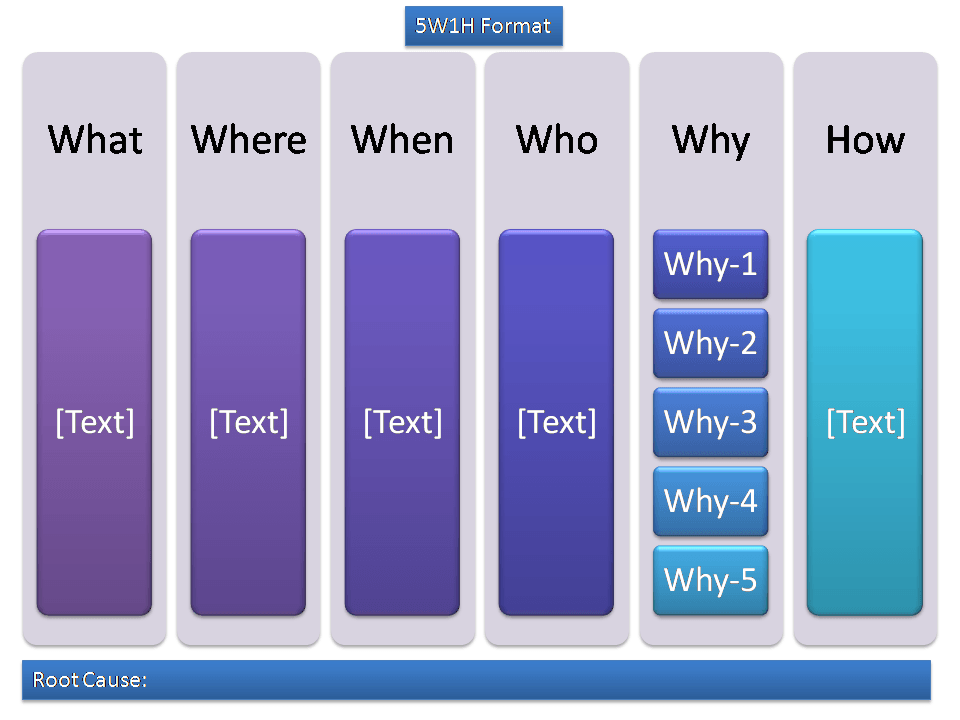
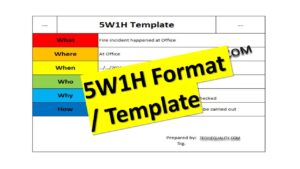
Hi Readers! Today we will discuss here 5W1H Analysis with a manufacturing example. 5W1H is a methodology consisting of six questions as What? Where? When? Who? Why? How? Needs to ask a lot of questions to collect all the necessary data to draw up a report of the existing situation with the aim of identifying the phenomenon of the problem. Go through the below details of the 5W1H Analysis Example (Manufacturing Example).

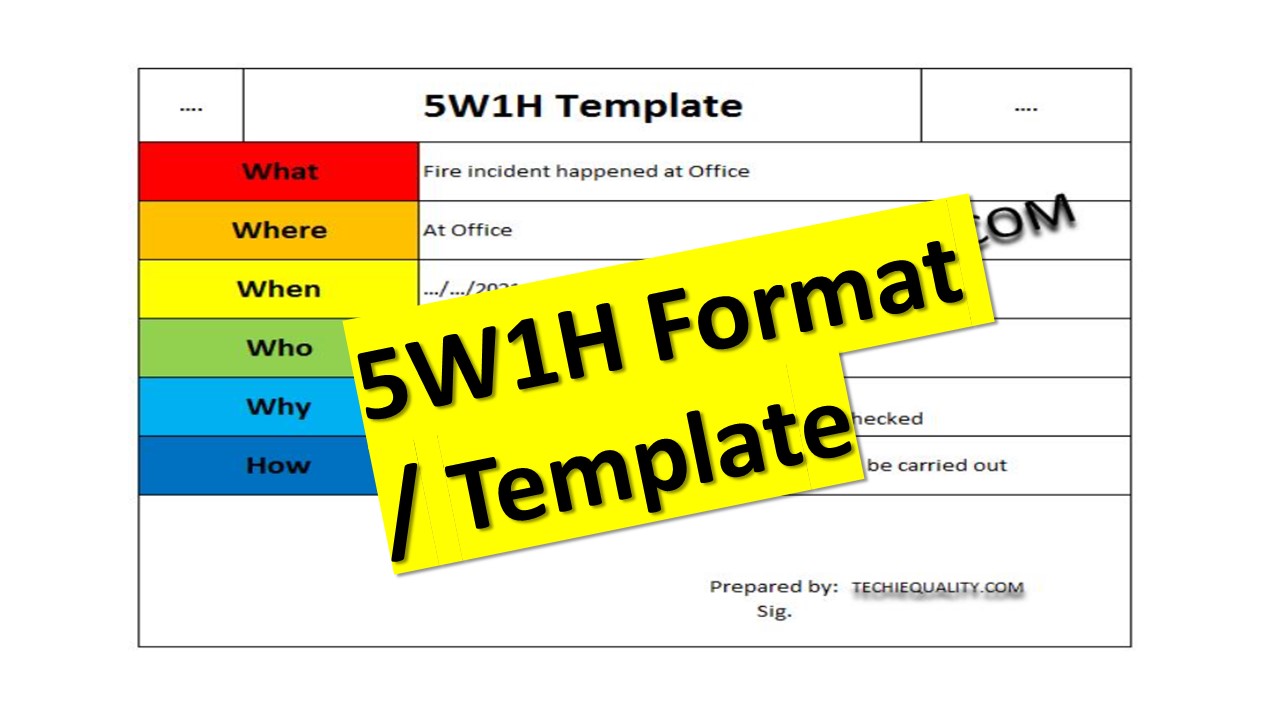
DOWNLOAD-5W1H Template/ Format.

5W1H Analysis:

5W1H Analysis will help you broadly to know the nature of the problem like What is the Problem? Where did the problem occur?  When did the problem happen? Who do you need to get involved? Why is it happening? How can you overcome the Problem?

The above pattern may be subject to change if it does not fit with the scenario/ nature of the problem. We can use “how much” additionally as and when applicable regarding the nature of the problem. And then it’s namely called 5W2H. Here, we will illustrate only 5W1H.

 Description of 5W1H:
Phenomenon of  Problem: Explanation:
What is the Problem? Where did the problem occur?
When did the problem happen? Describe the location, place, and m/c involved.
Who do you need to get involved? Find out the time when a situation took place.
Involvement of people, external providers, etc. Why is it happening?
How can you overcome the problem? To know the reason behind of facts
Method of implementation, deployment, etc. Method of implementation, deployment, etc.
[5W1H Description Table]
Benefits of 5W1H Method:
  • It can apply to all types of industries.
  • One can use it to address all kinds of problems to ask questions from every angle.
  • It’s a simple method, that everyone can understand, no need for training to ask these types of questions.

You could also like to read the below Articles:

The Process Approach to QMS (ISO 9001, IATF 16949).

7 principles of QMS | Quality Management Principles.

SPC Format |DOWNLOAD Excel Template of SPC Study

7QC Tools Excel Template |DOWNLOAD Format.

How to measure process capability (Cp & Cpk)? Download Excel Template.

How to measure process performance (Pp & Ppk)?

How to apply 5W1H method in Industries?

From my past experience, I’m trying to share how I was involved with Gemba’s investigation of the line rejection problem. I often use the 5W1H and 5W2H methodology to collect the information on line rejection, before doing the brainstorming, our team members collect the information about the problem with details like which machine, which place, who is responsible, etc. so that we can get the complete data and information for root cause analysis. One day during the line product checking, we found 5 products were rejected. so next I collected the whole data and informed to our CFT team for analysis, Thereafter I realized that how this (5W1H methodology) is helpful. Below is the step-by-step approach described for the deployment of the 5W1H method in industries.

In Manufacturing Industries, this 5W1H format is generally used for problem-solving and It’s widely used during shop floor red bin analysis and also, it’s utilized for analysis of different types of problems like machine breakdown, process-related issue, man-related issues, material related issues, utility breakdown, tools related issue, mechanical & electrical related breakdown, etc.

Step by step approach:
  • The 5W1H method is applicable to address all kinds of Problems, so go to the real place where the problem occurred. Understand and write in the first “W” that, what is the problem, e.g. Ingate shrinkage, write the technical definition and details of the problem with the defective product picture.
  • The second process is to cover the question related to “W-2” i.e (Where), Now we have to mention the process area, the machine no, defect location in the product, here we have to cover the defect’s generation area/ process, where it actually generated.
  • The third “W” is When, here you have to investigate the shop floor workforce and to check the relevant data to know the time/ period/ date/ shift, etc. that when the problem occurred.
  • Now we will discuss “Why” This is an important process where we have to analyze the root cause of the problem by using a why-why methodology.
  • In the step “HOW” we have to take an action plan against the root cause.
  • This is the last step i.e. “Who”: who is the responsible person to implement the action plan.
5W1H Analysis Example-1:

We have taken the same example here, which is already explained in previous articles. If you have not yet read then kindly go through it-previous article.

5W1H Analysis Example template
5W1H Analysis Template / Format

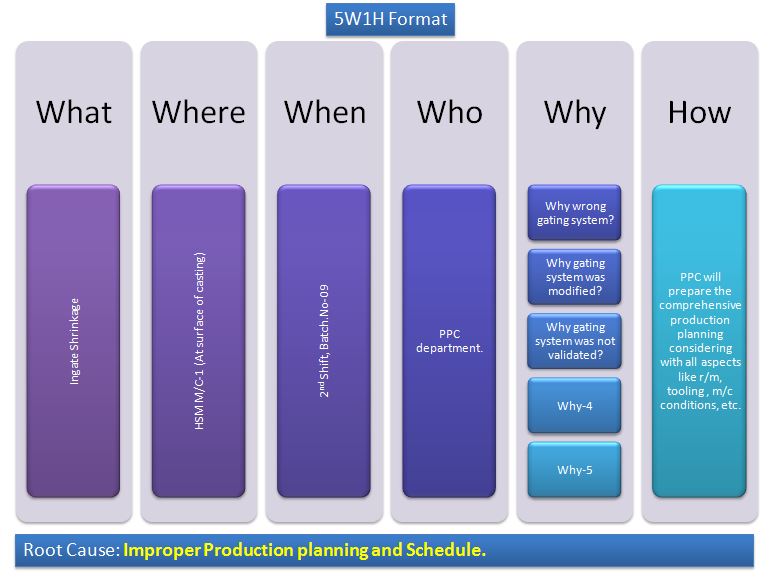
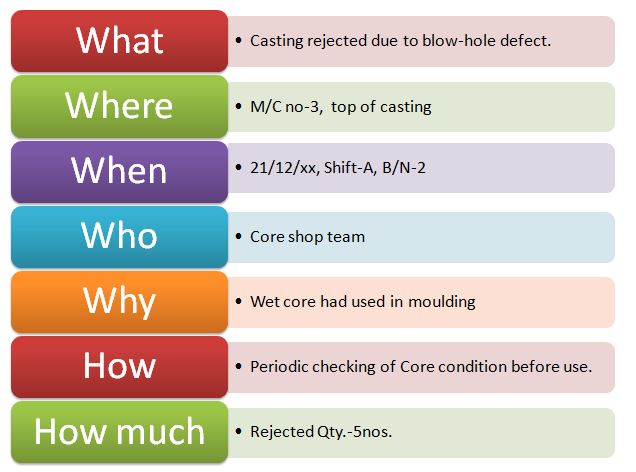
According to previous article the problem found in the process was Ingate Shrinkage. And same we are going to explain it through the 5W1H template.

5W1H Analysis Example template format
DOWNLOAD filled up Format |Manufacturing Example]
EXAMPLE-2:

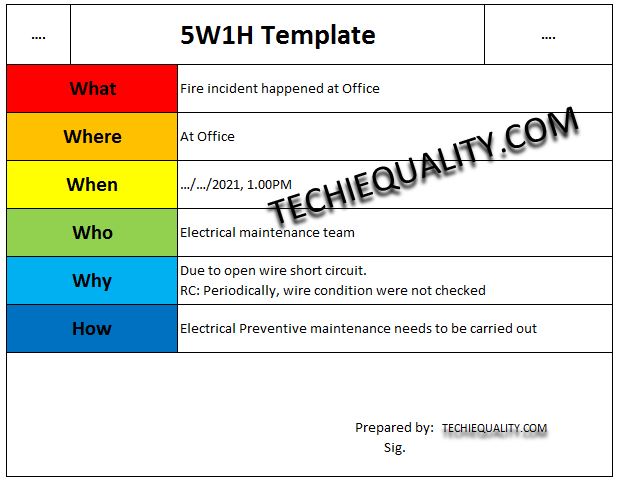
The cross-functional team has investigated the fire incident, which was happened in the office at 1.00PM. They have recorded the information in 5W1H format, the same as we have mentioned in below.

5w1h analysis example
Useful Articles:

Sales vs Marketing |Top-5 Marketing Issue SWOT Analysis.

Repeatability vs Reproducibility | Discussion of Key difference.

Verification vs Validation | What is difference between verification and validation?

Kaizen vs Innovation | Key Differences between Kaizen and Innovation

Corrective Action vs Preventive Action

FAQ:

What is the difference between 5W1H and 5W2H?

the main difference is the absence of 2H i.e. “How much” in the 5W1H methodology, otherwise all terms are the same in both 5W1H and 5W2H. but sometimes we use “how much” in place of “How” as per the nature of the problem in the 5W1H template

More on TECHIEQUALITY

Thank you for reading…Keep visiting Techiequality.Com

Popular Post:

5W2H Analysis Example |Download 5W2H Format

5W2H Analysis Example

5W2H Analysis Example |Download 5W2H Format:

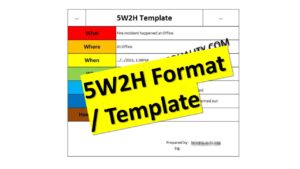
Hi Readers! Today we will discuss on 5W2H Analysis Example with industrial/manufacturing practices and also in this post, you can download our approved template for deployment in your workplace. We have already posted our previous article 5W1H analysis with examples. If you have not yet read that article then first go through it. Our 5W2H template/format is ready to use just download it from given below link.

DOWNLOAD-5W2H Template.

5W2H Analysis Example
5W2H Report
How to use the 5W2H Method in Manufacturing Industries?

In Industry, both the 5W2H and 5W1H are frequently used methods to Understand, collect, and analyze the Problem. The application of the 5W2H method depends on the nature of the problem. The full form of 5W2H is What, Where, When, Who, Why, How, and How much. Information and Data on any problem are always required for analysis and to find out the root cause. So 5W2H Format will help you to get the collective data and information in one place for problem analysis. From my past experience, I’m sharing the approach and steps for the usage and implementation of the 5W2H methodology.

Daily we find some problem in our production process/line, to overcome such problem we have to resolve these as soon as possible. The problems may be maintenance-related (like Breakdown, equipment failure, utility problems, quality issues, etc.). To understand and solve the problem, we need info. and data. In my point of view, always problem-solving team should always visit the Gemba ( Actual place) to clearly understand and investigate the problem. Below are the steps that we generally were being followed;

  • Visit to the Gemba (E.g.-Shop floor)
  • Ask the question to the operator /shop floor person and collect the information and data.
  • Investigate the 4M or 6M (Men, M/C, Material, Method, Mother Nature, and Measurement) factors and see if any clues are present or not.
  • Do Brainstorming and find out the Root Cause.

The Manufacturing Example is mentioned below covering all the above steps.

5W2H Analysis:

5W2H Analysis will help you broadly to know the nature of the problem like What is the Problem? Where did the problem occur?  When did the problem happen? Who do you need to get involved with? Why is it happening? How can you overcome the Problem? How much quantity?

The above pattern may be subject to change if it does not fit with the scenario/ nature of the problem. We can use only “how” as and when applicable regarding the nature of the problem. And then it’s namely called 5W1H. Here. Today in this article we will discuss only 5W2H Analysis with examples.

Explanation of 5W2H:
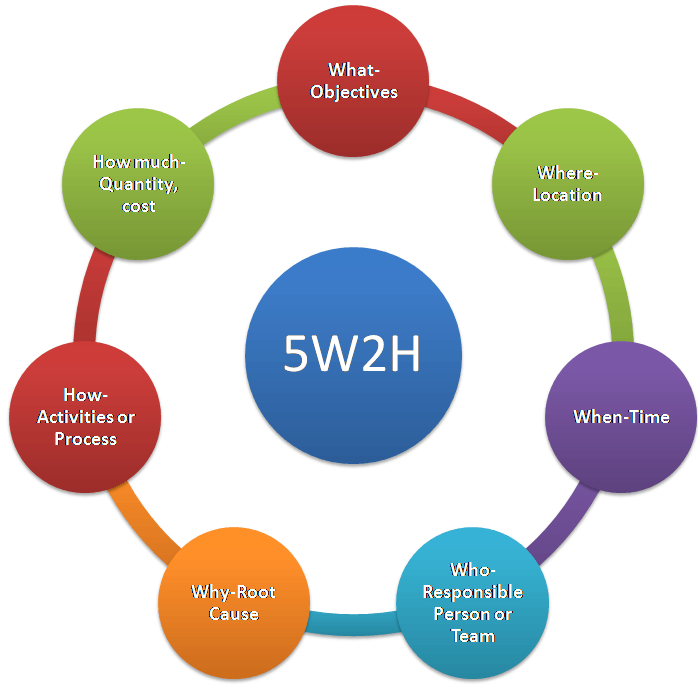
5W2H termsThe Phenomenon of the Problem: Explanation:
What What is the Problem? Goal or Objectives (To describe the problem, activity, task, or project purpose)
Where Where did the problem occur? Location (Describe the location, place, and m/c involved)
When When did the problem happen? Time (Find out the time, date, and schedule when the situation took place)
Who Who do you need to get involved with? Responsible Person or Team (Involvement of people, external provider, etc.)
Why Why is it happening? Root Cause (To know the reason behind facts, popular tools used for root cause finding are, e.g. RCA, why-why analysis, etc.)
How How can you overcome the problem? Activities or Process (Method of implementation, deployment, etc.), e.g. CAPA.
How Much How much quantity? Cost, Quantity, etc.
Explanation Table [5W2H]
5W2H Analysis Example

The above phenomenon of question is not always common for all scenarios; the question patterns will be changed according to the nature of issues/problems/risks/opportunities.

EXAMPLE-1:

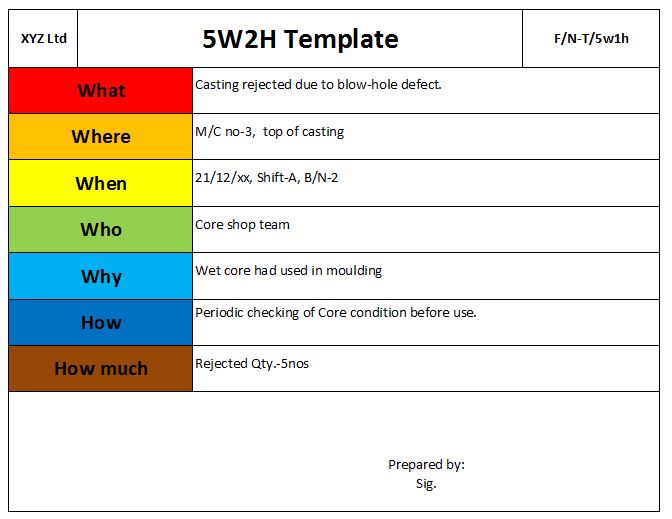
During shop floor rejection analysis at the rejection yard, we found 5 nos casting were rejected due to a blow-hole on the top surface. Same we have explained through the 5W2H format as;

5W2H Analysis Example
EXAMPLE-2:

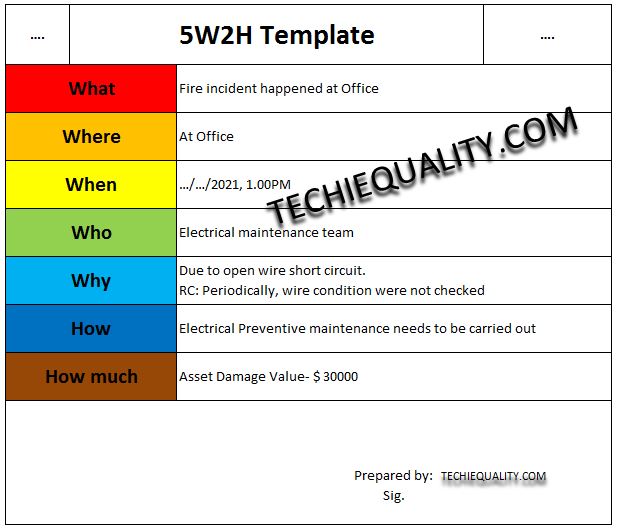
Unfortunately, one day at 1.00 PM, a Fire incident happened at the office. The organization had taken the necessary immediate action during the incident but later the CFT team investigated the area to collect the data for root cause analysis. They have recorded the data and analysis report in 5W2H Format, the same format is given below.

Example-2

FAQ:

What is the difference between 5W2H and 5W1H?

the main difference is the absence of 2H i.e. “How much” in the 5W1H methodology, otherwise all terms are the same in both 5W1H and 5W2H. but sometimes we use “how much” in place of “How” as per the nature of the problem in 5W1H format.

What is the meaning of 5W2H?

The methodology itself indicates that there are 5 Ws and two Hs. This means, what, where, when, who, why, how, and how much. it’s a questioning method and very easy to implement in any organization. we have already given multiple examples for your better understanding. and also defined each term of 5W2H in the above table. just think of one more example of a machine breakdown issue on the shop floor. and you are trying to solve it in a systematic way by applying the 5W2H methodology. Once you applied it and resolved the problem then simultaneously, you did both jobs i.e. one is a record of b/d CAPA and solved the actual problem. It’s a very useful record and you can refer to it when there is the same problem occurs on the same machine.

More on TECHIEQUALITY

Thank you for reading…keeps visiting Techiequality.Com

Popular Post:

Fault tree analysis template | Download format free…

Fault tree analysis template

 Fault tree analysis template | Download format | FTA with Example:

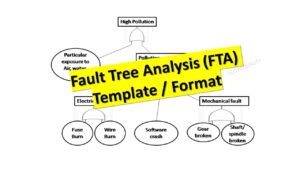
Hi Readers! Today we will discuss on FTA. And also we have prepared some templates/formats considering with some situations. You can download the same templates from the below links. FTA (Fault tree analysis template) was developed by H.A Watson at Bell Laboratory in 1962. Fault tree analysis is generally used to analyze the undesired state of a system through Boolean algebra. This is commonly applicable in the fields of the Nuclear power sector, Chemical manufacturing and service sector, Pharmaceutical, Petrochemical, Aerospace, and other high-hazard industries but now it has become a popular diagram that is being used in almost all types of organizations or sectors.

DOWNLOAD –Fault Tree Analysis Sample Template.

As we know, if any incidents occur (may be due to high-risk factors or particular system level failure) in a high-hazard factory may lead to a high Severity score in health, environment, and safety concerns. So here we will explain the FTA in detail with EHS-related Examples.

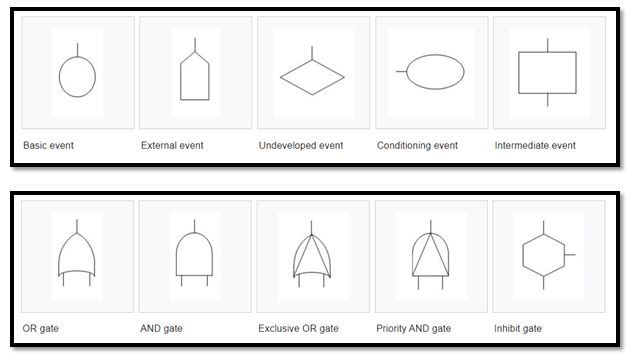
FTA Event and Gate Symbols:

Fault tree analysis template

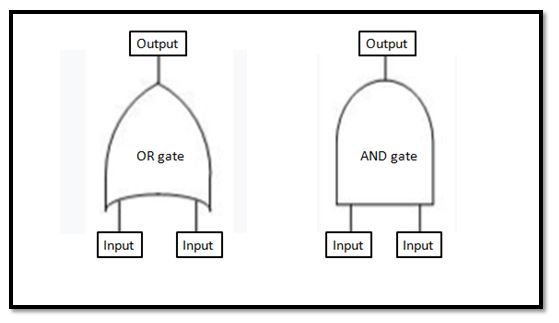
Frequently used gates are “OR gate” & “AND gate”.

Fault tree analysis template

You could also like to read our other articles:

5W2H Analysis Example |Download 5W2H Format.

5W1H Analysis Example |Download Template.

7 principles of QMS | Quality Management Principles.

Risk identification tools and techniques |Download Format.

SPC Format |DOWNLOAD Excel Template of SPC Study

Logic of “OR-Gate” & “AND-Gate”:

The output occurs if any input occurs. In the above figure you can see there is I/P-1 and I/P-2 in Or-Gate, The output of OR-gate will occur when any one of among two inputs will occurs. But in the case of AND-gate, the output will occur when both the input (I/P-1 & I/P-2) will occur.

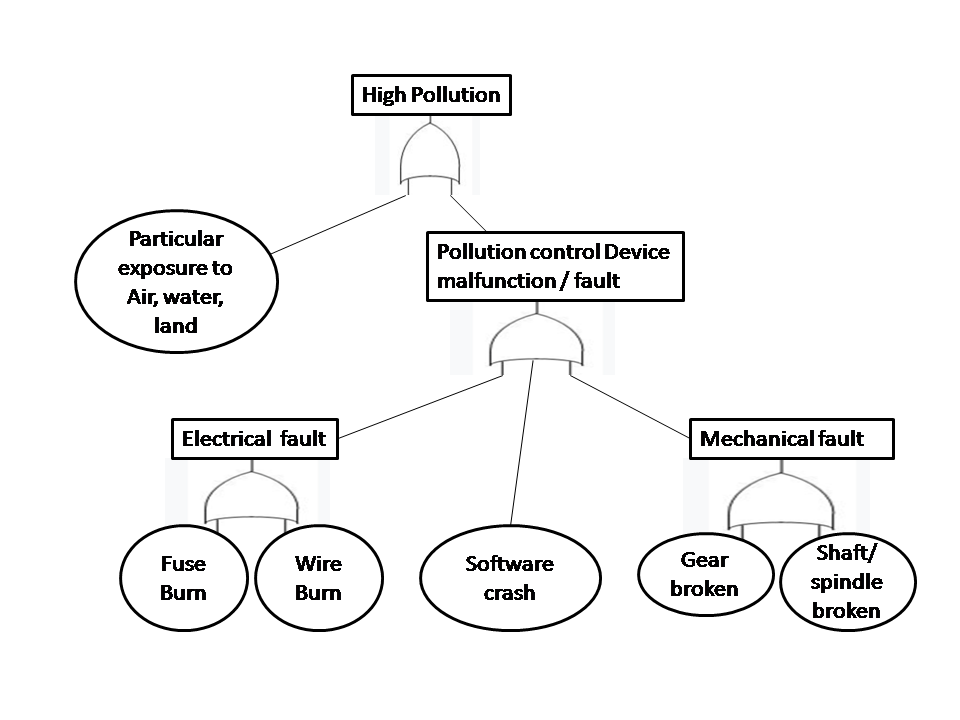
Example: AFT of High Pollution:

Fault tree analysis template
Similar Post:

7QC Tools Excel Template |DOWNLOAD Format.

why why analysis methodology | 5-why analysis step by step guide.

MSA interview questions and answers.

Decision of process capability analysis |Download Format.

How to measure process capability (Cp & Cpk)? Download Excel Template.

How to measure process performance (Pp & Ppk)?

Thank you for reading…keeps visiting Techiequality.Com

Popular Post:

Process Performance (Pp) & Ppk Excel Template |DOWNLOAD

Process Performance Excel Template

Process Performance Excel Template (Pp & Ppk Format) | DOWNLOAD

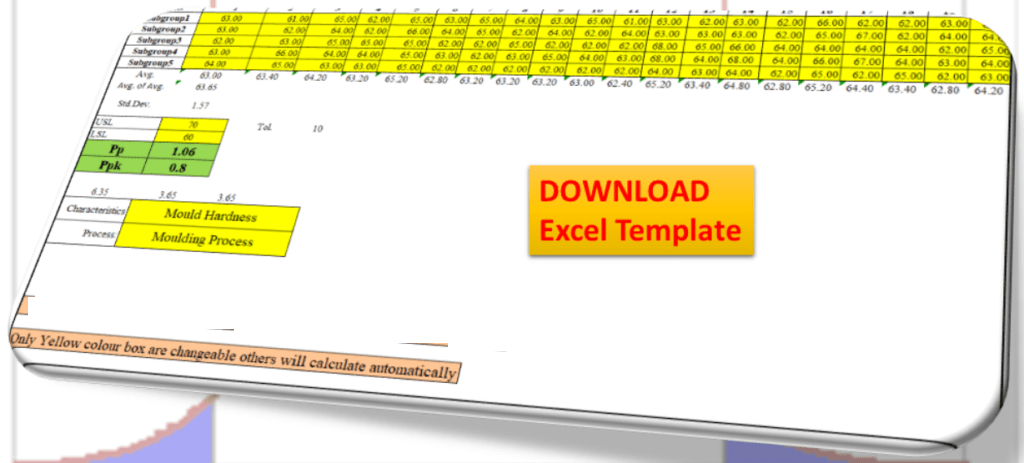
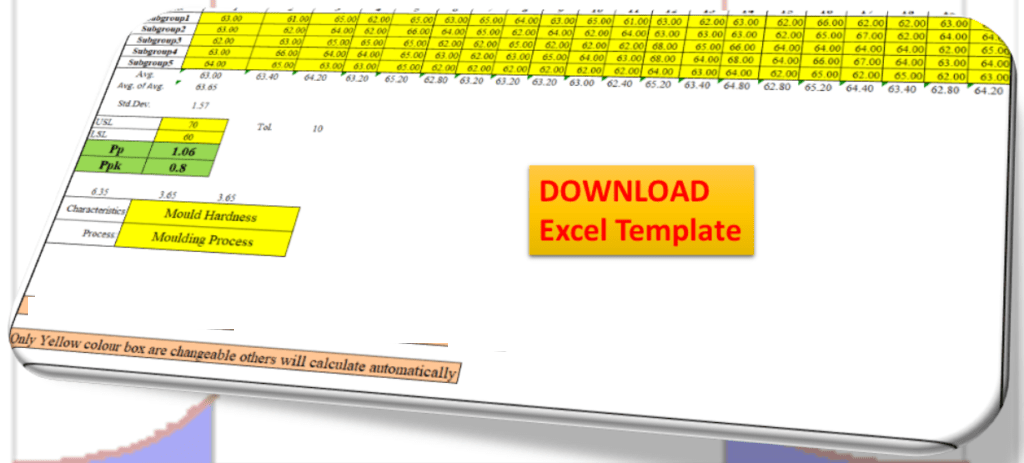
Process Performance Excel Template: According to the SPC (Statistical Process Control Manual), the process Performance (Pp) compares the process performance of the process to the maximum allowable variation as indicated by the tolerance. The Pp (Process Performance) provides a measure of how well the process will satisfy the variability requirements. And the Index of process performance is termed as Ppk. It takes the process location as well as the performance into account. Download the Excel Template /Format of Pp & Ppk from the below link.
DOWNLOAD Excel Template/Format of Pp & Ppk calculation with Example.
Process Performance Excel Template

How to use the Pp & Ppk Excel Format in your process to calculate the index value?

1: Download the Template/ Format from the above links.
2: Read the note mentioned in the Excel template.

3: Only the yellow colour box (mentioned in format) is changeable and other values will calculate automatically.

 The formula of Pp (Process Performance):

Pp = ((USL-LSL)/ (6 X S))

[Where USL=Upper specification limit, LSL=Lower specification limit and S= Standard Deviation]

The formula of Ppk (Process Performance Index):

Ppk = Minimum of PPU or PPL

PPU= ((USL-Average of average)/ (3 X S))

PPL= ((Average of average-LSL)/ (3 X S))

Note: Pp ≥ Ppk.

Example:

Company XYZ pvt ltd is interested to know the process performance of moulding process that, how well the process is performing and satisfies the variability requirements of mould hardness. The process engineer has collected the total 100 numbers of readings considering with subgroup size 5. Readings are given below;

Sl.No. 1 2 3 4 5 6 7 8 9 10
Subgroup1 63.00 61.00 65.00 62.00 65.00 63.00 65.00 64.00 63.00 65.00
Subgroup2 63.00 62.00 64.00 62.00 66.00 64.00 65.00 62.00 64.00 62.00
Subgroup3 62.00 63.00 65.00 65.00 65.00 62.00 62.00 65.00 62.00 62.00
Subgroup4 63.00 66.00 64.00 64.00 65.00 63.00 62.00 63.00 65.00 64.00
Subgroup5 64.00 65.00 63.00 63.00 65.00 62.00 62.00 62.00 62.00 62.00
11 12 13 14 15 16 17 18 19 20
61.00 63.00 62.00 63.00 62.00 66.00 62.00 62.00 63.00 65.00
64.00 63.00 63.00 63.00 62.00 65.00 67.00 62.00 64.00 64.00
62.00 68.00 65.00 66.00 64.00 64.00 64.00 64.00 62.00 65.00
63.00 68.00 64.00 68.00 64.00 66.00 67.00 64.00 63.00 64.00
62.00 64.00 63.00 64.00 62.00 65.00 62.00 65.00 62.00 63.00
Characteristics Mould Hardness
Process: Moulding Process
USL 70
LSL 60
Pp 1.06
Ppk 0.8

In the above example, the value of Ppk (0.8) is indicating that the process needs further improvement. The start-up process requires at least 1.33 and next to 1.67 and 2 onward.

Useful Articles:

Quality at the source | Steps to Implement It

Jidoka Autonomation, Bakayoke & Yo-I-don |Concept in TPS

Pull Production System | Concept

Download QA & QC useful template/ format in free

More on TECHIEQUALITY

Thank you for reading… Keep visiting Techiequality.Com

Popular Post

Histogram Template with example | Download

Histogram Template

Histogram Template with example | Download

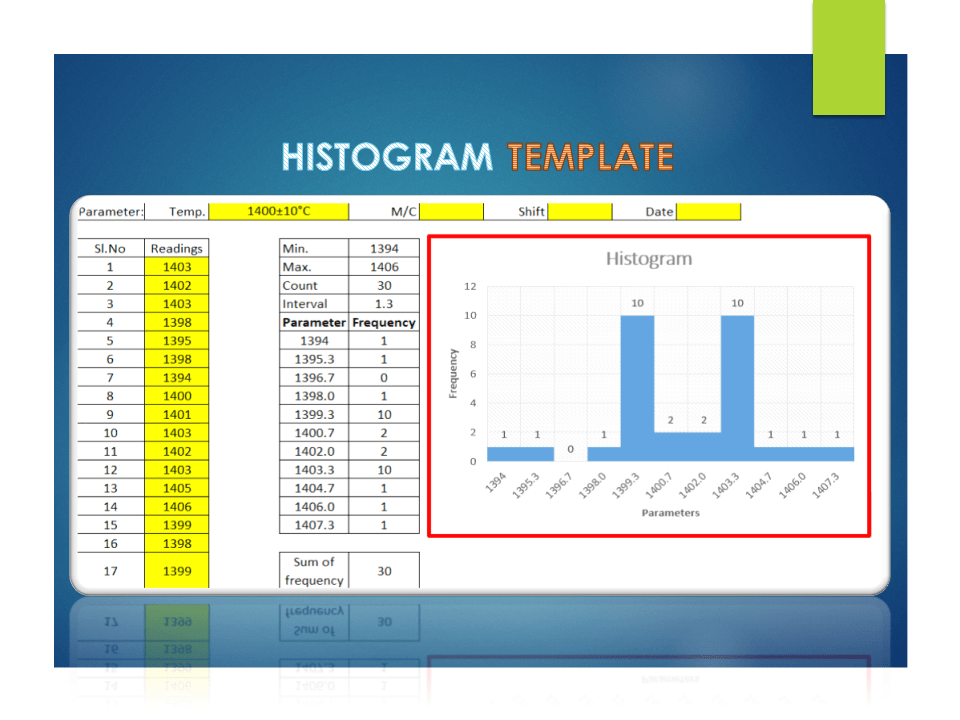
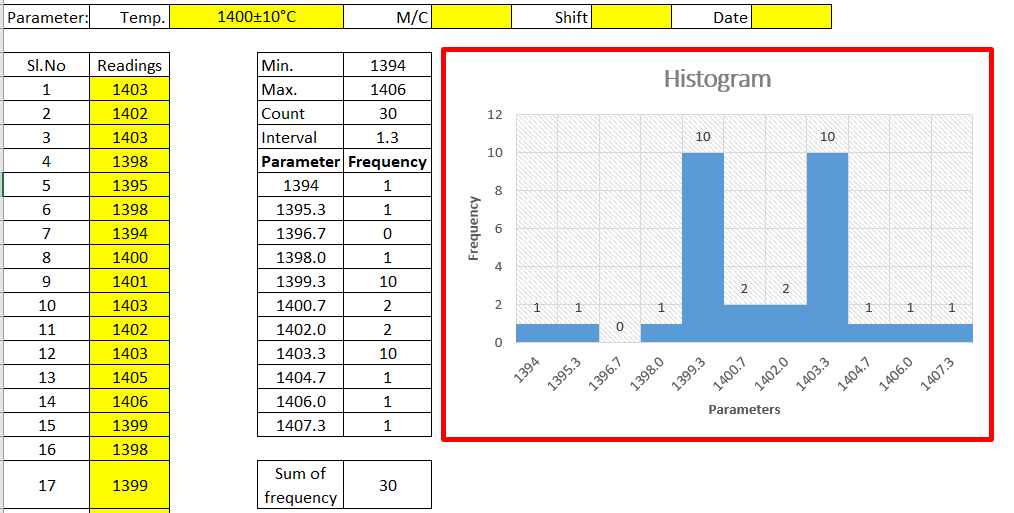
The Histogram Template is prepared in a simple format with an industrial example. We have described the example in below, just go through this article and Download the Template / Format. It’s a very useful tool and is frequently used in manufacturing industries. The main function is to know the frequency distribution, symmetry, and skewness, and it also helps to determine the normality of data by drawing the bell curve.

DOWNLOAD [Histogram Template in Excel format].

Histogram Template
Histogram Template

Basic Information on Histogram:

A histogram is one of the 7QC tools and commonly used graph to show frequency distribution. Helps summarize data from a process that has been collected over a period of time.

A histogram is a representation of the frequency distribution of numerical data. it was first familiarized by Karl Pearson. A histogram is related to merely one type of variable data. You should calculate the interval value to represent the bins. Bins shall give an idea about the how much data falls within the selected data range’s width. Histogram gives the indication about data distribution as normal, skewed, or bi-modal.

How to use our Histogram Template:

Step-1: Download the Histogram Template from the above link.

Step-2: Carefully read the “Note” mentioned in the Excel template.

Step-3: Enter the reading only in the yellow color box. Then other values will calculate automatically and your histogram will be ready for interpretation.

Note:

1. Only yellow colour boxes are changeable

2. Make sure that the sum of frequency is equal to the total count, e.g. sum of frequency in a given example [example is given in histogram excel format, just download and see the example] is 30 and the count is also 30, if not then you have to adjust the parameters and frequency table in frequency distribution format for doing so click on the link given “How to adjust parameters and frequency table in Histogram Template?”.

Useful Links:

How to Plot Pareto Chart in Excel ( with example)

What is SPC | SPC Tools?

Corrective and Preventive Action Format | CAPA with Example.

OEE Calculation-How To Calculate OEE (Overall Equipment Effectiveness) with Example

Implementation of KAIZEN in Industry

Thank you for reading…. Keep visiting Techiequality.Com

Let us know if you have any questions…and drop your comments below.

Popular Post:

SWOT Analysis Word Template

SWOT Analysis Word Template

SWOT Analysis Word, Excel, PDF and PPT Template:

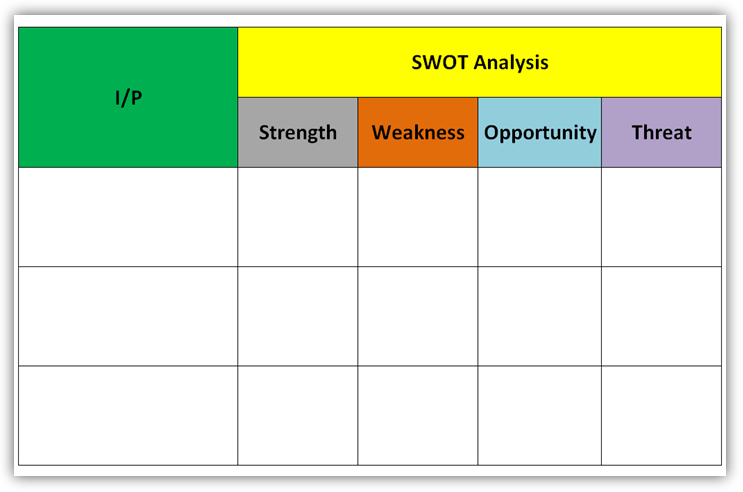
Hello Readers! Download the SWOT Analysis Word Template, and also in Excel, PDF, and PPT from. Links are given below.

DOWNLOAD– QA & QC Format

The SWOT Analysis is a strategic planning technique, which is generally used to identify the strengths, weaknesses, opportunities, and threats related to the context of the organization.

DOWNLOAD the SWOT Analysis Templates / Formats in Word, Excel, PDF, and PPT form:

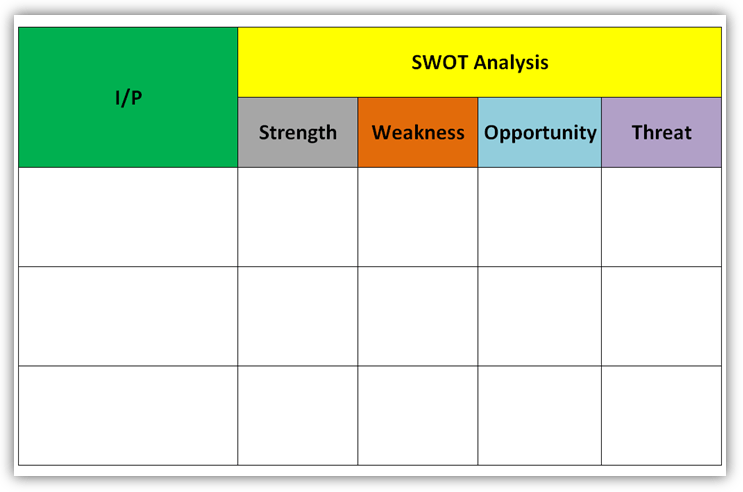
Illustration of Template / Format:

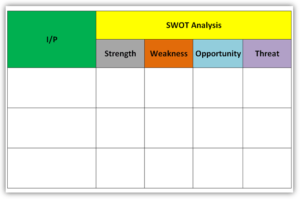
SWOT Analysis Word Template
  • I/P: This is the input points that you would like to do the SWOT analysis. For example, several factors and business issues (Internal and External).
  • Internal issues example: policy, Standards, business strategy, labor strikes, Major accidents, Raw material Crisis, etc.
  • External Issues Example: Legal, Customer Contract, Profit loss, loss in share market, etc.
  • Strength: Advantages of Business Characteristics.
  • Weakness: Disadvantage of Business Characteristics.
  • Opportunity: Business Element that could be exploited to its advantage.
  • Threat: The Business element that could cause trouble for the business.

When to use SWOT Analysis:

You can use the SWOT analysis process in the below field but not limited to;

  • To overcome the Business concern types problem.
  • To explore the new opportunities in NPD, Process Defects, Design defects, Manufacturing defects, R/M Defects, Customer End defects, technology up-gradation, Socio-political issues, Internal factors, Issues to business strategy,  etc.

Note: The SWOT Analysis tool is the best one to use for identifying the Risk and Opportunity of several Business system standards like IATF 16949, ISO 9001, ISO 14001, ISO 45001, ISO 31000, etc.

EXAMPLES:

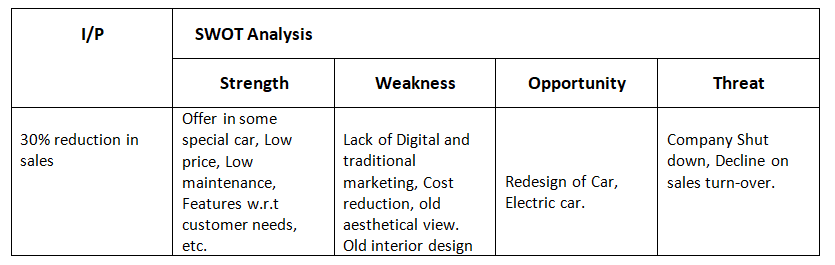
A car manufacturing company has lost its car sales 30% of the average of the last six months’ sales. After that, top management decided to do a SWOT analysis to identify the opportunity and their major threats.

SWOT Analysis (Example): 30% reduction in sales

I/PStrengthWeaknessOpportunityThreat
30% reduction in salesOffer in some special car, Low price, Low maintenance, Features w.r.t customer needs, etc.Lack of Digital and traditional marketing, Cost reduction, and old aesthetical view. Old interior designRedesign of Car, Electric car.Company Shut down, Decline in sales turn-over.
example

Useful Articles:

Detailed SWOT Analysis Examples

How to calculate Cp and Cpk? |Practical Case Study | Process Capability Example.

How to plot the Run Chart in Minitab

How to do Capability Analysis by Minitab 18? | Minitab Process Capability Tutorial

Thank you for reading…..Keep visiting Techiequality.com

I hope the above is useful to you.

Popular Post:

Process Capability Analysis | Cp & Cpk Calculation Excel Sheet with Example

Process Capability Analysis

Process Capability Analysis | Cp & Cpk Calculation Excel Sheet with Example

Process Capability Analysis: – The Process Capability (Cp) and Process Capability Index (Cpk) are the important tools, which give an Idea about the Process Capability of a Stable Process. Here we will discuss on Calculation of Cp and Cpk with Examples. We are offering here Process Capability Excel Template / Format for you, hence click on the below links to Download the Excel Format.

DOWNLOAD (Cp & Cpk Excel Template / Format-Sample copy)

Process Capability (Cp):

  • Process Capability (Cp) is a statistical measurement of a process’s ability to produce parts within specified limits on a consistent basis
  • It gives us an idea about the width of the Bell curve.
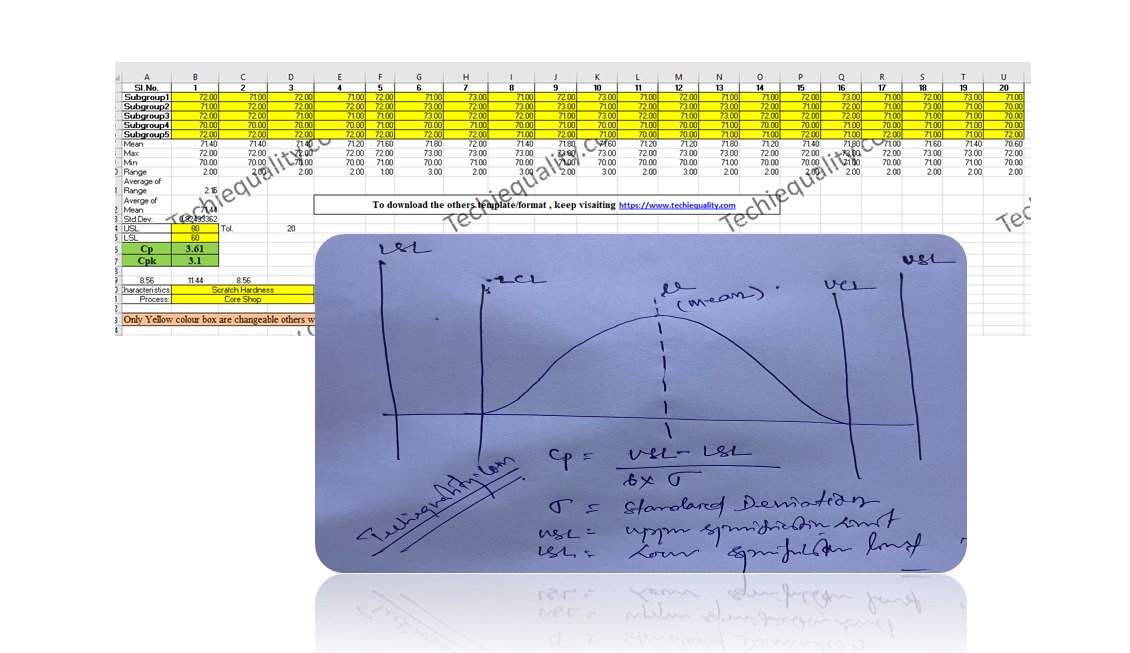
  • The Process Capability for a stable process is typically defined as ((USL-LSL)/ (6 x Standard Deviation)).
Cpk-Process Capability Index :
  • It shows how closely a process is able to produce the output to its overall specifications.
  • More Value of Cpk means more process capable.
  • The Process Capability Index for a stable process is typically defined as the minimum of CPU or CPL.
Process Capability Analysis:

Industrial Example:

As per the Quality Assurance Plan, The shift engineers of Core Shop have started collecting the readings of the scratch hardness of Core. Given below are the details of Product Characteristics;

Specification of Scratch hardness is 70±10.

The Upper Specification Limit is 80.

The Lower Specification Limit is 60.

Tolerance is 20.

Scratch hardness readings Table:
Table-1
Sl.No. 1 2 3 4 5 6 7 8 9 10
SG 1 72.00 71.00 72.00 71.00 72.00 71.00 73.00 71.00 72.00 73.00
SG2 71.00 72.00 72.00 72.00 72.00 72.00 72.00 73.00 73.00 71.00
SG 3 72.00 72.00 71.00 71.00 71.00 73.00 72.00 72.00 71.00 73.00
SG4 70.00 70.00 70.00 70.00 71.00 70.00 71.00 70.00 71.00 70.00
SG 5 72.00 72.00 72.00 72.00 72.00 72.00 72.00 71.00 72.00 71.00
Table-1 [Scratch hardness readings Table]
Table-2
Sl.No. 11 12 13 14 15 16 17 18 19 20
SG1 71.00 72.00 71.00 71.00 72.00 73.00 71.00 72.00 73.00 71.00
SG2 72.00 73.00 73.00 72.00 71.00 72.00 71.00 73.00 71.00 70.00
SG3 72.00 71.00 73.00 72.00 72.00 72.00 71.00 71.00 71.00 70.00
SG4 71.00 70.00 71.00 70.00 70.00 71.00 70.00 71.00 71.00 70.00
SG5 70.00 70.00 71.00 71.00 72.00 71.00 72.00 71.00 71.00 72.00
Table-2 [Scratch hardness readings Table]

In the above two tables (Table-1 &2), we have taken the 100 readings i.e. (20 times X 5 readings at a time).

Range=Maximum Value-Minimum Value

Average of Range=2.15

Value of d2=2.326 (For Subgroup size 5)

USL = 80, LSL = 60.

Standard Deviation:

 = Average of Range/d2

 2.15/2.326

=0.92

Process Capability (Cp):

 = ((USL-LSL)/ (6 x Standard Deviation))

(80-60)/ (6 x 0.92)

20/5.52

= 3.61

Process Capability Index (Cpk):

CPU:

= ((USL-Average of Mean)/3 x Standard Deviation)

(80-71.43)/ (3 x 0.92)

8.57/ 2.76

= 3.10

CPL:

= ((Average of Mean-LSL)/3 x Standard Deviation)

(71.43-60)/ 2.76

10.4211.43/2.76

=4.14

Cpk= 3.10 (minimum of CPU or CPL).

After doing the Process Capability Analysis on Scratch hardness readings, we got the below result value:

Characteristics: Scratch Hardness
Cp (Process Capability) = 3.61
Cpk (Process Capability Index) = 3.10
[ Cp & CpK ]
Process Capability Analysis with Manufacturing Example

The process engineer has collected the 100 nos laddle temperature reading and the same is mentioned in the below table.

Laddle Temperature Specification= 600 ± 15°C

USL = 615

LSL = 585

Table-1
 12345678910
S1605599610605603604600609605601
S2603601612599601598603610603598
S3604598609610612609605612604603
S4600603605598599610598609600610
S5602602607609605612599605609603
Max.605603612610612612605612609610
Min.600598605598599598598605600598
Range55712131477912
Average of Range9.85         
Mean602.8600.6608.6604.2604606.6601609604.2603
Average of Mean603.92         
Table-2
 11121314151617181920
S1599601602604598598609598600598
S2610598602603603603605603603610
S3598603607598610607612607605598
S4609610609603603598604598607602
S5600603605607598610603610598603
Max.610610609607610610612610607610
Min.598598602598598598603598598598
Range1212791212912912
Mean603.2603605603602.4603.2606.6603.2602.6602.2

d2=2.326

Standard Deviation = Average of Range / d2 = 4.23

Cp = (USL-LSL)/6*Standard Deviation = 1.2

CPU = ((USL-Average of Mean)/3 x Standard Deviation) = 0.872

CPL = ((Average of Mean-LSL)/3 x Standard Deviation) = 1.489

CpK = 0.872(minimum of CPU or CPL).

Note: Download the Cp & Cpk excel template or format and deploy it in manufacturing process. downloading links are provided at top of this Article.
FAQ:
What is the difference between Cp & Cpk?

Ans.: Cp & CpK are termed as process capability and process capability index. In both cases, we would like to verify whether the process can meet the customer’s requirements or not. Generally, it is used when the process is under stable & statically control.

What is the formula of Cp & Cpk?

Cp= ((USL-LSL)/ (6 x Standard Deviation)) , where USL=Upper Specification Limit & LSL=Lower Specification Limit.

Cpk= Minimum of CPU or CPL, where CPU= ((USL-Average of Mean)/3 x Standard Deviation) & CPL= ((Average of Mean-LSL)/3 x Standard Deviation)

What are the good values of Cpk?

Generally, the customers provide the Cpk value to their supplier to maintain it in their manufacturing process. but for your knowledge, a Cpk value of 2 or greater than 2 is an excellent one.

What is cpk?

The cpk is the process capability index which shows how closely a process is able to produce the output to its overall specifications.

What is the IATF 16949 requirement of Statistical Concepts or SPC?

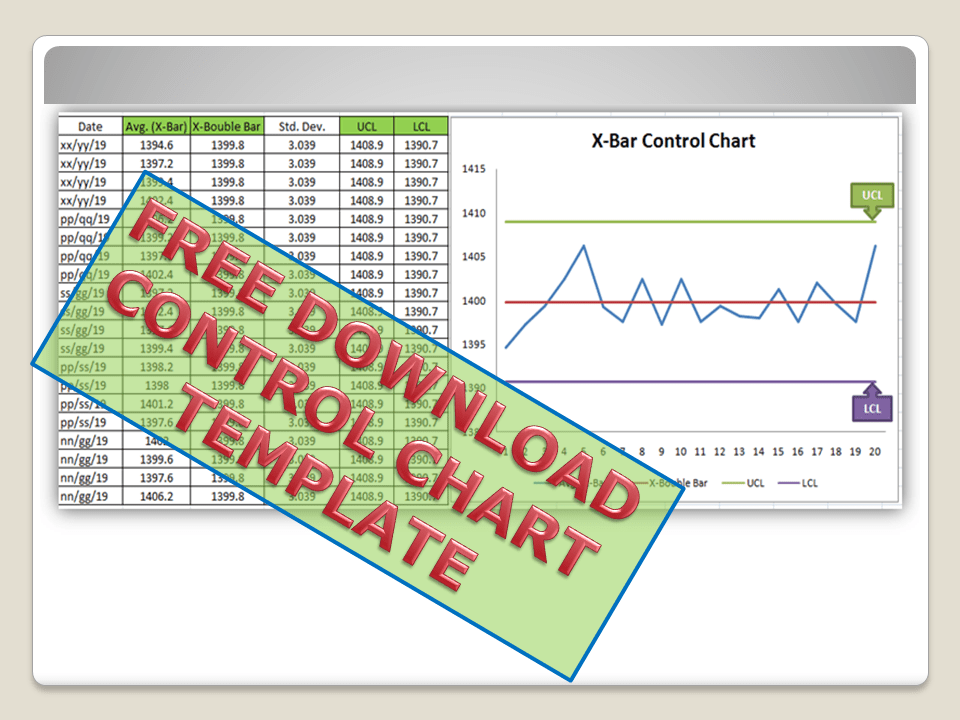
Application of statistical concepts in the IATF 16949 standard has been mentioned in Clause no-9.1.1.3, both Control chart (variable and Attribute) and process capability are the mandatory requirements. The application of statistical concepts shall be understood and used by the employees involved. We have published a separate article on Control Charts for our readers and you can Download Control Chart Excel Template / Format.

More on TECHIEQUALITY

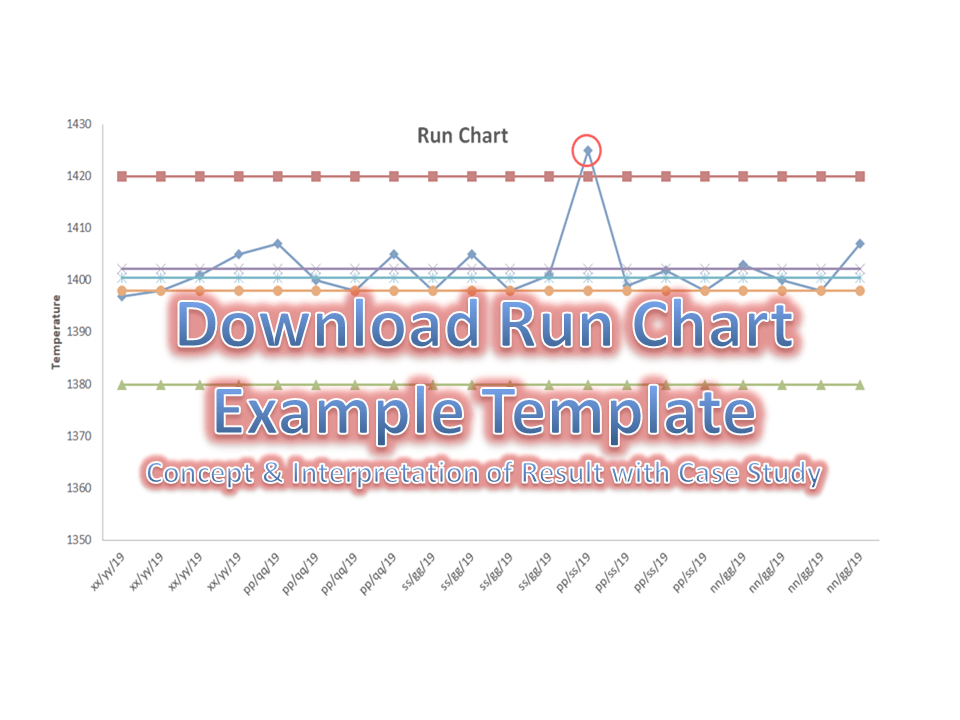
Run Chart Example | Concept & Interpretation of Result with Case Study | Industrial Example:

Run Chart Example

Run Chart Example | Concept & Interpretation of Result with Case Study | Industrial Example:

Hi readers! today we are going to discuss on Run Chart Example. A run chart is also called a Line graph. It’s a live Chart that you can use it on the shop floor to monitor the Process variation. In the run chart, you could able to set up the mean value, upper specification limit, and lower specification limit. A Run chart will not be able to give an idea about the control limits. It represents the variation in summarizing data of Process, or Product characteristics. However, it can show you how the process is running.

Download the Run Chart Example Template in Excel.

Interpretation of Result with Case Study:

  • Interp.-1: Six or more consecutive points fall above or below the centre line (Median Line). 
  • Interp.-2: Five or more successive points are going up or down.
  • Interp.-3: Too many or too few runs.
  • Interp.-4: An astronomical data point.

If any, one of the above interpretations has been identified in the run chart, it means variation (non-random variation) present in the process’s characteristics.

Industrial Practical Example of Run Chart (Run Chart Example):

We are going to take an example from the Iron manufacturing industry. Such a company is produced as an automobile part with the following specifications.

Pouring Temperature =1400°C±20°C.

The company has decided to maintain the variation trend of Pouring temperature. They have implemented a run chart on the shop floor to monitor and measure the variation of pouring temperature w.r.t time period. The process engineer promptly started to measure the temperature readings four times a day (three working shifts) for five days. Below are the readings for your reference as;

Temperature Reading Table:

 Date Observed Value
xx/yy/19 1397
xx/yy/19 1398
xx/yy/19 1401
xx/yy/19 1405
pp/qq/19 1407
pp/qq/19 1400
pp/qq/19 1398
pp/qq/19 1405
ss/gg/19 1398
ss/gg/19 1405
ss/gg/19 1398
ss/gg/19 1401
pp/ss/19 1425
pp/ss/19 1399
pp/ss/19 1402
pp/ss/19 1398
nn/gg/19 1403
nn/gg/19 1400
nn/gg/19 1398
nn/gg/19 1407
Now, we are supposed to calculate the mean, median, and mode values to plot the run chart.
Date Observed Value USL LSL Mean Median Mode
xx/yy/19 1397 1420 1380 1402.25 1400.5 1398
xx/yy/19 1398 1420 1380 1402.25 1400.5 1398
xx/yy/19 1401 1420 1380 1402.25 1400.5 1398
xx/yy/19 1405 1420 1380 1402.25 1400.5 1398
pp/qq/19 1407 1420 1380 1402.25 1400.5 1398
pp/qq/19 1400 1420 1380 1402.25 1400.5 1398
pp/qq/19 1398 1420 1380 1402.25 1400.5 1398
pp/qq/19 1405 1420 1380 1402.25 1400.5 1398
ss/gg/19 1398 1420 1380 1402.25 1400.5 1398
ss/gg/19 1405 1420 1380 1402.25 1400.5 1398
ss/gg/19 1398 1420 1380 1402.25 1400.5 1398
ss/gg/19 1401 1420 1380 1402.25 1400.5 1398
pp/ss/19 1425 1420 1380 1402.25 1400.5 1398
pp/ss/19 1399 1420 1380 1402.25 1400.5 1398
pp/ss/19 1402 1420 1380 1402.25 1400.5 1398
pp/ss/19 1398 1420 1380 1402.25 1400.5 1398
nn/gg/19 1403 1420 1380 1402.25 1400.5 1398
nn/gg/19 1400 1420 1380 1402.25 1400.5 1398
nn/gg/19 1398 1420 1380 1402.25 1400.5 1398
nn/gg/19 1407 1420 1380 1402.25 1400.5 1398

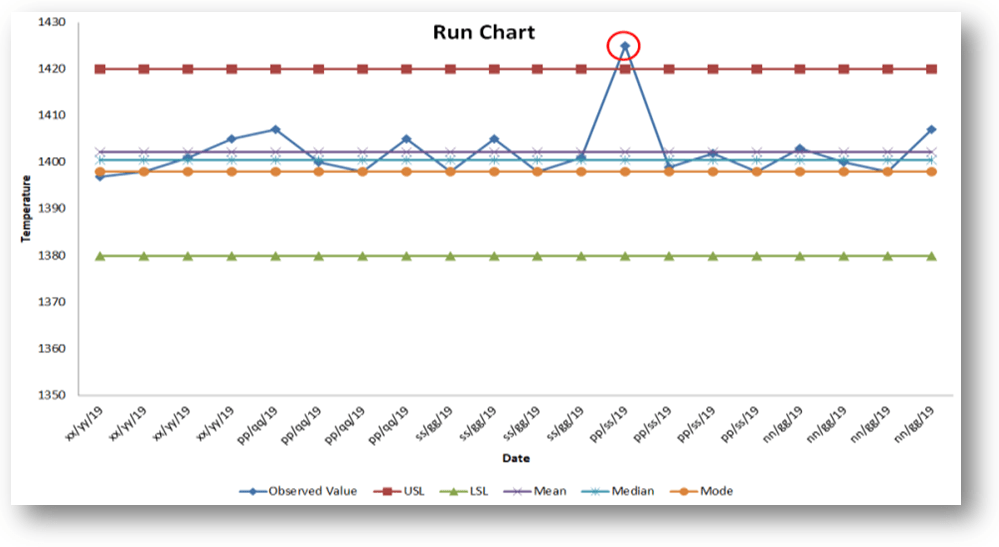
By using the aforesaid data table, we have plotted a run chart/line chart with the help of Excel. But you can also plot the run chart by Minitab such a process we will discuss later in separate articles.

Run Chart Example
Run Chart Example

[Run Chart Plot by Excel]

Interpretation of the above run chart:

Before, we discuss the result of the above run chart. I would like to request you kindly go through the above chart prudently.

In the above chart, one reading (red highlighted point) suddenly goes up and the chart represents an astronomical data point interpretation. It means there is the existence of variation in the process and it is a non-random variation. In such a way you can plot the run chart to know how the process is running and according you could able to act on it.

Useful Links: (Download Template)

Thank you for reading….Keep visiting Techiequality.Com

Popular Post:

Risk Register | Download Risk Register Template:

Risk Register

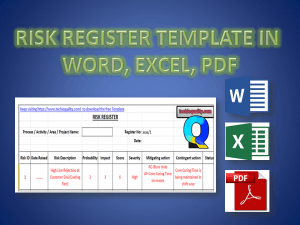
Download Risk Register Template:

Hi Reader! Today we are going to discuss an important topic, which is called Risk-based thinking and Risk management. The organization uses different types of tools to identify the Risks but here, we will be discussing one of the popular tools, i.e. Risk Register. As we know most probably business standards like QMS, EMS, OH&SMS, etc. are now risk-based thinking approaches. So we will only concentrate on learning how to use the Risk register with Examples.

DOWNLOAD–the Risk Identification Template in Excel.

DOWNLOAD–the Risk Record Template in Word.

Risk Identification Template in Pdf.–DOWNLOAD

If you are interested to know about Risk Management, then Click here.

How to Use Risk Register Template:

Step-1: Download the Above Template by simply clicking on the Download link.

Step-2: Read carefully the terminology.

Step-3: The severity Table is given in the Excel Template in a Separate Sheet, So don’t forget to download the Excel Template.

Step-4: Read carefully the sample example written in red colour in Template.

Example: Before I describe the Template, Please go through the below figure.

Risk Register Template
 Terminology:

[1] Risk No.: Unique identification of each and every identified risk.

[2] Risk: Details about the Risk.

[3] Mitigating Action: Action to eliminate the Impact of Risk.

[4] Contingent Action: Action to eliminate the re-occurrence of Risk.

Here, in the above Figure, I have taken an Example of Customer complaints. So let’s get started with details about the above complaint.

High Line rejection at the Customer end was the Risk which has the score value 6 and severity is coming under the High Level. The criteria of probability and impact depend upon the organization’s decision. For a sample basis, I have taken the severity ranking according to the below data;

severity table

A Mitigation plan has taken w.r.t the Root Cause Analysis, so here Increasing the core curing time was the corrective action and contingent action is the Preventive action. Which is “Core curing time is being maintained shift-wise”.

FAQ:

Q1: Where can we use this template?

A1: You can use this template in Project management, Risk Management, to identify the QMS, EMS OHSAS, and Business-related risks.

Q2: Who will decide the Criteria of Probability, Impact, and Severity?

A2: The organization itself will decide the criteria as to what it would be.

Download Free Templates/Format:

Thank You for Reading………Keep Visiting Techiequality.Com

Popular Post: