How to Plot Scatter Diagram in Excel |Guides with example | Interpretation:
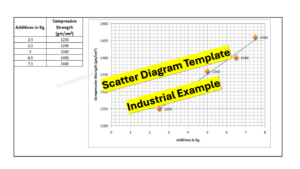
Hi reader! Today we will discuss on How to Plot Scatter Diagram in Excel? The scatter diagram is a type of tool that is generally used to know the correlation between two variables. We have published a separate post on the concept of scatter diagrams with industrial examples and interpretation of results, if you are interested in knowing the concept before reading this article then you may read more, the link is provided below.
A class teacher tried to survey their top five students’ marks obtained in % v/s study hours. Details of the data are given below.
Variable-1
Variable-2
Study hours
Mark obtained in %
5
40
6
50
7
65
8
82
10
89
Now class teacher has drawn the scatter diagram to know the correlation between variables. Step by step guide is mentioned below;
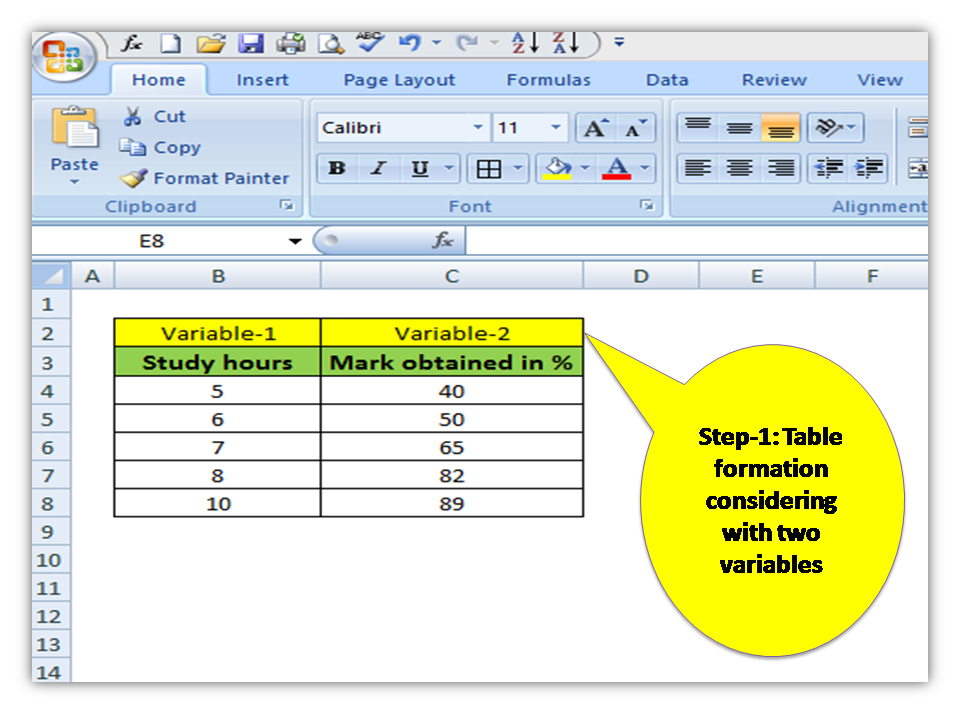
Step-1:
Open the excel sheet and make a table.
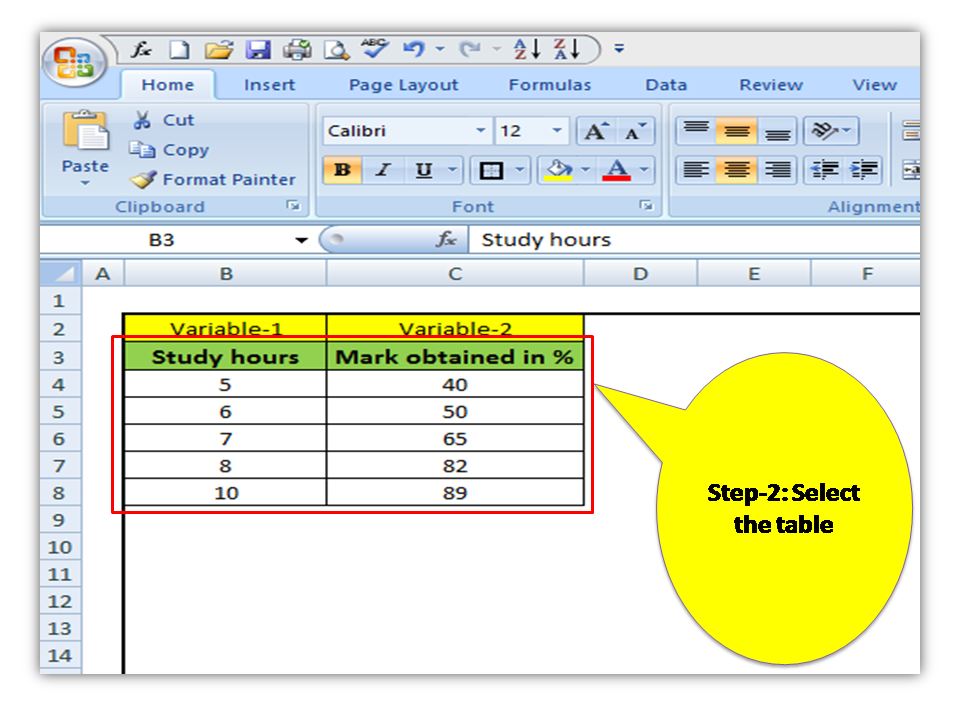
Step-2:
Select the table to plot
the diagram.
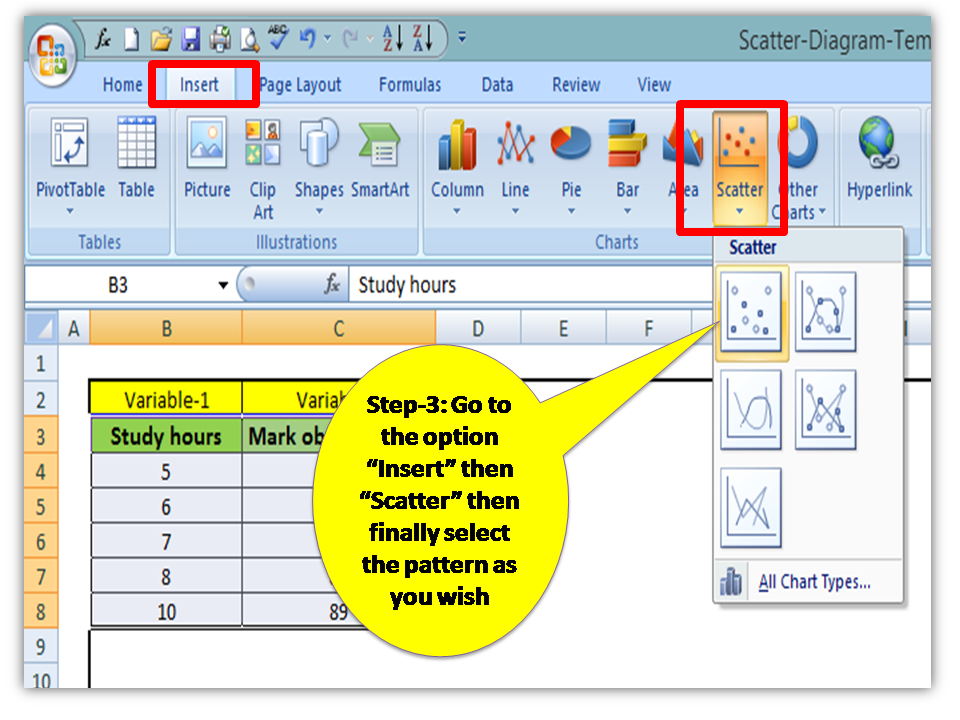
Step-3:
Choose the pattern of the Scatter diagram as you wish, To do so first go to the option “Insert” and then select the scatter diagram option with your preferred pattern. Details are mentioned in the below figure.
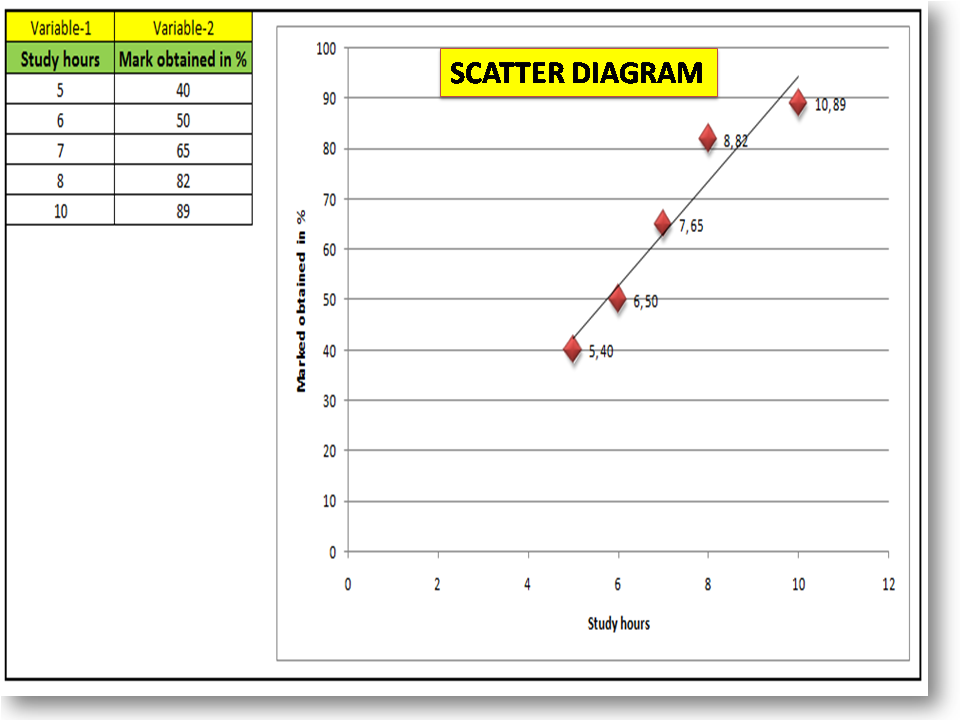
Step-4:
Now, your Scatter Diagram
is ready.
Interpretation of the above scatter diagram:
All sample points are nearer to the trend line and in a positive direction. So the scatter diagram indicates us there is a perfect positive correlation between two variables. Read more…to know more about common possibilities of correlation.
Free Templates / Formats of QM: we have published some free templates or formats related to Quality Management with manufacturing / industrial practical examples for better understanding and learning. if you have not yet read these free template articles/posts then, you could visit our “Template/Format” section. Thanks for reading…keep visiting techiequality.com
Our Author is an experienced professional in Quality Management Systems, Quality Assurance, Operations, and Business Excellence, with cross-industry expertise in Automotive, AMR, Robotics, Battery Manufacturing, Foundry, and Sheet Metal industries. He has strong expertise in international standards including IATF 16949, ISO 9001, ISO 14001, ISO 45001, and ISO 17025, along with methodologies such as TQM, TPM, and Six Sigma. He holds a degree in Mechanical Engineering along with an MBA, combining strong technical acumen with strategic business insight, he is a Certified Internal Auditor, Lead Auditor, and Six Sigma Black Belt, with a proven track record in driving quality transformation and operational excellence.
Through TECHIEQUALITY, he shares practical insights, quality tools, and industry best practices to help professionals improve processes and achieve operational excellence.
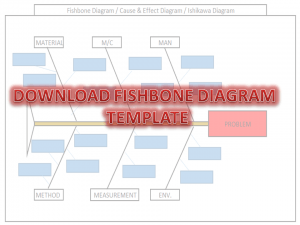
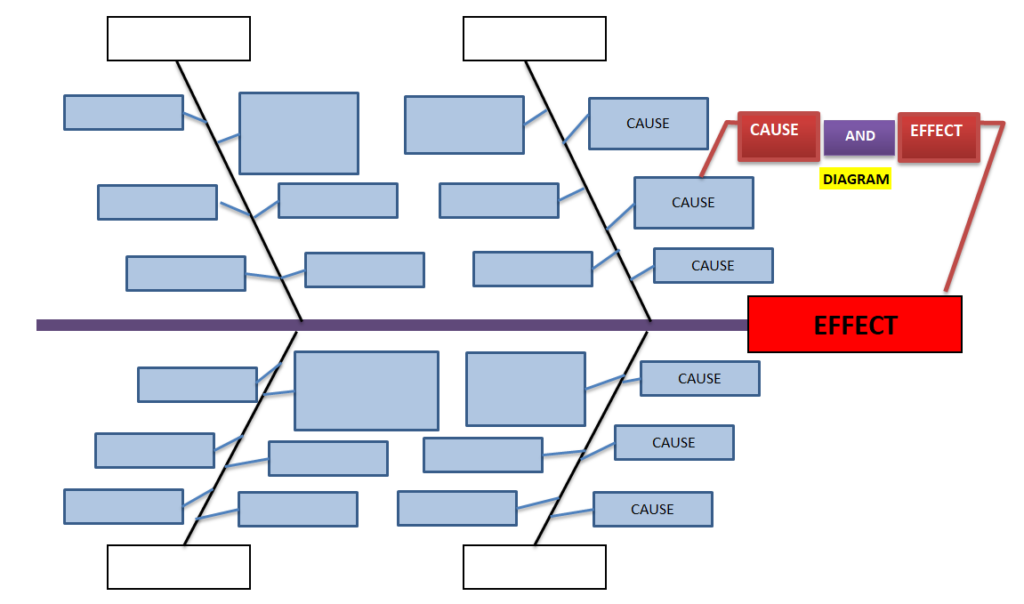
Hi readers! Today we will discuss on Types of Fishbone Diagram. Basically, the fishbone/ cause & Effect/Ishikawa diagram is one of the most popular tools among 7QC Tools. Due to the simplicity and easy understanding, almost all sectors (manufacturing, service sector, non-manufacturing) are using this tool for represent the potential cause of a Problem statement. It’s an effective tool for the diagnosis of the various causes of the problem and helping to solve the problem. You can download the all types of C&E Diagram Template/formats from the below links.
DOWNLOAD– Cause & Effect Diagram Template (DA, E & PC types).
Types of
Fishbone Diagram/ Cause & Effect/ Ishikawa Diagram:
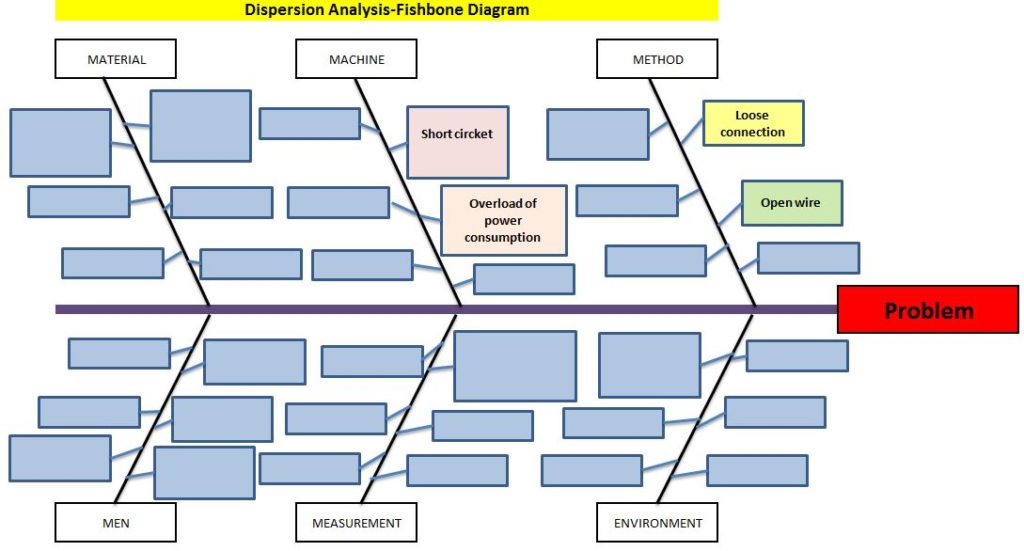
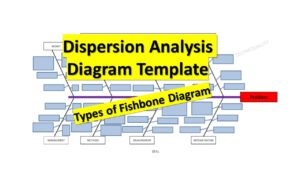
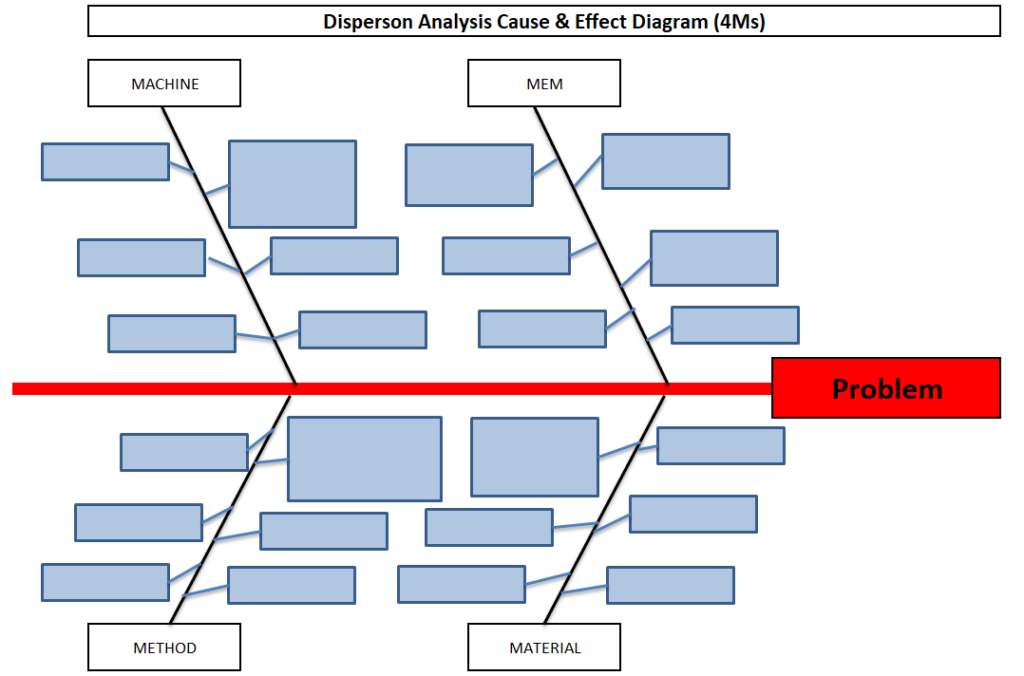
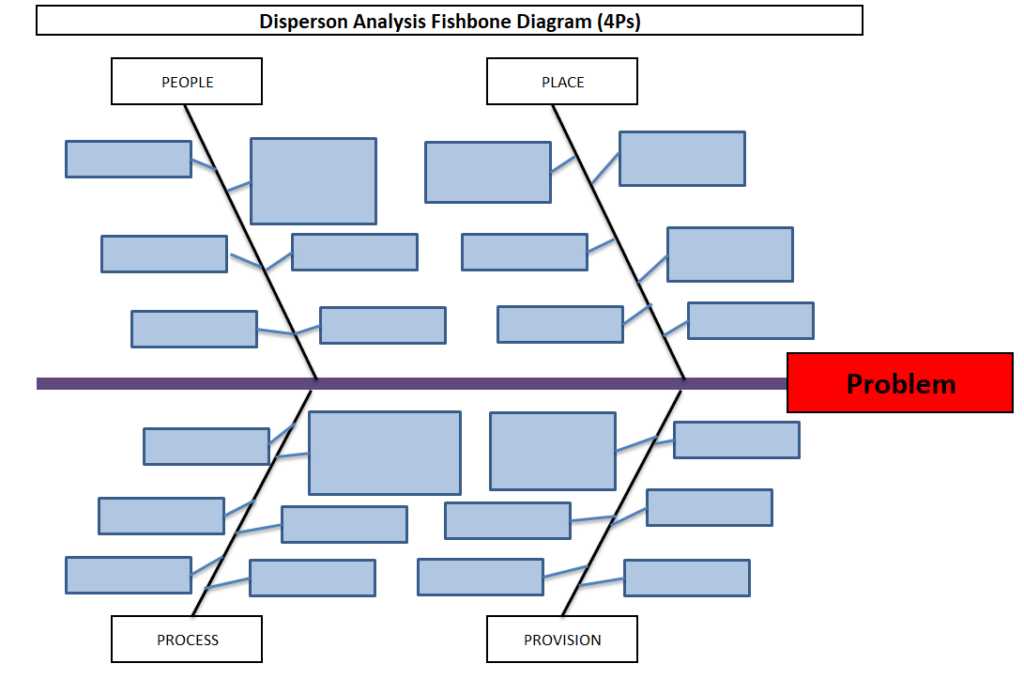
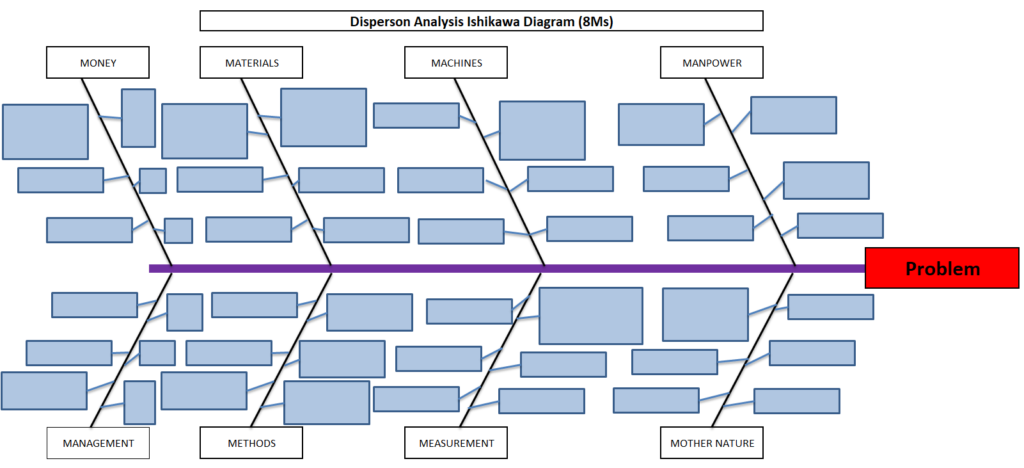
Three basic types of Fishbone Diagrams are [1] Dispersion Analysis [2] Process Classification [3] Enumeration. Dispersion analysis type of cause and effect diagram involves identifying and classifying possible causes for a specific quality problem. For example, 4Ps, 4Ms, 8Ms, and 4M1E are the most popular pattern of dispersion analysis fishbone diagrams. Some sample pattern templates are given below;
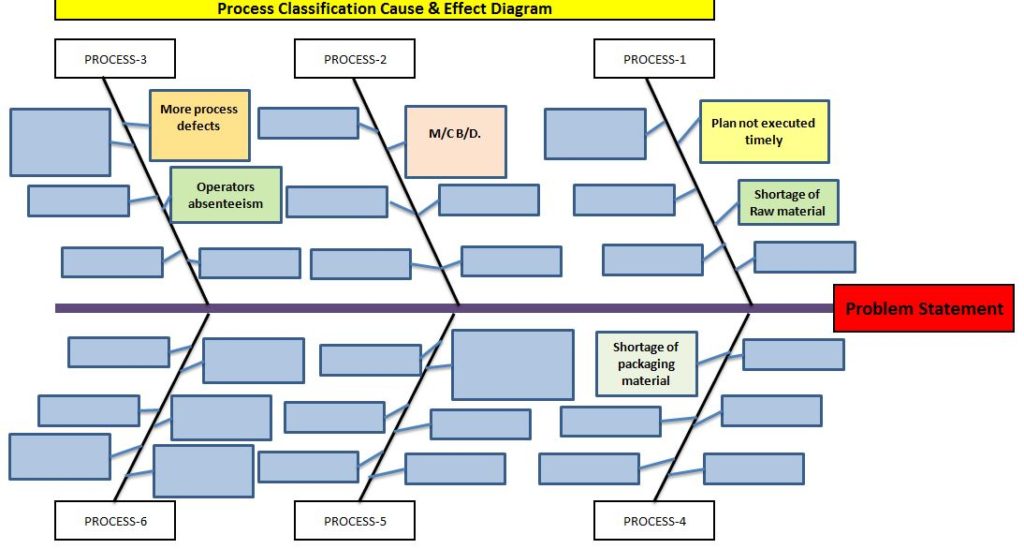
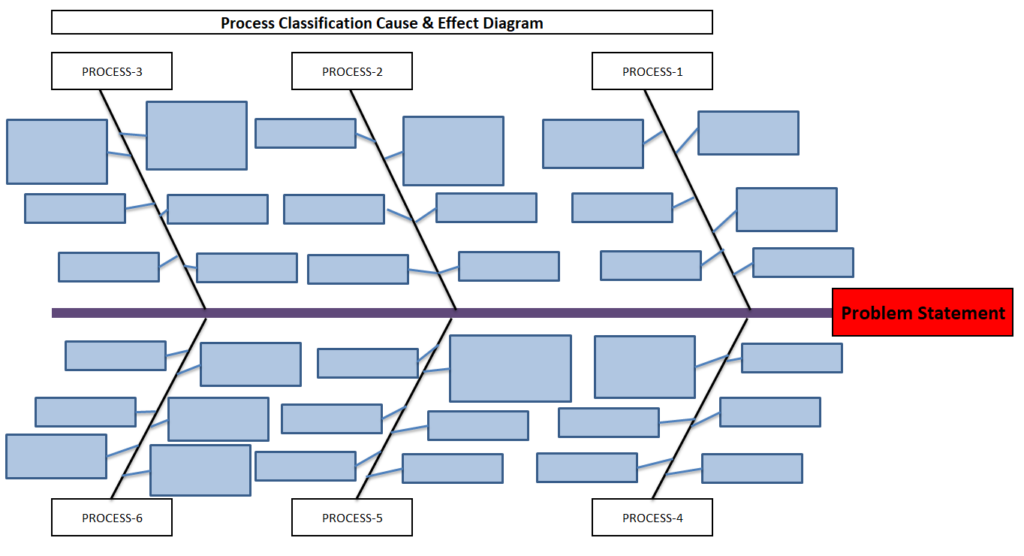
The Process classification fishbone diagram involves establishing causes related to the Process. But in Enumeration types, there a slight changes as compared to the above both types, simply list all the possible causes first and then draw the chart in order to relate the causes to each other.
Example of Dispersion analysis type of cause and effect diagram:
We have built the two popular C&E diagrams considering with two scenarios as [1] Electric fire [2] Product delivery issues. First of all, we have listed up the potential causes and then constructed the fishbone diagram.
What are the 3 types of cause and effect diagrams?
Ans. The common three types of fishbone or cause & effect diagrams are 1-Dispersion Analysis, 2- Process Classification, and 3-Enumeration.
Free Templates / Formats of QM: we have published some free templates or formats related to Quality Management with manufacturing / industrial practical examples for better understanding and learning. if you have not yet read these free template articles/posts then, you could visit our “Template/Format” section. Thanks for reading…keep visiting techiequality.com
Our Author is an experienced professional in Quality Management Systems, Quality Assurance, Operations, and Business Excellence, with cross-industry expertise in Automotive, AMR, Robotics, Battery Manufacturing, Foundry, and Sheet Metal industries. He has strong expertise in international standards including IATF 16949, ISO 9001, ISO 14001, ISO 45001, and ISO 17025, along with methodologies such as TQM, TPM, and Six Sigma. He holds a degree in Mechanical Engineering along with an MBA, combining strong technical acumen with strategic business insight, he is a Certified Internal Auditor, Lead Auditor, and Six Sigma Black Belt, with a proven track record in driving quality transformation and operational excellence.
Through TECHIEQUALITY, he shares practical insights, quality tools, and industry best practices to help professionals improve processes and achieve operational excellence.
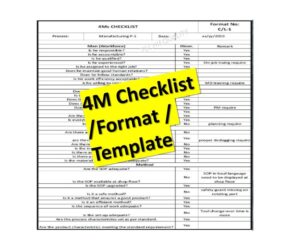
Hi Readers! Today we will discuss here on 4M Checklist Template. Generally, the 4M concept is used in several methodologies, In the Cause and effect diagram it represents the potential causes and similarly, it is also used as a checklist for Kaizen. In the kaizen approach, there are some checklists used as [1] 5MUs checklist [2] 5W1H checklist [3] 4M Checklist. But here we will only explain on the 4M checklist. We have prepared the 4M checklist for your ready reference. You can easily download this checklist/check sheet from the below link.
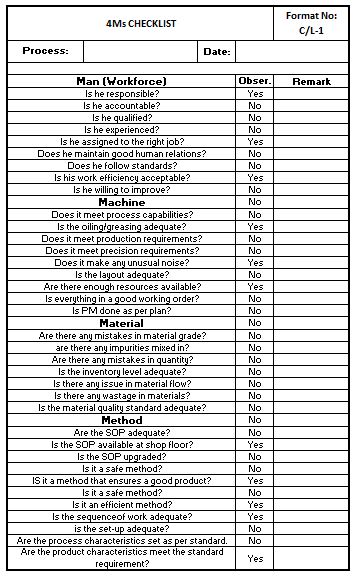
4M i.e. Men, Machines, Materials & Methods are the common aspects and important for quality improvement and KAIZEN. Questions to be asked related to 4M to implement kaizen activities effectively are;
Man (Workforce)
Is he responsible?
Is he accountable?
Is he qualified?
Is he experienced?
Is he assigned to the right job?
Is everything in a good working order?
Does he follow standards?
Is his work efficiency acceptable?
Is he willing to improve?
Machine
Does it meet process capabilities?
Is the oiling/greasing adequate?
Does it meet production requirements?
Does it meet precision requirements?
Does it make any unusual noise?
Is the layout adequate?
Are there enough resources available?
Are there any mistakes in the material grade?
Is PM done as per plan?
Material
Is there any issue with material flow?
Are there any impurities mixed in?
Are there any mistakes in quantity?
Is the inventory level adequate?
Is there any wastage of materials?
Is the material quality standard adequate?
IS it a method that ensures a good product?
Method
Is the SOP adequate?
Is the SOP available on the shop floor?
Is the SOP upgraded?
Is it a safe method?
Is the setup adequate?
Is it a safe method?
Is it an efficient method?
Is the sequence of work adequate?
Are there any mistakes in the material grade?
Are the process characteristics set as per standard?
Are the product characteristics meeting the standard requirement?
Template
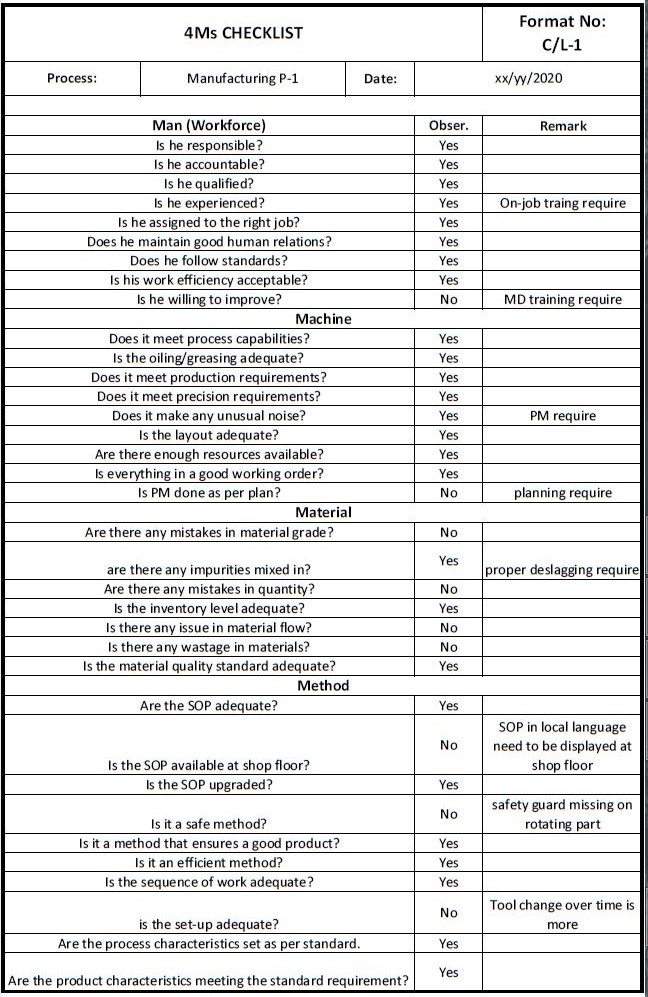
Example: We had audited the manufacturing process and got the below observations;
4M Checklist Template
During the process audit through the 4M checklist, we have observed so many improvement points, these are mentioned in the above checklist remark column. In this way, you can easily find out the process improvement points. Download the above 4M Checklist and try to customize it according to your manufacturing process.
How to Implement the 4M checklist /Check sheet in Manufacturing Industries?
I always try to share my own industrial experience so that my readers can easily understand, learn, and implement the skill-based concept in their operational process.
Posts/articles on this website are skilled base, you can read our articles for your personal learning, for training purposes, and for practical implementation in the industry as well.
Generally, we use the 4M, and 6M check sheets to audit /investigate and to check the condition and lacking points of 4M factors (Men, Machine, Method, and Material). Some industries plan the checking schedule on a weekly and some on a monthly basis as per the production plan. By doing so we can easily maintain the machine condition, reduce the B/D, Increase the machine run time, we can identify the on-job training of operators /workers, maintain the material inventory, monitor the effectiveness of the Method, we can further improve our process, etc.
Below are the steps for implementation of 4M checklist/ check sheet:
Prepare the 4M checklist /Check sheet as per your Process in detail considering with past 6 months’ quality defect causes, B/D nature causes, customer complaints, etc.
Define the Checking plan (e.g. weekly, monthly, etc.)
Check 4M factors by using the 4M check sheet as per your plan,
Write the observations.
Discuss with the concerned department and formulate the Action plan / CAPA.
Implement the CAPA /Action Plan.
Monitor the implementation of the action plan (For example, verify it in the next checking).
4M Change Management:
After doing the 4M Audit you can easily identify the 4M-related changes. the above 4m checklists is mentioned for your reference but the checking points are not limited. you can customize the above checklist as per your manufacturing process.
Ans.: In Industries the term 4M is generally used as [1] Man [2] Machine [3] Material & [4] Method.
What is 4M method?
Ans.: The 4M method is generally used in manufacturing industries for problem-solving /analysis. These terms are generally represented in 4M change management and also in the Cause and effect diagram or Fishbone diagram. The potential causes are basically represented under the category of 4M- Cause and effect diagram for further processing like causes/problem analysis and validation of causes, etc.
Our Author is an experienced professional in Quality Management Systems, Quality Assurance, Operations, and Business Excellence, with cross-industry expertise in Automotive, AMR, Robotics, Battery Manufacturing, Foundry, and Sheet Metal industries. He has strong expertise in international standards including IATF 16949, ISO 9001, ISO 14001, ISO 45001, and ISO 17025, along with methodologies such as TQM, TPM, and Six Sigma. He holds a degree in Mechanical Engineering along with an MBA, combining strong technical acumen with strategic business insight, he is a Certified Internal Auditor, Lead Auditor, and Six Sigma Black Belt, with a proven track record in driving quality transformation and operational excellence.
Through TECHIEQUALITY, he shares practical insights, quality tools, and industry best practices to help professionals improve processes and achieve operational excellence.
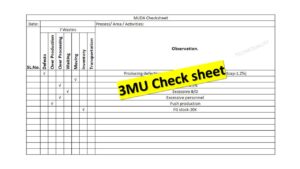
Hi Readers! Today we will discuss here details on MURA, MURI & MUDA. you can download our free template of the 3MU check sheet from the below links. The 3MU’s are MURA (Discrepancy), MURI (Strain), MUDA Waste).
A system, facility, or process designed beyond the physical capacities of equipment/ workforce
Activities which does not add value.
MUDA:
Waste, Unusefulness;
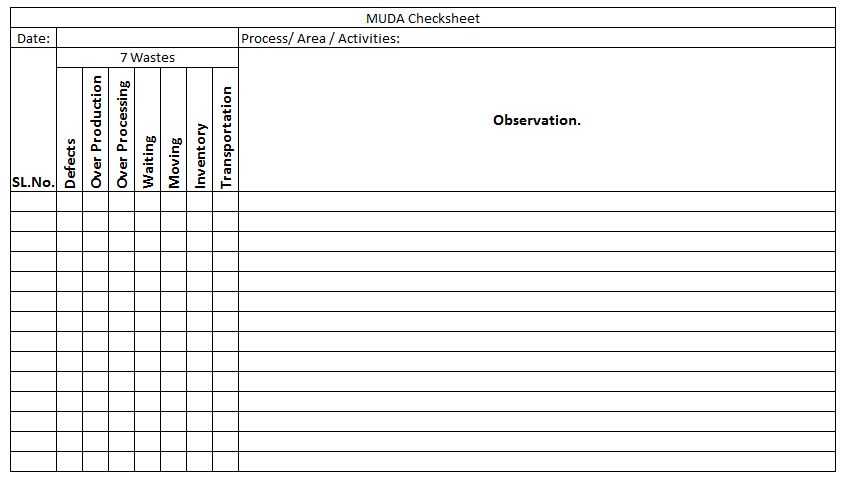
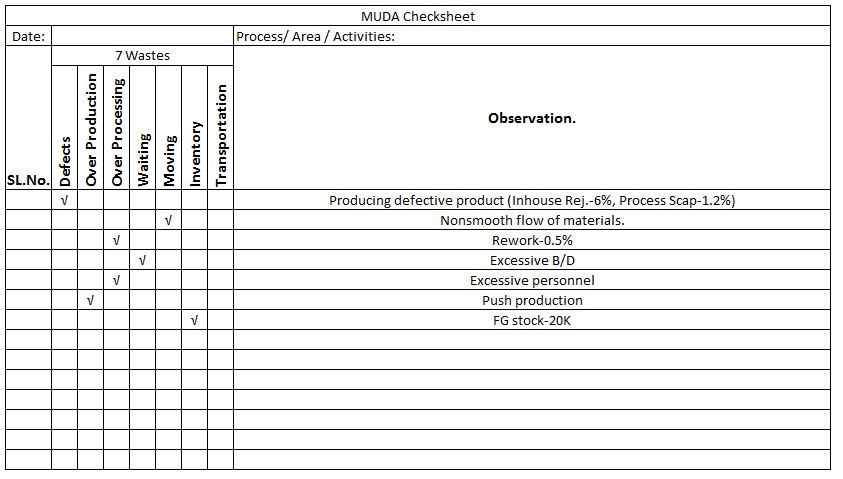
An any activities that do not add value w.r.t the customer perspective, presently in industry; elimination of waste (MUDA) is the big challenge. Many lean tools are there that you can implement it to deduce the MUDA. Value stream mapping is the one of the popular tools that basically used in many industries. But the identification of waste is a big job. The common 7 wastes are;
Defects: The Defective product is total waste.
Overproduction: Production more than demand or less than demand is a loss.
Over Processing: Rework, Repair, Rechecking is a waste of time and money.
Waiting: Waste of time, and money.
Moving: The movement of goods within or outside is waste.
Inventory: Unfinished goods, R/M, BOP add no
value.
Transportation: Unnecessary transfer of goods is
waste.
Considering with above points we have prepared a sample MUDA Checklist for your ready reference. DOWNLOAD the MUDA Check sheet.
MURA:
Unevenness, Discrepancy, Irregular;
MURA can exist when the workflow is out of balance.
A system, facility, or process designed beyond the physical
capacities of equipment/ workforces.
How to
eliminate 3MUs?
The MURA (Unbalanced Process) can lead to an overburden on the workforce or equipment which may cause later on all kinds of non-value-added activities (MUDA). So to eliminate the 3MUs you have to give more focus on Value stream mapping, Process layout design, and 5’S, Visual standard, Kaizen, Process feasibility analysis, and Process variation.
Example:
You can audit your respective area by using our 3MU-MUDA Check Sheet, Similarly, we have done this in the manufacturing unit and found some observations, same mentioned in below for your easy understanding.
Our Author is an experienced professional in Quality Management Systems, Quality Assurance, Operations, and Business Excellence, with cross-industry expertise in Automotive, AMR, Robotics, Battery Manufacturing, Foundry, and Sheet Metal industries. He has strong expertise in international standards including IATF 16949, ISO 9001, ISO 14001, ISO 45001, and ISO 17025, along with methodologies such as TQM, TPM, and Six Sigma. He holds a degree in Mechanical Engineering along with an MBA, combining strong technical acumen with strategic business insight, he is a Certified Internal Auditor, Lead Auditor, and Six Sigma Black Belt, with a proven track record in driving quality transformation and operational excellence.
Through TECHIEQUALITY, he shares practical insights, quality tools, and industry best practices to help professionals improve processes and achieve operational excellence.
Strategies for Manufacturing Process Improvement |11+ Strategies:
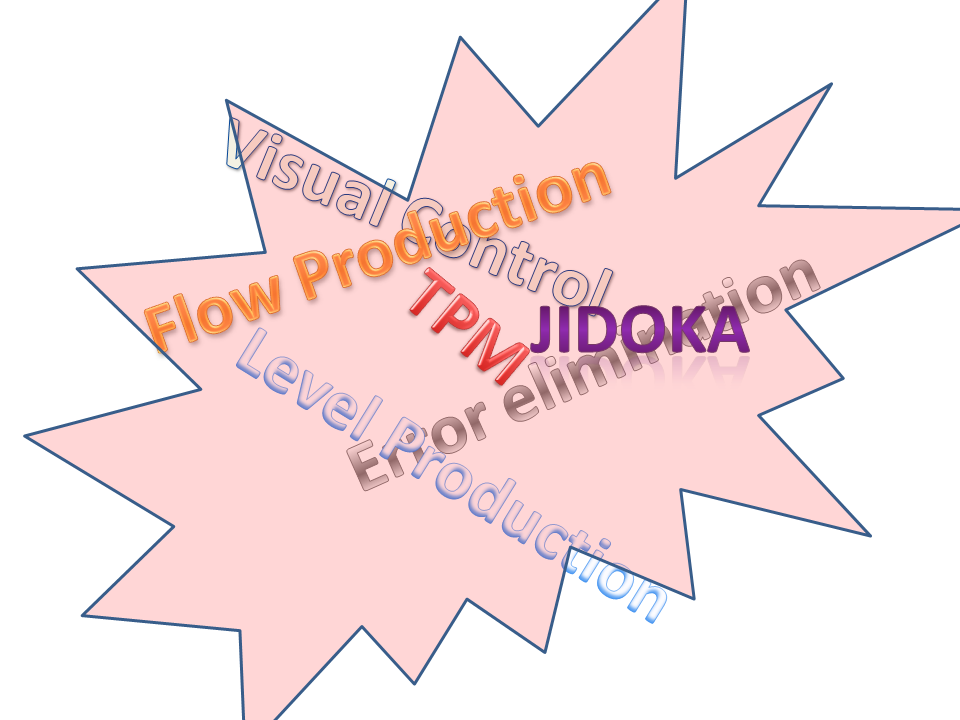
Process improvement is the challenging work in manufacturing industries for continuous Improvement. For continuous improvement, many organizations are following arbitrarily several strategies to improve the process. But they can’t achieve it. As we know the manufacturing unit has many different processes, so they can’t follow a single strategy in all processes. So here we are going to discuss some common standard strategies that will help you to improve the manufacturing process. Following are the Strategies for Manufacturing Process Improvement.
Strategies for Manufacturing Process Improvement
Strategies:
Details of Process:
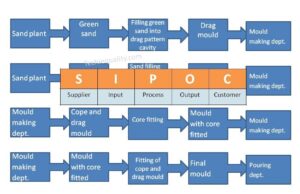
Team members who are involved in process improvement should have details knowledge of the process. You have to first prepare the PFD (Process flow diagram) or SIPOC (Supplier, Input, Process, Output, Customer) to know the depth idea in the process. Study the Work procedure and verify the work going on in the process. If any obvious problem is identified then immediately correct it.
Tools/Methods/Approaches used in this Strategy are PFD, SIPOC, WP, and Process verification with standard Procedure.
Process Standardization:
Operators involved in operation should follow the standardized procedure, which is the most efficient, effective, and best. So process owner should take the initiative to standardize the check sheet, operational procedure, control plan, etc. To do so process owner is supposed to create a CFT team to validate process characteristics and standardize the validated parameters. Monitoring of record to be executed. And time to time all relevant documents need to be revised.
Tools/Methods/Approaches used in this Strategy are WP, CFT, Check sheet, SOP, Process validation, and Standardization of operation.
Process Streamline:
Streamlining of the process can be done by removing unnecessary activities and reducing the cycle time, inventory, etc. During the streamlining of the process, all the team members should eliminate the extra activities that do not provide the desired result and value to the organization and customer. Strong brain-storming is needed to identify the non-value-added activities.
Tools/Methods/Approaches used in this Strategy are VSM, Brain-storming, JIT, World class supply management, etc.
Elimination of Errors:
In this activity, CFT team members need to study the process including 4M (Man, Machine, Material, and Method) factors as a potential source of error. Following are the methods or approaches that CFT team members need to follow to identify the source of error and need to react immediately to improve.
Tools/Methods/Approach used in this Strategy are:
Man
On-job Training, Visual Standard, 5’S, MSA, WP, Operators skills, etc.
Machine
Calibration, Test report, Validation, Error proofing device, Machine maintenance, etc.
SOP, Skill of operator, Testing, equipment calibration, etc.
Statistical Process Control:
Process Inspectors have to collect the data and prepare the control chart according to data types. If a special cause exists there then they have to plan for continual improvement.
The CFT team needs to decide first which factors are going to be measured for improvement by experiment (DOE, DSS, etc.) methods. Before starting the experiment project, CFT members should represent the theoretical benefits and technical logic behind the improvement project. Then they have to set up, conduct an experiment project, and collect the data for analysis. If found positive result then the action of the experiment needs to be implemented in the process.
Tools/Methods/Approaches used in this Strategy are DOE, DSS, Experiment Projects, etc.
Flow Production:
Machines should be set up in such a way that productions will run smoothly and steadily without interruption. Process layout needs to be standardized according to workflow.
Tools/Methods/Approach used in this Strategy is: Standardizing of Work Layout.
Level Production:
This involves breaking the large lots into smaller lots and producing them at a constant level. All manufacturing industries should prepare the production plan accordingly so that a constant quantity of daily production will run without storing the whole period of raw material as inventory.
Tools/Methods/Approaches used in this Strategy are JIT, PPC, Inventory Management, etc.
Visual Control:
Visual control is one of the best methodologies for process improvement, in this process, you can visualize the Q-component level and decision-making component level in the shop floor process, activities, and machine to know the deviation in the process. You can easily act on it online.
For example, leveling of lubricant oil at the machine, during daily machine inspection you can easily check the oil level, which may allow you to prevent the machine break-down caused by the low level of lubricant oil in the machine.
Tools/Methods/Approach used in this Strategy is Match-mark, sign, level, Photos, 5’S, etc.
This involves identifying the process variation (special cause, common cause, wastage, defects, yield, scrap, etc.). Process owners need to analyze it and take the necessary action on it.
By actively doing the TPM activities may lead to some benefits like zero breakdown, zero defects, etc. and the machine’s basic condition will be maintained.
Note that all the above strategies are not applicable to all sectors/ units and it depends on the nature of the Manufacturing process and suitability.
Our Author is an experienced professional in Quality Management Systems, Quality Assurance, Operations, and Business Excellence, with cross-industry expertise in Automotive, AMR, Robotics, Battery Manufacturing, Foundry, and Sheet Metal industries. He has strong expertise in international standards including IATF 16949, ISO 9001, ISO 14001, ISO 45001, and ISO 17025, along with methodologies such as TQM, TPM, and Six Sigma. He holds a degree in Mechanical Engineering along with an MBA, combining strong technical acumen with strategic business insight, he is a Certified Internal Auditor, Lead Auditor, and Six Sigma Black Belt, with a proven track record in driving quality transformation and operational excellence.
Through TECHIEQUALITY, he shares practical insights, quality tools, and industry best practices to help professionals improve processes and achieve operational excellence.
Dispersion Analysis & Process Classification Cause & Effect Diagram Template
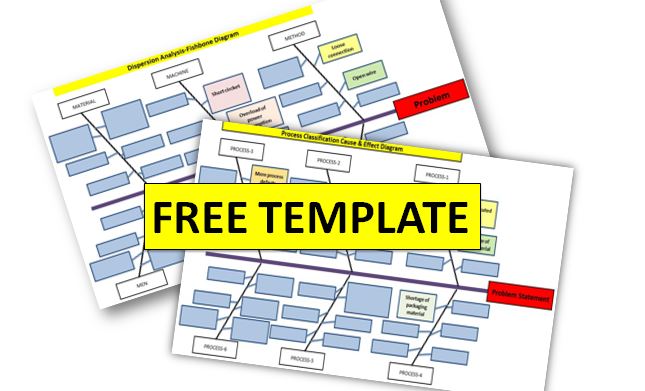
Hi readers! Today we will discuss on types of Cause & Effect Diagram/Fishbone diagram. The cause and effect diagram is the most popular and frequently used tool among the seven QC tools. Basically Fishbone diagram is classified into mainly two types as [1] Dispersion Analysis Cause and Effect diagram, and [2] Process Classification Fishbone diagram. The Dispersion analysis fishbone diagram involves identifying the potential cause for a specific quality problem. However, a Process classification cause & effect diagram involves establishing causes related to the Process. In the manufacturing industry, both types of diagrams are used but Dispersion types are most frequently used to identify the potential causes of the quality-related problems. If you are interested in downloading the Dispersion Analysis Cause & Effect Diagram Template & Process Classification fishbone diagram, then click on the given below links.
DOWNLOAD– Dispersion analysis cause & effect diagram template. (4Ms).
Our Author is an experienced professional in Quality Management Systems, Quality Assurance, Operations, and Business Excellence, with cross-industry expertise in Automotive, AMR, Robotics, Battery Manufacturing, Foundry, and Sheet Metal industries. He has strong expertise in international standards including IATF 16949, ISO 9001, ISO 14001, ISO 45001, and ISO 17025, along with methodologies such as TQM, TPM, and Six Sigma. He holds a degree in Mechanical Engineering along with an MBA, combining strong technical acumen with strategic business insight, he is a Certified Internal Auditor, Lead Auditor, and Six Sigma Black Belt, with a proven track record in driving quality transformation and operational excellence.
Through TECHIEQUALITY, he shares practical insights, quality tools, and industry best practices to help professionals improve processes and achieve operational excellence.
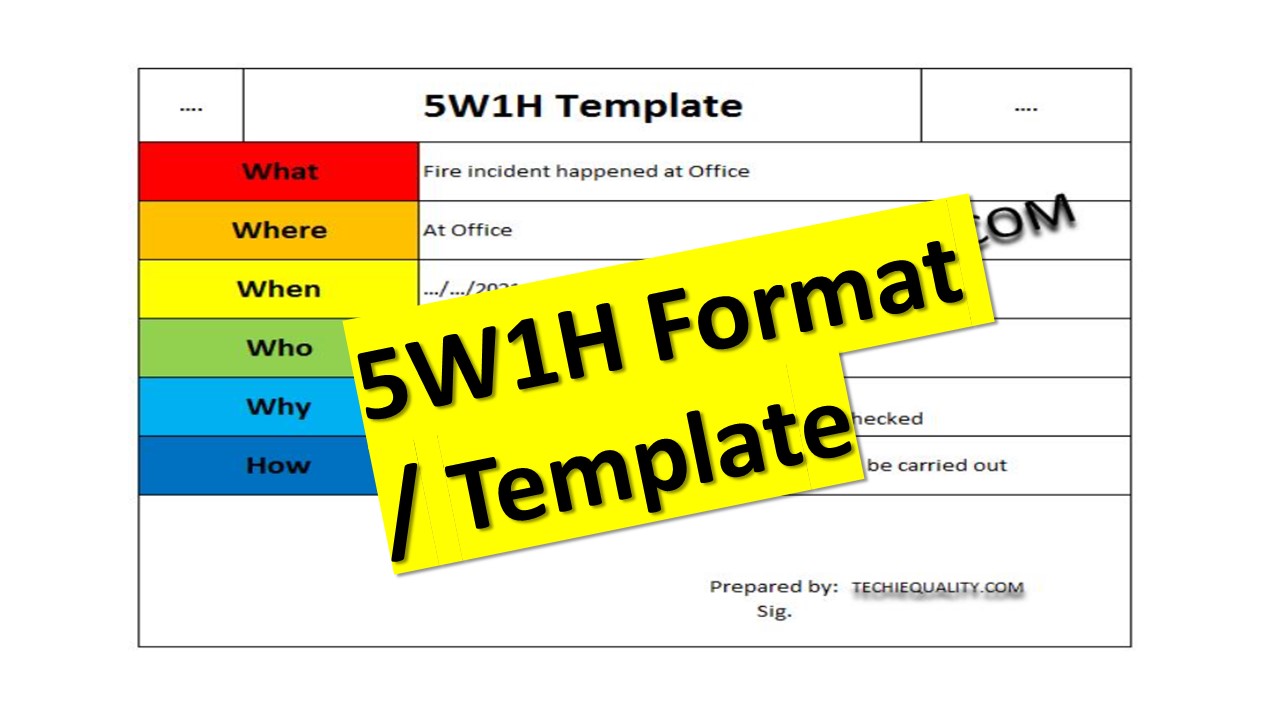
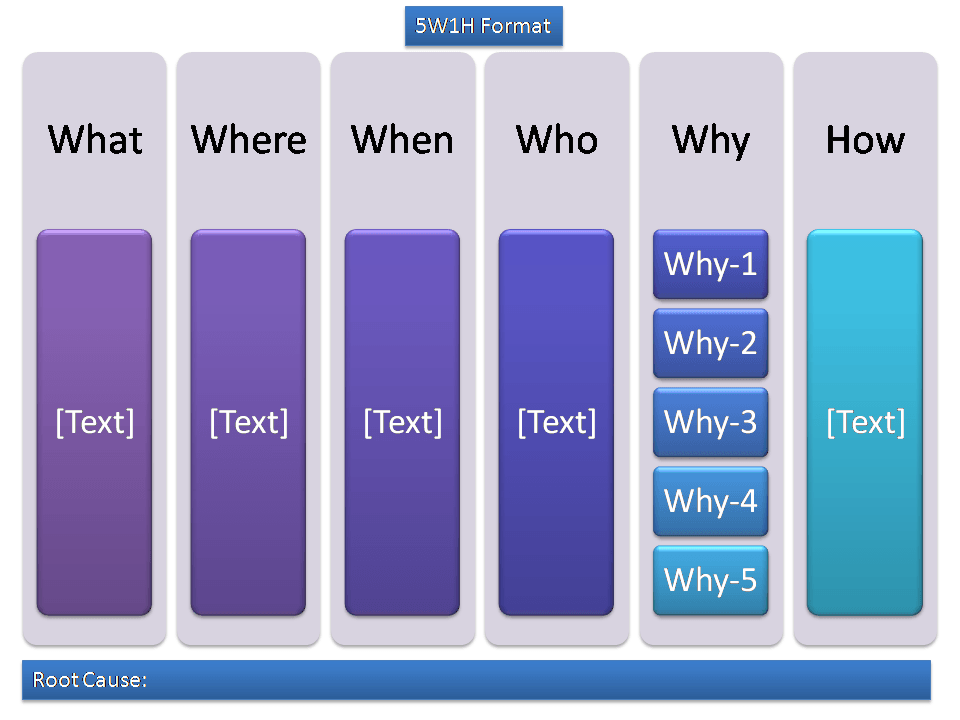
Hi Readers! Today we will discuss here 5W1H Analysis with a manufacturing example. 5W1H is a methodology consisting of six questions as What? Where? When? Who? Why? How? Needs to ask a lot of questions to collect all the necessary data to draw up a report of the existing situation with the aim of identifying the phenomenon of the problem. Go through the below details of the 5W1H Analysis Example (Manufacturing Example).
5W1H Analysis will help you broadly to know the nature of the problem like What is the Problem? Where did the problem occur? When did the problem happen? Who do you need to get involved? Why is it happening? How can you overcome the Problem?
The above pattern may be subject to change if it does not fit with the scenario/ nature of the problem. We can use “how much” additionally as and when applicable regarding the nature of the problem. And then it’s namely called 5W2H.Here, we will illustrate only 5W1H.
Description
of 5W1H:
Phenomenon of Problem:
Explanation:
What is the
Problem?
Where did the problem occur?
When did the problem happen?
Describe the location, place, and m/c involved.
Who do you need to get involved?
Find out the time when a situation took place.
Involvement of people, external providers, etc.
Why is it happening?
How can you overcome the problem?
To know the reason behind of facts
Method of implementation, deployment, etc.
Method of implementation, deployment, etc.
[5W1H Description Table]
Benefits of 5W1H Method:
It can apply to all types of industries.
One can use it to address all kinds of problems to ask questions from every angle.
It’s a simple method, that everyone can understand, no need for training to ask these types of questions.
From my past experience, I’m trying to share how I was involved with Gemba’s investigation of the line rejection problem. I often use the 5W1H and 5W2H methodology to collect the information on line rejection, before doing the brainstorming, our team members collect the information about the problem with details like which machine, which place, who is responsible, etc. so that we can get the complete data and information for root cause analysis. One day during the line product checking, we found 5 products were rejected. so next I collected the whole data and informed to our CFT team for analysis, Thereafter I realized that how this (5W1H methodology) is helpful. Below is the step-by-step approach described for the deployment of the 5W1H method in industries.
In Manufacturing Industries, this 5W1H format is generally used for problem-solving and It’s widely used during shop floor red bin analysis and also, it’s utilized for analysis of different types of problems like machine breakdown, process-related issue, man-related issues, material related issues, utility breakdown, tools related issue, mechanical & electrical related breakdown, etc.
Step by step approach:
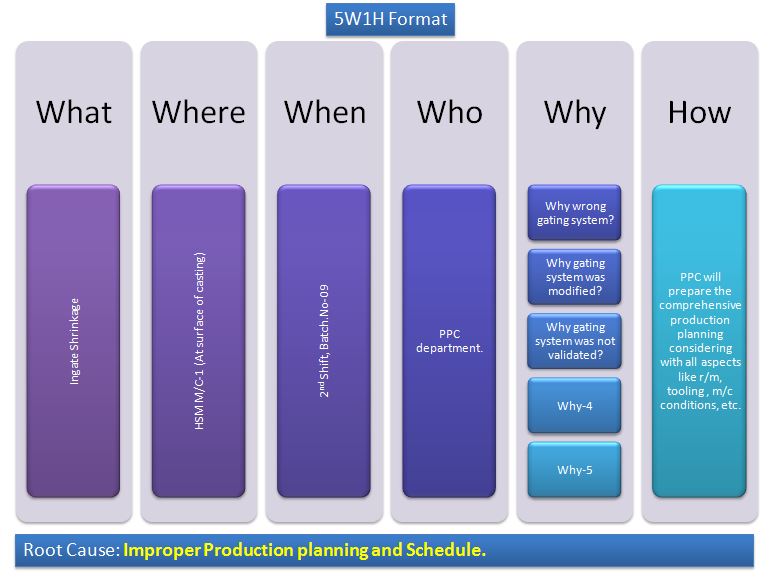
The 5W1H method is applicable to address all kinds of Problems, so go to the real place where the problem occurred. Understand and write in the first “W” that, what is the problem, e.g. Ingate shrinkage, write the technical definition and details of the problem with the defective product picture.
The second process is to cover the question related to “W-2” i.e (Where), Now we have to mention the process area, the machine no, defect location in the product, here we have to cover the defect’s generation area/ process, where it actually generated.
The third “W” is When, here you have to investigate the shop floor workforce and to check the relevant data to know the time/ period/ date/ shift, etc. that when the problem occurred.
In the step “HOW” we have to take an action plan against the root cause.
This is the last step i.e. “Who”: who is the responsible person to implement the action plan.
5W1H Analysis Example-1:
We have taken the same example here, which is already explained in previous articles. If you have not yet read then kindly go through it-previous article.
5W1H Analysis Template / Format
According to previous article the problem found in the process was Ingate Shrinkage. And same we are going to explain it through the 5W1H template.
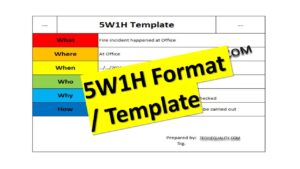
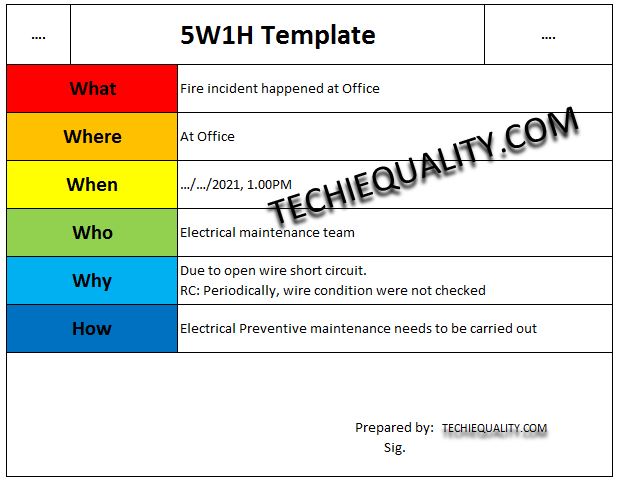
The cross-functional team has investigated the fire incident, which was happened in the office at 1.00PM. They have recorded the information in 5W1H format, the same as we have mentioned in below.
the main difference is the absence of 2H i.e. “How much” in the 5W1H methodology, otherwise all terms are the same in both 5W1H and 5W2H. but sometimes we use “how much” in place of “How” as per the nature of the problem in the 5W1H template
Our Author is an experienced professional in Quality Management Systems, Quality Assurance, Operations, and Business Excellence, with cross-industry expertise in Automotive, AMR, Robotics, Battery Manufacturing, Foundry, and Sheet Metal industries. He has strong expertise in international standards including IATF 16949, ISO 9001, ISO 14001, ISO 45001, and ISO 17025, along with methodologies such as TQM, TPM, and Six Sigma. He holds a degree in Mechanical Engineering along with an MBA, combining strong technical acumen with strategic business insight, he is a Certified Internal Auditor, Lead Auditor, and Six Sigma Black Belt, with a proven track record in driving quality transformation and operational excellence.
Through TECHIEQUALITY, he shares practical insights, quality tools, and industry best practices to help professionals improve processes and achieve operational excellence.
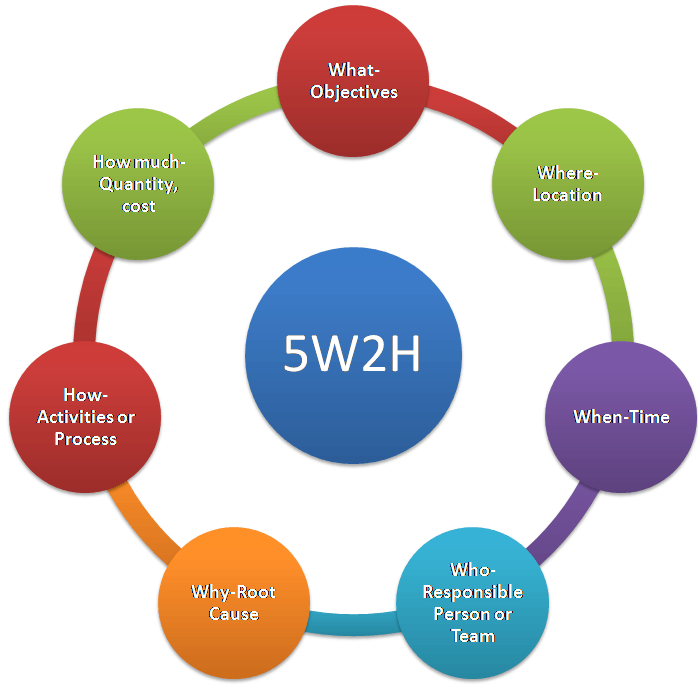
Hi Readers! Today we will discuss on 5W2H Analysis Example with industrial/manufacturing practices and also in this post, you can download our approved template for deployment in your workplace. We have already posted our previous article 5W1H analysis with examples. If you have not yet read that article then first go through it. Our 5W2H template/format is ready to use just download it from given below link.
How to use the 5W2H Method in Manufacturing Industries?
In Industry, both the 5W2H and 5W1H are frequently used methods to Understand, collect, and analyze the Problem. The application of the 5W2H method depends on the nature of the problem. The full form of 5W2H is What, Where, When, Who, Why, How, and How much. Information and Data on any problem are always required for analysis and to find out the root cause. So 5W2H Format will help you to get the collective data and information in one place for problem analysis. From my past experience, I’m sharing the approach and steps for the usage and implementation of the 5W2H methodology.
Daily we find some problem in our production process/line, to overcome such problem we have to resolve these as soon as possible. The problems may be maintenance-related (like Breakdown, equipment failure, utility problems, quality issues, etc.). To understand and solve the problem, we need info. and data. In my point of view, always problem-solving team should always visit the Gemba ( Actual place) to clearly understand and investigate the problem. Below are the steps that we generally were being followed;
Visit to the Gemba (E.g.-Shop floor)
Ask the question to the operator /shop floor person and collect the information and data.
Investigate the 4M or 6M (Men, M/C, Material, Method, Mother Nature, and Measurement) factors and see if any clues are present or not.
Do Brainstorming and find out the Root Cause.
The Manufacturing Example is mentioned below covering all the above steps.
5W2H Analysis:
5W2H Analysis will help you broadly to know the nature of the problem like What is the Problem? Where did the problem occur? When did the problem happen? Who do you need to get involved with?Why is it happening? How can you overcome the Problem? How much quantity?
The above pattern may be subject to change if it does not fit with the scenario/ nature of the problem. We can use only “how” as and when applicable regarding the nature of the problem. And then it’s namely called 5W1H. Here. Today in this article we will discuss only 5W2H Analysis with examples.
Explanation of 5W2H:
5W2H terms
The Phenomenon of the Problem:
Explanation:
What
What is the Problem?
Goal or Objectives (To
describe the problem, activity, task, or project purpose)
Where
Where did the problem occur?
Location (Describe the location, place, and m/c involved)
When
When did the problem happen?
Time (Find out the time, date, and schedule when the situation took place)
Who
Who do you need to get involved with?
Responsible Person or Team (Involvement of people, external provider, etc.)
Why
Why is it happening?
Root Cause (To know the reason behind facts, popular tools used for root cause finding are, e.g. RCA, why-why analysis, etc.)
How
How can you overcome the problem?
Activities or Process (Method of implementation, deployment, etc.), e.g. CAPA.
How Much
How much quantity?
Cost, Quantity, etc.
Explanation Table [5W2H]
5W2H Analysis Example
The above phenomenon of question is not always common for all scenarios; the question patterns will be changed according to the nature of issues/problems/risks/opportunities.
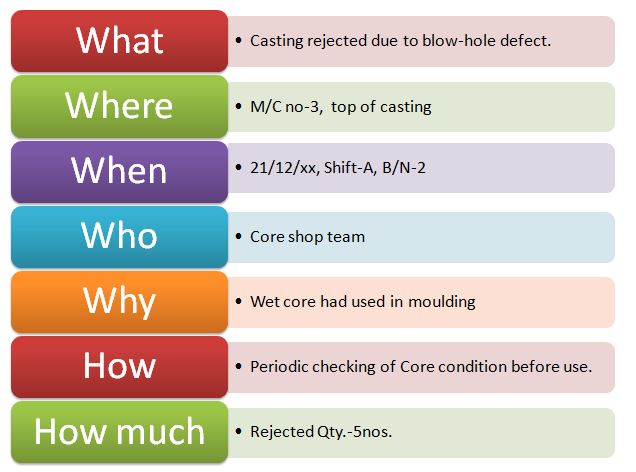
EXAMPLE-1:
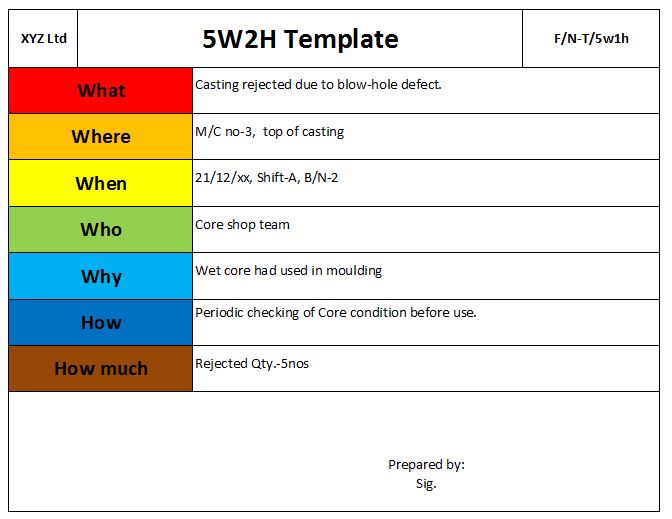
During shop floor rejection analysis at the rejection yard, we found 5 nos casting were rejected due to a blow-hole on the top surface. Same we have explained through the 5W2H format as;
5W2H Analysis Example
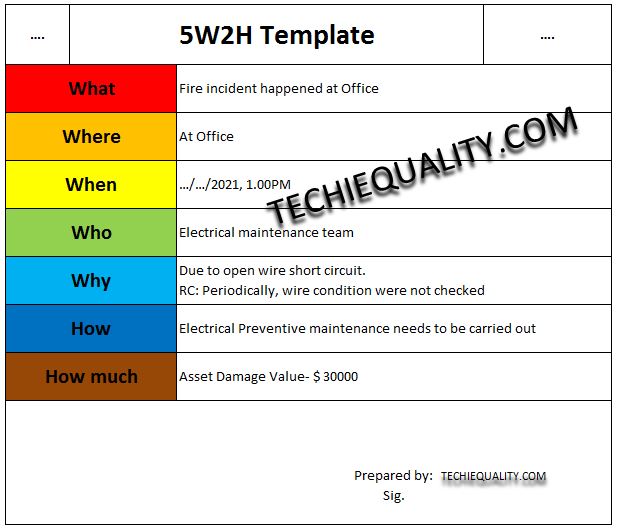
EXAMPLE-2:
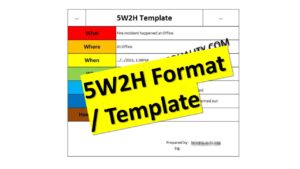
Unfortunately, one day at 1.00 PM, a Fire incident happened at the office. The organization had taken the necessary immediate action during the incident but later the CFT team investigated the area to collect the data for root cause analysis. They have recorded the data and analysis report in 5W2H Format, the same format is given below.
the main difference is the absence of 2H i.e. “How much” in the 5W1H methodology, otherwise all terms are the same in both 5W1H and 5W2H. but sometimes we use “how much” in place of “How” as per the nature of the problem in 5W1H format.
What is the meaning of 5W2H?
The methodology itself indicates that there are 5 Ws and two Hs. This means, what, where, when, who, why, how, and how much. it’s a questioning method and very easy to implement in any organization. we have already given multiple examples for your better understanding. and also defined each term of 5W2H in the above table. just think of one more example of a machine breakdown issue on the shop floor. and you are trying to solve it in a systematic way by applying the 5W2H methodology. Once you applied it and resolved the problem then simultaneously, you did both jobs i.e. one is a record of b/d CAPA and solved the actual problem. It’s a very useful record and you can refer to it when there is the same problem occurs on the same machine.
Our Author is an experienced professional in Quality Management Systems, Quality Assurance, Operations, and Business Excellence, with cross-industry expertise in Automotive, AMR, Robotics, Battery Manufacturing, Foundry, and Sheet Metal industries. He has strong expertise in international standards including IATF 16949, ISO 9001, ISO 14001, ISO 45001, and ISO 17025, along with methodologies such as TQM, TPM, and Six Sigma. He holds a degree in Mechanical Engineering along with an MBA, combining strong technical acumen with strategic business insight, he is a Certified Internal Auditor, Lead Auditor, and Six Sigma Black Belt, with a proven track record in driving quality transformation and operational excellence.
Through TECHIEQUALITY, he shares practical insights, quality tools, and industry best practices to help professionals improve processes and achieve operational excellence.
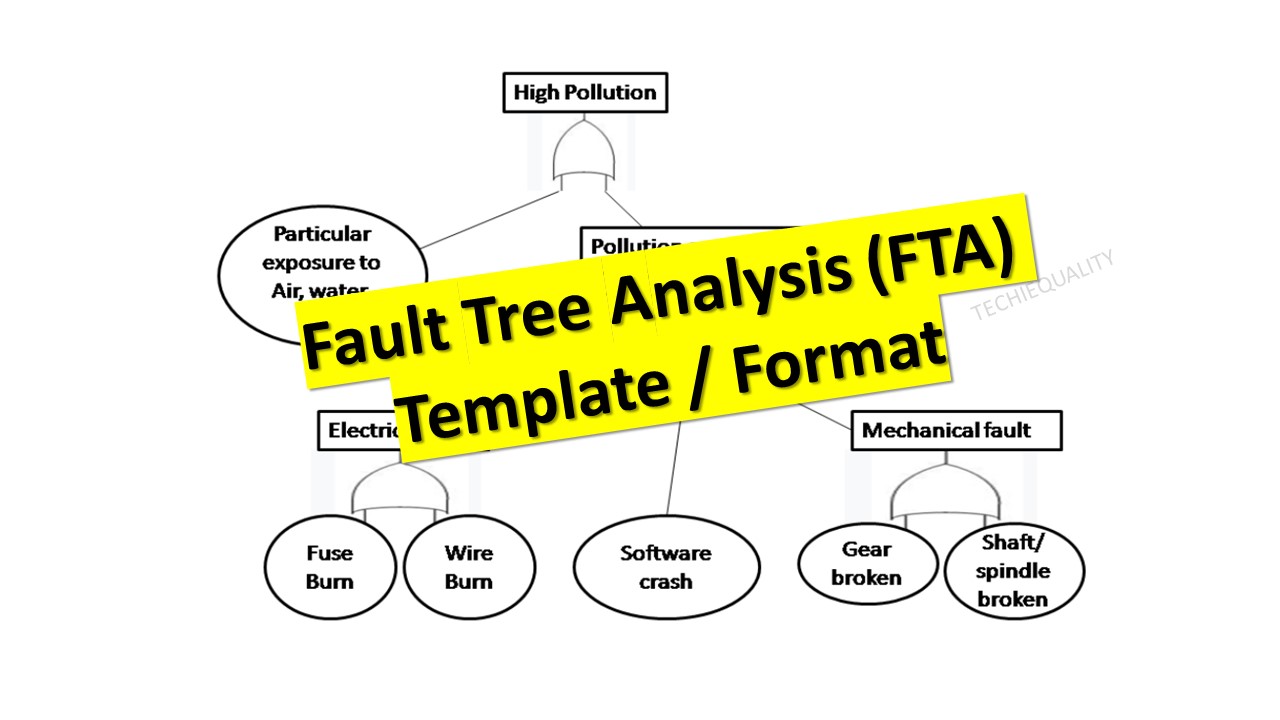
Fault tree analysis template | Download format | FTA with Example:
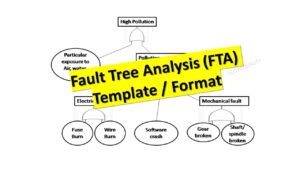
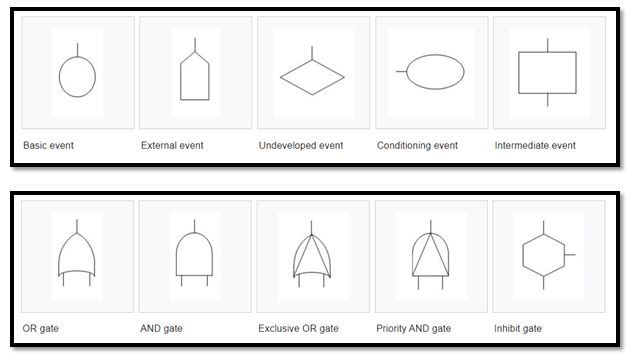
Hi Readers! Today we will discuss on FTA. And also we have prepared some templates/formats considering with some situations. You can download the same templates from the below links. FTA (Fault tree analysis template) was developed by H.A Watson at Bell Laboratory in 1962. Fault tree analysis is generally used to analyze the undesired state of a system through Boolean algebra. This is commonly applicable in the fields of the Nuclear power sector, Chemical manufacturing and service sector, Pharmaceutical, Petrochemical, Aerospace, and other high-hazard industries but now it has become a popular diagram that is being used in almost all types of organizations or sectors.
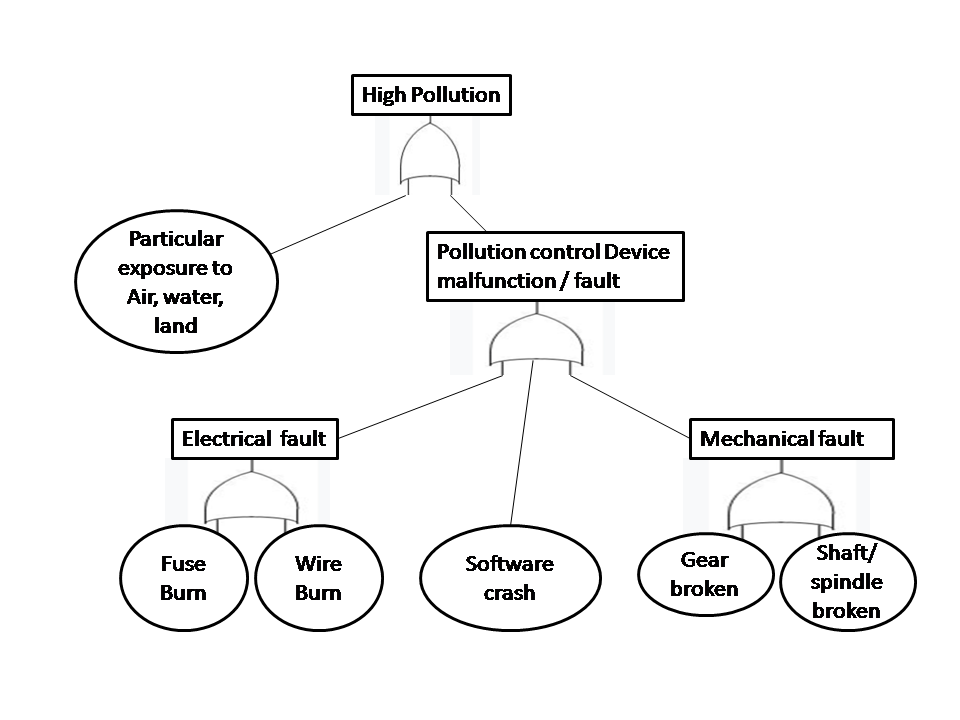
As we know, if any incidents occur (may be due to high-risk factors or particular system level failure) in a high-hazard factory may lead to a high Severity score in health, environment, and safety concerns. So here we will explain the FTA in detail with EHS-related Examples.
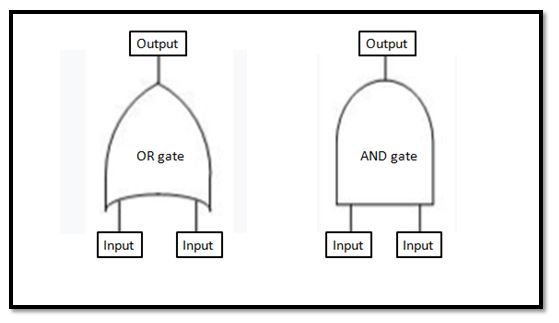
The output occurs if any input occurs. In the above figure you can see there is I/P-1 and I/P-2 in Or-Gate, The output of OR-gate will occur when any one of among two inputs will occurs. But in the case of AND-gate, the output will occur when both the input (I/P-1 & I/P-2) will occur.
Our Author is an experienced professional in Quality Management Systems, Quality Assurance, Operations, and Business Excellence, with cross-industry expertise in Automotive, AMR, Robotics, Battery Manufacturing, Foundry, and Sheet Metal industries. He has strong expertise in international standards including IATF 16949, ISO 9001, ISO 14001, ISO 45001, and ISO 17025, along with methodologies such as TQM, TPM, and Six Sigma. He holds a degree in Mechanical Engineering along with an MBA, combining strong technical acumen with strategic business insight, he is a Certified Internal Auditor, Lead Auditor, and Six Sigma Black Belt, with a proven track record in driving quality transformation and operational excellence.
Through TECHIEQUALITY, he shares practical insights, quality tools, and industry best practices to help professionals improve processes and achieve operational excellence.
Hello readers! Today we will discuss on How to enhance production in manufacturing unit. So you know that enhancing the production quantity with the same capacity is a big challenge in the manufacturing industry. Changing the mindset of manpower (operators, unions, staff, etc.) is another challenge. So here we will discuss on same points to overcome such type of issue and will give you some solutions that you need to follow some below steps for enhancing the production quantity. Many organizations are giving more focus on cost reduction in several ways. As you know that if organisations will succeed in the below parameters then definitely they shall enhance the turnover.
To Reduce
the COPQ.
Eliminate
the wastage.
Comprehensive
PPC.
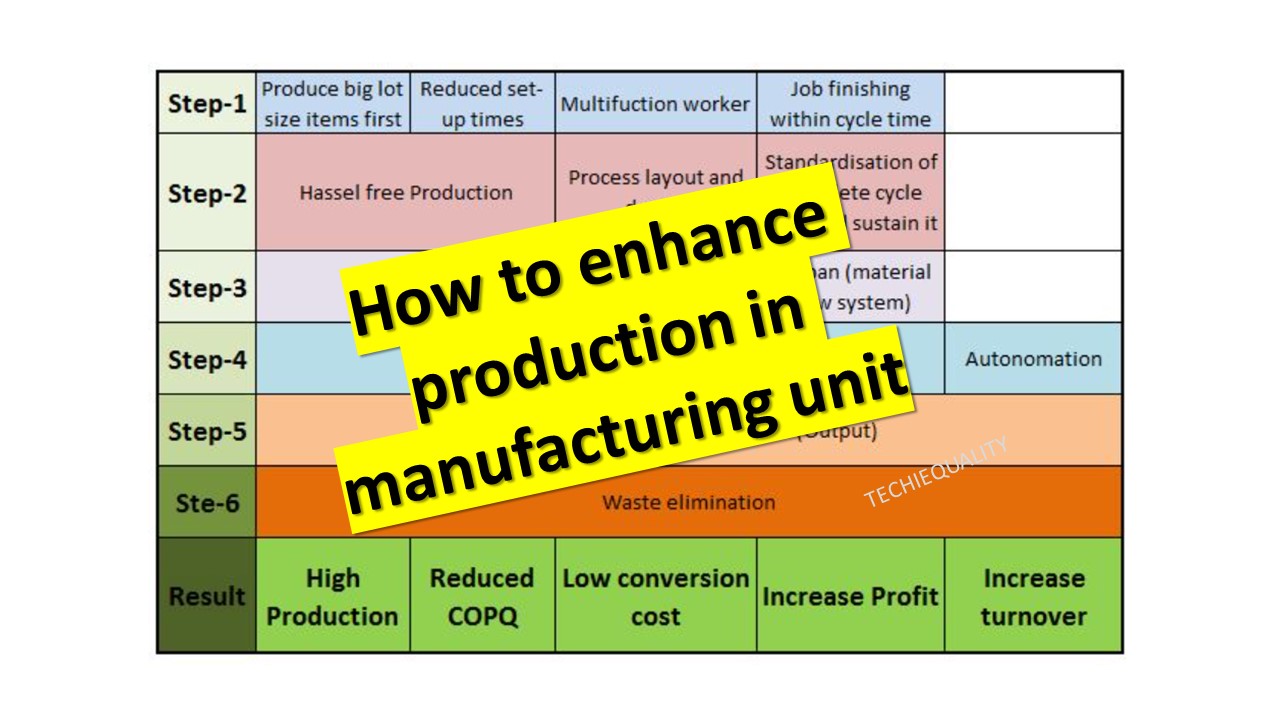
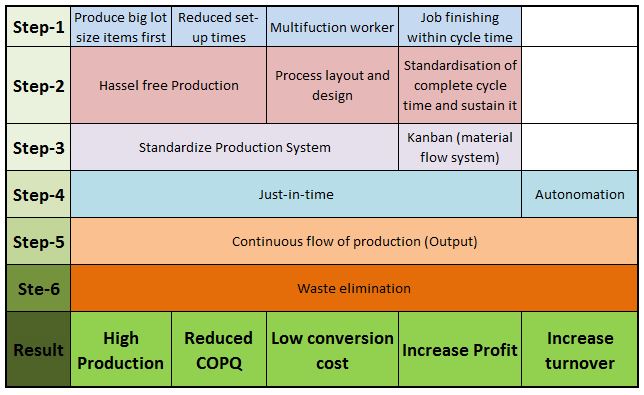
In a wide range, there are so many parameters that we need to give more focus to improve them step by step. Some are mentioned in below figure;
Figure-1
Before we discuss step by step, kindly have a quick look at the above figure first. Many organizations skip the little things or do not consider them during production planning due to some unavoidable circumstance. But later on, they face many problems at the in-process, customer end, and business planning levels.
Details on How to enhance production in manufacturing unit:
Frequently changing of production tooling may take more set-up time which can reduce the quantity needed to be produced. Consider big lot-size items first and reduce the tool set-up time by introducing SMDC methodology, and automatic tooling handling, by reducing the tool repairing time, by enhancing the skill level of personnel, by introducing the tooling management system. etc.
The multifunction worker can reduce the job finishing cycle time by doing multiple jobs at a time in a standardized machine layout. Many automobile manufacturing industries have installed the machine in a ‘U-layout’ at the assembly process. This layout is the most popular one in the automobile manufacturing industry which can reduce the operation cycle time and manpower as well.
After completion of the above job, now it’s time to think about the smooth movement of incoming material to the operation process, quality control at place and just-in time. For doing so KANBAN methodology is the older one but is more effective and helpful for the smooth movement of material for pre and post-operation. And for quality control, many organization transferred their traditional manual process to Autonomation. In this platform, organizations are installing the Andon system, Poka-yoke (Error proofing), Yo-i-don (Ready, set, go). Same you can introduce in your manufacturing process.
For just-in-time, an organization has to work hard at their supplier end as well as their own process. Just-in-time’s primary focus is zero inventories. If you will succeed in implementing the Jus-in-time concept at your and the vendor’s end then the organization can reduce the wastage. There are so many initiatives available to eliminate wastage like Lean manufacturing, lean design, Lean six-sigma, Quality circle concept, and kaizen, TPM (OEE improvement and loss reduction), etc.
Our Author is an experienced professional in Quality Management Systems, Quality Assurance, Operations, and Business Excellence, with cross-industry expertise in Automotive, AMR, Robotics, Battery Manufacturing, Foundry, and Sheet Metal industries. He has strong expertise in international standards including IATF 16949, ISO 9001, ISO 14001, ISO 45001, and ISO 17025, along with methodologies such as TQM, TPM, and Six Sigma. He holds a degree in Mechanical Engineering along with an MBA, combining strong technical acumen with strategic business insight, he is a Certified Internal Auditor, Lead Auditor, and Six Sigma Black Belt, with a proven track record in driving quality transformation and operational excellence.
Through TECHIEQUALITY, he shares practical insights, quality tools, and industry best practices to help professionals improve processes and achieve operational excellence.