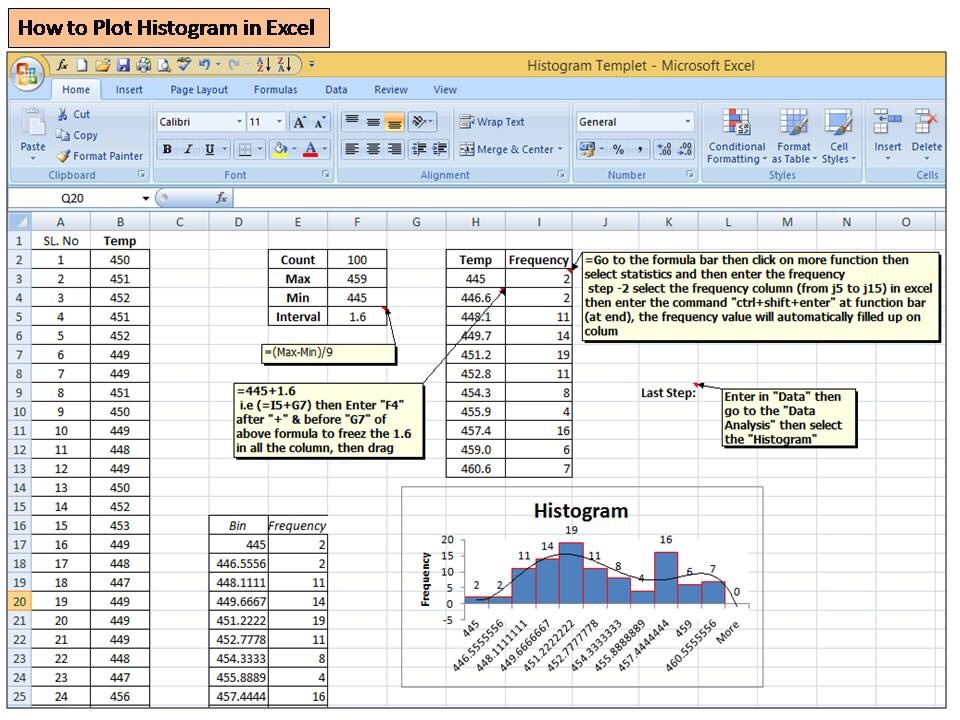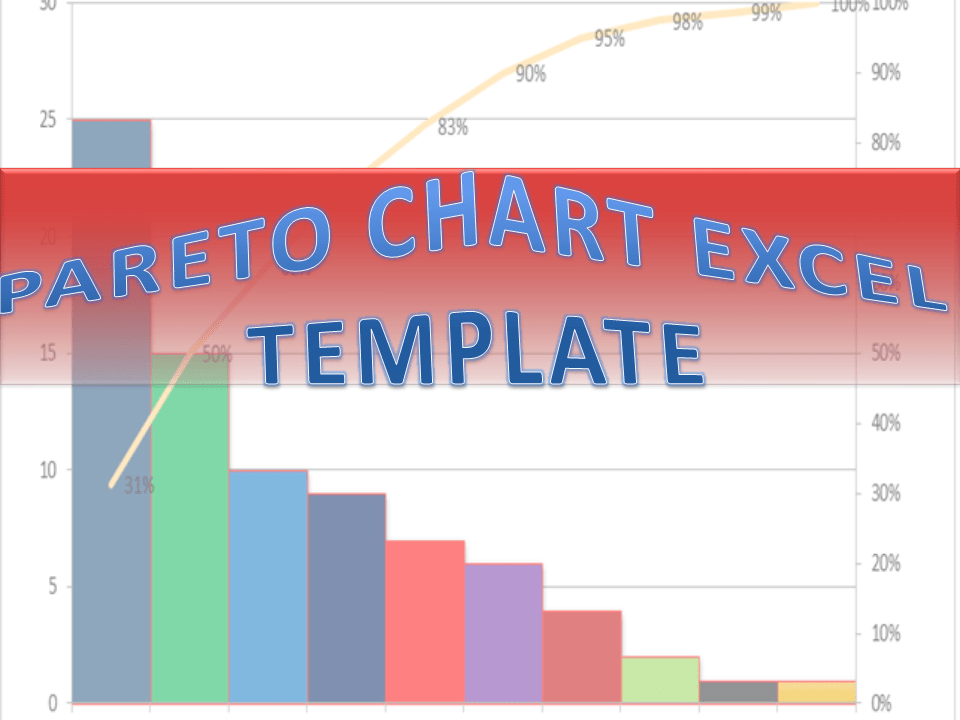
QA Excel Template | Top Skills of Quality Assurance Engineer
Hello readers! Today we will be discussing on one of the important topics in the quality domain, it’s Quality assurance. In the digital era, smart quality assurance technology is fully entering into manufacturing and service industries. But as a QA professional, you have to be hungry for the enchantment of skills set on QA activities and you are supposed to have an advanced level of QA knowledge, so here we are going to help you to fulfill it through this article. Just go through it and learn the details and advanced level of knowledge on QA. As you know the QA function is a vast subject, but we will try to cover the maximum major part and mostly use QA Excel template to enhance your knowledge of statistical and analytical parts.
We have already published two advanced-level articles on the QA function, I would recommend you first read these articles, both two topic tiles are given below, just go through it, then read this article for a better understanding.
As we have already published the QA function in the above two topics, that’s why here we are directly going to discuss on different types of QA tools, techniques, methodology, charts, graphs, and principles.
Top essential Quality Assurance Engineer’s skills set required for manufacturing industries:
From incoming process to FG product -PDI process and customer handling the roles of QA engineer is essential and vital to ensure that product quality and process quality. Here are some major skills (both soft and hard skills) of quality assurance engineers are;
Drawing study
Technical knowledge
Understanding the operations
Warranty Analysis
Statistical Tools and test
Defects and Rejection Analysis.
Auditing
QMS
TPM
TQM
Six-sigma
International quality standard
Improvement projects
5’S
SGA
Testing
IFC
Application of 5 core tools (PPAP, APQP, MSA, SPC, FMEA)
Risk Management
Daily management
Policy management.
Quality Circle
Root Cause Analysis
Metrology and measurement technique
Documentation and Reporting
Supplier quality management
SRM
Customer handling
Problem-solving and decision making
Continuous improvement
Quality4.0
AI and ML
Presentation skills
Communication skill
Teamwork and collaboration
Time management
Adaptability
Leadership
Conflict resolution
Creativity
Risk and critical-based thinking
All the above skill sets are essential for a QA engineer but these are not limited to. the requirement of the skill set depends on the function, operation, service type, and product types as well. To enhance your QA skills based on the above set, you are supposed to learn the advanced level of the above skills set and also, you would like to practice below QA Excel template to gain practical knowledge on it.
Shanti Gopal Pradhan is an experienced professional in Quality Management Systems, QA, Operations, Business Excellence, and Process Improvement. He has strong expertise in international standards including IATF 16949, ISO 9001, ISO 14001, ISO 45001, and ISO 17025, along with methodologies such as TQM, TPM, and Six Sigma.
He holds a degree in Mechanical Engineering along with an MBA, combining strong technical acumen with strategic business insight, he is a Certified Internal Auditor, Lead Auditor, and Six Sigma Black Belt, with a proven track record in driving quality transformation and operational excellence.
Quality Assurance Template | 28+ Free QA Template for Practices
Hello readers! Today we are going to discuss on an important topic which is related to the Quality Assurance Process. There are small and big problems in every company or organization and if you would like to solve them or want to improve your process then as a Quality Assurance Engineer you can take improvement projects to meet your target value. But you have to apply methodology, principles, and different tools for systematic continuous improvement, hence here we will learn many methodology and statics tools of QA. Details of 28+ Quality Assurance Template are given below for your practices and knowledge enhancement purposes.
QA or Quality Assurance is a systematic approach to ensure that a product/ item or service meets specified requirements which are mentioned in SOP, Standard, Customer specific requirements, Drawing, WP, etc. QA is Proactive and its team operates proactively so the main purpose is to prevent defects/ quality issues/waste/ scrap/ rework and to ensure that the final product/output meets the quality requirement/ standard/ CSR. It enhances customer satisfaction by assuring the CSR and their need & expectations.
Below are some major key approaches to QA process or activities
Process-oriented and risk-based thinking approach
Proactive or Preventive approach
QMS Approach
Customer centricity
SQA Approach
Continuous Improvement
Change Management
Documentation
Testing & QA Auditing.
Data Analysis
TQM approach
TPM Approach
Quality4.0
Statistical analysis and Tools, etc.
Process-oriented and risk-based thinking approach:
Starting from product development to dispatch, you should establish the standard and procedure to ensure the quality standard in every stage. Involvement of QA is necessary for the process approach and similarly, we have to identify the risk associated with it to prevent Quality damage.
Proactive or Preventive approach:
In This approach, you have to be more active in preventing defects, quality issues, rework reduction, waste reduction, etc. rather than identifying them after they occur. Quality assurance plan or control plan preparation and full-phase implementation to prevent any type of quality issue is first priority. You have to give more attention to adherence to standard requirements.
QMS Approach:
The quality management system is the systematic approach for standardizing each activity related to the standard requirements of Iso 9001 and IATF 16949. Implement the all clauses of the standard, document the activities, retain the record, and carry out different types of Audits like QMS audits, Supplier audits, process audits, product audits, layer audits, etc. Doing gap analysis and conducting the management review for an action plan and allocating the resource requirement is the next level of QA activities. So it’s a systematic and effective approach to QA.
Customer centricity:
Customer is king for every organization and business, so converting the customer requirement to objective and Process or product characteristics to meet their requirement is one of the major activities of the QA process. SRM (Supplier relationship management), customer-specific requirements, warranty analysis, customer enhancement, customer feedback, customer satisfaction in scorecard monitoring, and customer complaint management are those activities that you have to give more emphasis on it.
SQA Approach:
Like in-house processes, your outsourcing and Supplier activities are also important to ensure as per your business requirements. Incoming material, BOP, and service of supplier can directly or indirectly affect your product quality or hamper the in-process quality as well. The major activities involved in SQA are supplier development, enlistment, supplier rating, supplier auditing, incoming material testing, BOP part testing and inspection, etc.
Continuous Improvement:
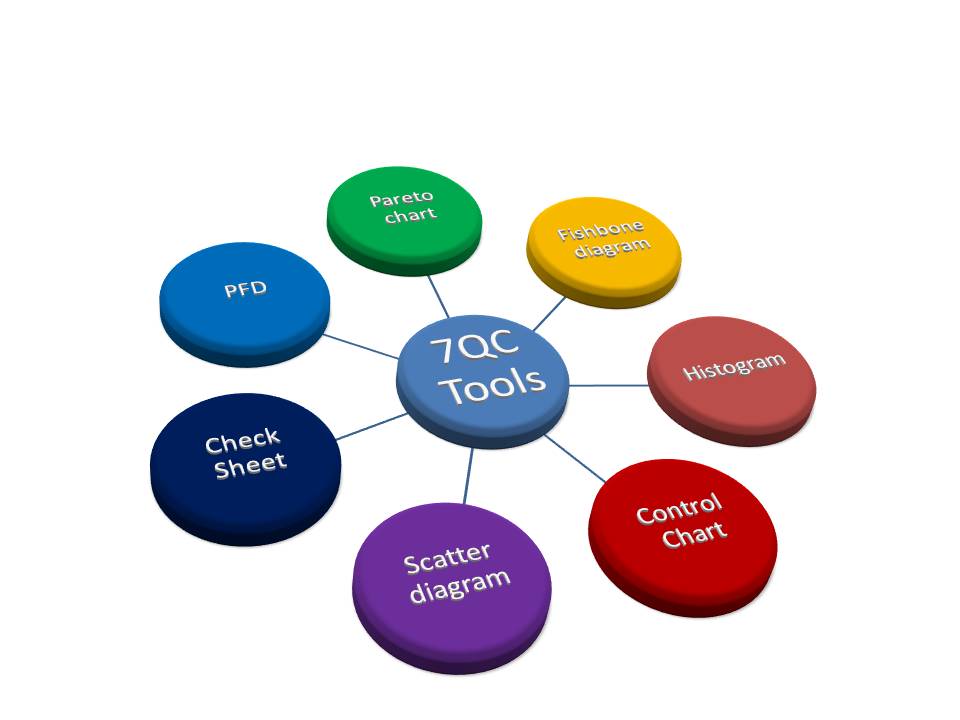
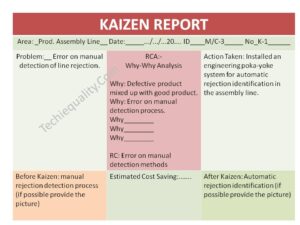
The process is a dynamic activity, and there is always a scope for improvement. Continuous improvement is not a one-time activity but it’s an ongoing process towards quality improvement. You can gather the issues, quality problems, and suggestions through a feedback mechanism. There are many tools and techniques that you can follow like 7QC tools, Six Sigma tools, statistical tools, hypothesis tests, KAIZEN, QC, SGA, DMAIC methodology, DOE, Automation, Poka-yoke, PDCA, SDCA, etc. You can involved in reviewing processes and adjusting to improve efficiency and effectiveness.
Change Management:
Design change to process change, or anything is amended then you have to update/revise it on pertinent document and same to be communicated to relevant users like inspector or operators or end workforce for effective result. 4M change management is a very popular change management approach that many organizations following it.
Documentation:
Documentation including maintained and retained Documented information. Each and every process and activity involved are supposed to be in written form in a standardized manner so that you can easily refer to those when you need them for your reference. You can establish a systematic document control mechanism in your organization.
Testing & QA Auditing:
For the process & product verification and validation, the contribution of both testing & auditing is taking the major activities among the whole QA process. testing may vary industries to industry, process to process, and product to product range but it is a very useful process for monitoring the performance and confirming the product quality. There are so many auditing types like process audit, product audit, layer audit, QMS audit, Autopsy audit, etc. According to the requirement you can select the audit types.
Data Analysis:
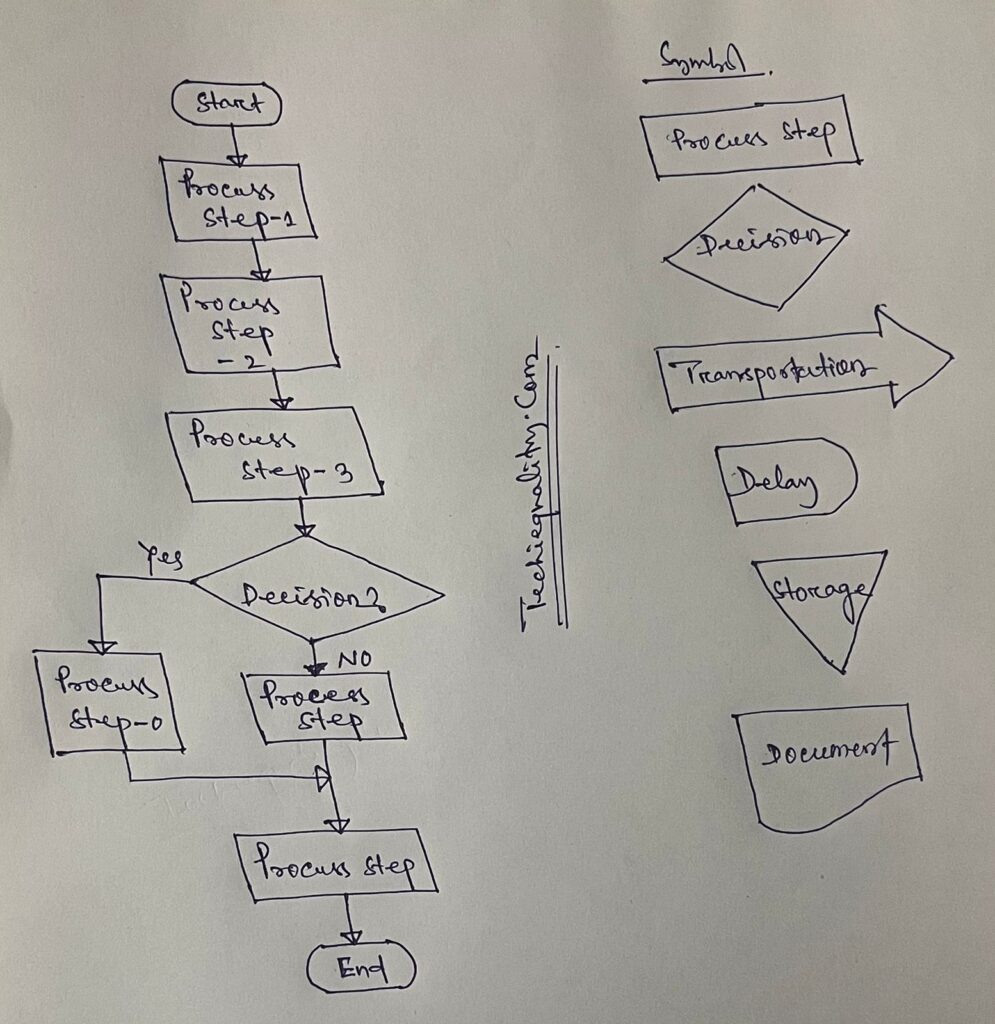
The heart of the QA process is Data Analysis and its interpretation. Your decision-making on quality is directly related to data analysis and its correct and accurate interpretation of results. The complete data analysis process is given below; (step-by-step guide to do the data analysis).
Data collection from sources like shop floor operation, different operations, testing, auditing, feedback, etc.
Selection of data type
Normality test
Selection of tools, techniques, tests, graphs, charts, etc.
Interpret the test result, graph, or chart.
Identify the significant cause, if applicable
Do the Why-Why analysis.
Identify the Root Cause
Prepare the Proposed action plan
Do the trial implementation
Compare the result with the standard
Do the final implementation.
Compare the result
Standardize the process
Above is the complete step-by-step guide to doing the data analysis related to quality defects, damage, problems, issues, complaints, risks, and also for continuous improvement.
TQM Approach:
Total Quality Management is a management approach that is focused on continuous improvement. TQM is involved in all steps and activities of the organization to enhance quality at every stage of the business.
The main three management for TQM activities are [1] Policy management, [2] Daily management, and [3] Cross function management. The key components of TQM are given below;
Customer Focus
Continuous Improvement
Employee Involvement
Process Approach
Decision-making based on Data
Supplier Relationship
Leadership
Education & Training
Benchmarking
Recognition and reward.
TPM Approach:
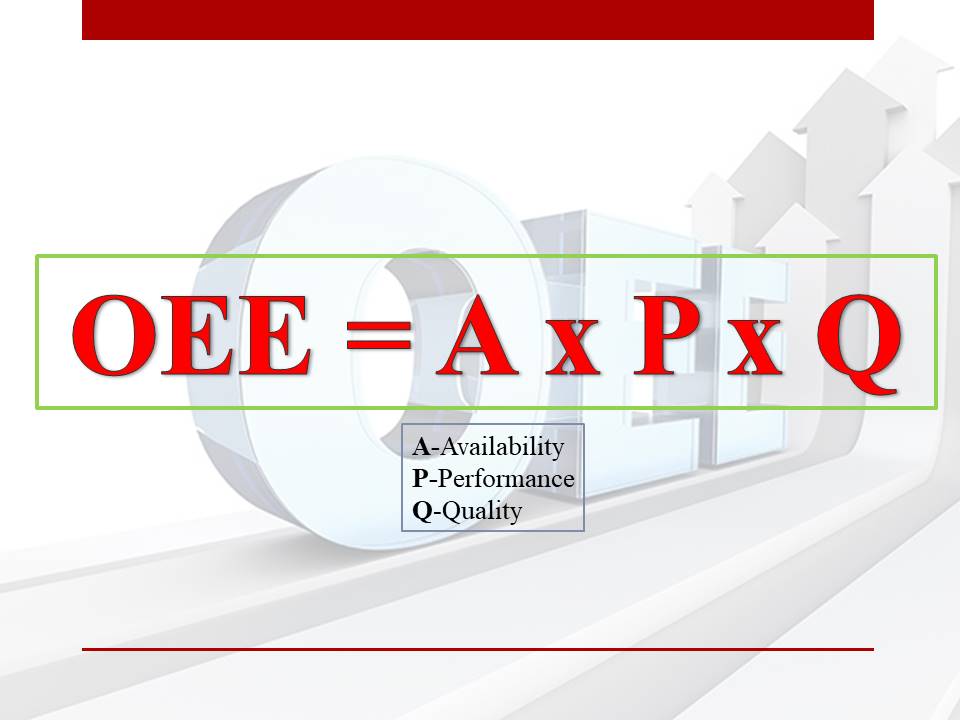
The main objective of Total Productive maintenance is to achieve Zero BAD (Zero breakdowns, Zero Accidents, Zero Defects). The main focus of TPM is to maximize the effectiveness and efficiency of machines or equipment. It also emphasizes the proactive and cooperative involvement of all employees.
OEE – Overall equipment effectiveness.
Planned Maintenance
Autonomous Maintenance
Focused Improvement
E&T – Education, Training & skill development
Quality Maintenance
Early Equipment Management.
SHE – Safety, Health and Environment.
TPM has one Base pillar, which is called 5’S, and 08 main pillars.
08 Pillars of TPM:
Autonomous Maintenance (AM) or Jishu Hozen (JH)
Focused Improvement (FI) or Kobetsu Kaizen (KK)
Planned Maintenance (PM)
Quality Maintenance (QM)
Early Equipment Management (EEM)
E&T – Education and training
SHE – Safety, health and Environment
Office TPM.
Quality4.0:
In this digital era, every organization trying to implement an automation system with fully digitally controls the operation. As we are aware like Industry4.0, Quality4.0 also contributes towards smart factory operation. The main purpose of Quality4.0 is real-time monitoring, digitalization, QA and QC through Smart technology, Robotics involvement, Data Analysis through AI and ML, and Remote controlling of QA/QC by IOT application.
Key Features of Quality4.0 are;
Data Integration
Advanced Analytics
Smart Maintenance
Real-Time Monitoring
Traceability & Transparency
QC/QA Automation
Statistical Analysis and Tools:
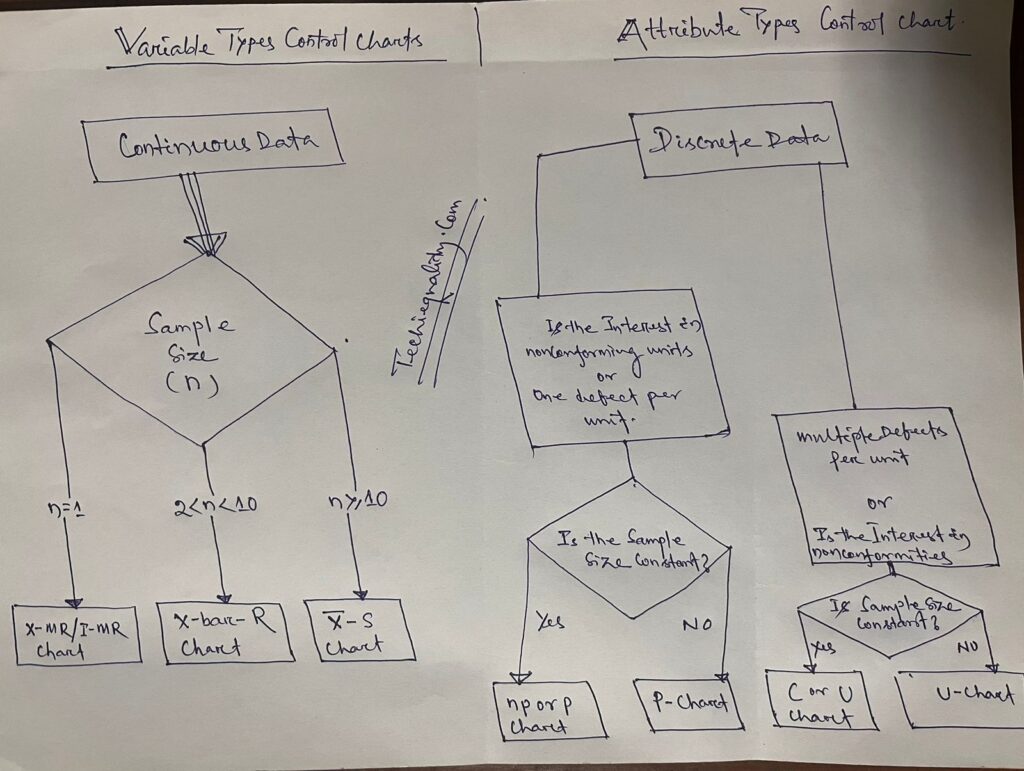
The statistical analysis is generally performed through data collection, testing, doing charts/graphs, and interpretation of results. In the manufacturing industry, we commonly use the SPC and Statistical Tests to perform the statistical Analysis.
SPC- Statistical Process control:
SPC are mainly classified into two types and these are;
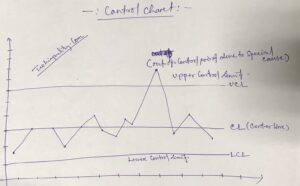
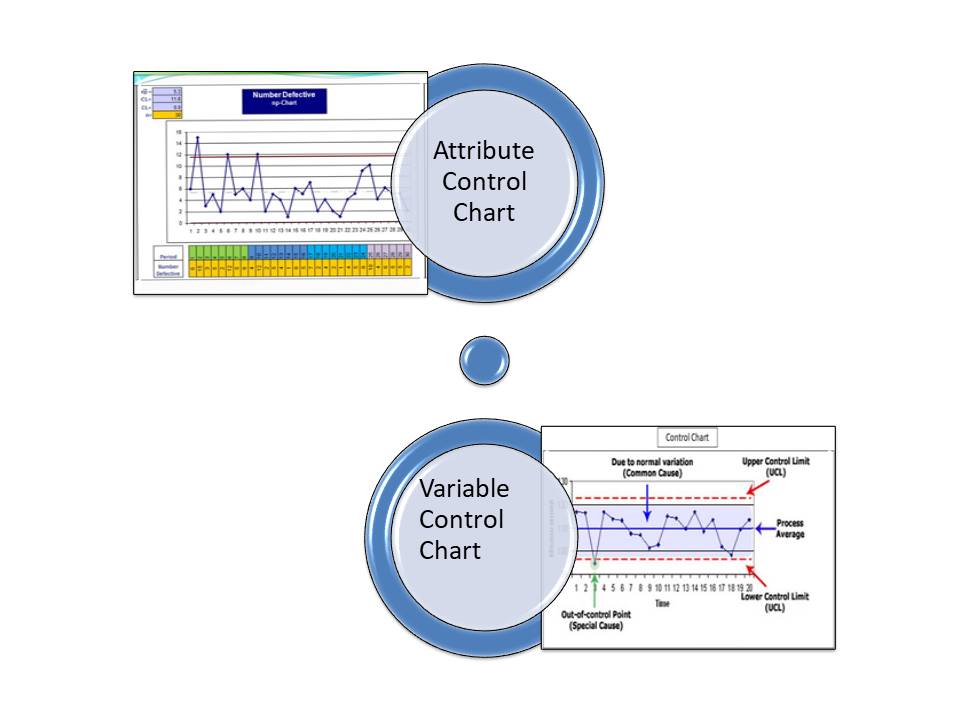
Control Chart
Process Capability.
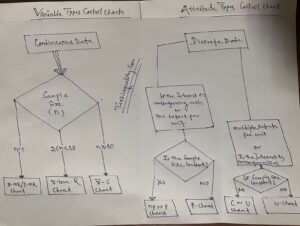
The Control Chart is further classified into again two types [1] Attribute type Control Chart, [2] Variable Type Control Chart.
Attribute Type Control Chart are:
NP chart
P chart
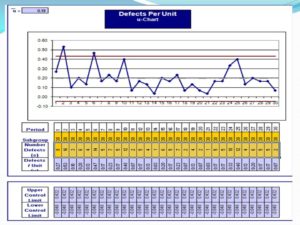
U chart
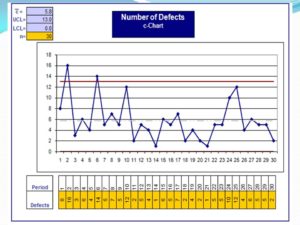
C chart
Variable Type Control Chart are:
I-MR chart
X bar R chart
X bar S chart
Quality Assurance (QA) vs Quality Control (QC):
QA
QC
Aim to prevent defects
Involve in checking and verifying
It is Proactive
It’s a reactive
Focuses on Process improvement, standard adherence
Focuses on product inspection, and verification
Example: Process review, Auditing, Training, documentation, standardization, RCA, etc.
Example: Inspection, verification, testing,
Benefits of Quality Assurance:
Implementing QA in an organization can give you several benefits and some of the major points are mentioned below;
Improved Product Quality.
Enhance customer satisfaction
Improved the Process
Cost saving
Increased the productivity
Reduced the waste/scrap
Risk Management
Brand reputation
Competitive advantage
Better decision making
Continuous Improvement.
28+ Quality Assurance Template for Practices:
Quality Assurance Template
As we learned from this article to better manage the QA activities in an organization we are supposed to know the advanced level of concept of several QA Tools, Techniques, and Methodology in terms of application, analysis, and its result interpretation. Following below are some popular and useful Quality Assurance Template are given for your advanced level of learning and practice.
Shanti Gopal Pradhan is an experienced professional in Quality Management Systems, QA, Operations, Business Excellence, and Process Improvement. He has strong expertise in international standards including IATF 16949, ISO 9001, ISO 14001, ISO 45001, and ISO 17025, along with methodologies such as TQM, TPM, and Six Sigma.
He holds a degree in Mechanical Engineering along with an MBA, combining strong technical acumen with strategic business insight, he is a Certified Internal Auditor, Lead Auditor, and Six Sigma Black Belt, with a proven track record in driving quality transformation and operational excellence.
5 Whys Excel Template, Download Why Why analysis Excel format
Hello readers! Today we will be discussing a very useful topic along with the example. But we have already published a details article on it. So don’t worry it’s a popular topic in every manufacturing industry and a very valuable method for identifying the root cause of any problem. I hope now you have understood which topic I want to talk about, this is a 5 whys Analysis. In this post, I will not cover details on why why analysis because you can learn details on it by just visiting on below given link. But we will learn on the 5 Whys Excel Template for documented information purposes. You can download different types of 5 Whys Excel templates or format those given below.
I would recommend you before downloading the below 5 whys Excel template or Format, try to learn the details concept on below topic.
The 5 Whys analysis technique is generally used to identify the root cause of a problem by repeatedly asking “Why”. 5 Whys does not mean you need to ask 5 times whys for all significant causes, you just stop asking “why” when RC (root cause) is identified. We have prepared 3 useful templates in Excel format as mentioned below.
Shanti Gopal Pradhan is an experienced professional in Quality Management Systems, QA, Operations, Business Excellence, and Process Improvement. He has strong expertise in international standards including IATF 16949, ISO 9001, ISO 14001, ISO 45001, and ISO 17025, along with methodologies such as TQM, TPM, and Six Sigma.
He holds a degree in Mechanical Engineering along with an MBA, combining strong technical acumen with strategic business insight, he is a Certified Internal Auditor, Lead Auditor, and Six Sigma Black Belt, with a proven track record in driving quality transformation and operational excellence.
What is Quality 4.0 | What Type of Skill Set Needs to be Developed as an Employee
Hello readers! Today we will be discussing on an important topic which is nothing is called Quality 4.0. In this digital era, both the manufacturing industry and its functional departmental activities are going to transit to the next Digital level. Quality 4.0 is also called 4th revolution smart quality. The most important thing is the new challenges to both employees and employers. Definitely, we will cover both important things over here. Just read the complete articles.
What is Quality 4.0:
Before directly going to the topic “Quality 4.0”. I would like to tell you about the revolution of Quality from 1.0 to 4.0. then we will discuss the complete subject of Quality 4.0 and how it would affect both employees and employers of manufacturing industries.
In the above picture, it has been clearly mentioned that Quality 1.0 to Quality 4.0. As we know there is industry 4.0 is rapidly penetrating in the industry. Similarly, Quality 4.0 is part of Industry 4.0.
Nothing is permanent in this world; accordingly, revolution, improvement, and innovation are always there in the industry it could be a product revolution, process, or industry revolution. Revolution is the dynamic system for better quality, product, service and cost reduction, revenue enhancement, etc. so both employee and employer should adopt the new challenges with respect to a new revolution. Data and smart operations are the future of any type of organization. So, quality 4.0 is also giving more emphasis on Smart digitalization, Data-driven, and smart quality management.
Quality 4.0 is a concept/method/ smart activity that builds upon the principles of Industry 4.0, Q4.0 is the integration of digital technologies, automation, and data exchange in manufacturing and industrial processes. Quality 4.0, similarly, its focuses on technologies for Quality assurance activities within industries mainly on manufacturing units.
Quality4.0 Main Features:–
As you can see in the above image, the main features/structures of Quality4.0 are mentioned and these are
Data Integration
Advanced Analytics
Smart Maintenance
Real-Time Monitoring
Traceability & Transparency
QC/QA Automation.
Customization & Personalization
Continuous Improvement.
Let us understand details on the above main features with examples.
Data Integration:
Nowadays many organizations use traditional methods for data collection and data recording on a manual basis, for example, many organizations still do manual inspections for getting the data/measurement/ Dimension/ parameter reading/ process & product characteristics checking. But Quality4.0 relies on the integration of data from several sources within manufacturing activities through advanced smart devices like sensors, cameras, automatic equipment, and software integration. Using machine learning and artificial intelligence in machines as advanced programable software for data collection and advanced-level interpretation.
Data is more important for further analysis and decision-making in manufacturing industries. So, data Integration is a very crucial activity in manufacturing industries.
Advanced Analytics:
Data analysis and result interpretation are the major activities in manufacturing industries. Analysis and interpretation can be done using advanced analytics including artificial intelligence and machine learning. A machine or device can automatically do these activities using artificial intelligence.
Smart Maintenance:
Maintaining the health of machines is a major challenge in manufacturing industries due to the time factor, customer demand, and limited resources. Machine health can directly affect product quality. So both predictive and preventive maintenance are important, but think about the automatic system where the machine itself sends you the health alert to your mobile or laptop through IOT or any other smart digital way then it will be very useful to maintain the condition of the machine and tools.
Real-Time Monitoring:
Real-time monitoring of production process, quality parameters, and product & process characteristics to detect and address quality issues. And then analyzing it for result interpretation can help to minimize the non-conformity.
Traceability and Transparency:
Real-time traceability and back path traceability can be easily done through the quality4.0 system. Many technologies like blockchain and other tools are used in supply chain management for traceability and transparency purposes.
QC/QA Automation:
Automatic inspection and process control can be done by using Automation technologies like robots, MVS (machine vision systems), Cameras, sensors, and automatic poka-yoke systems for more efficient and accurate process control.
Continuous Improvement:
Advanced data analysis and perfect interpretation through automation systems can be always helpful for continuous improvement.
There are big and small challenges in every revolution, similarly in Quality4.0 there are many challenges but we will be discussing only some major key challenges of implementing Q4.0.
Major Key Challenges of Quality 4.0
Confirming data correctness, safety, and compatibility across different systems and equipment can be a significant difficulty.
As we know data are more important things for any organization, so protecting and preventing data breaches is crucial. This is one of the major key challenges for organizations.
An initial investment in training, software, devices, and technology is also a big challenge for some companies, especially for small categories of industries or organizations.
Operating the new technology, including quality4.0, AI, Machine learning, and Data Science required trained operators and new skills.
Cultural and process changes related challenges due to the implementation of Quality4.0
Compliance obligation challenges.
Ensuring Automatic system functioning, maintenance, and accuracy of data.
How to Implement Quality 4.0
To implement the Q4.0 in your organization, you have to prepare the milestone or roadmap of the Q4.0 implementation plan. Details are given below;
Here we will learn the process of implementation of Quality4.0 with a practical example for manufacturing industries, let us say you are going to implement one of the popular projects of Quality4.0, which is real-time monitoring and Quality control of products at the production line. Just follow the below steps for implementation (these are not limited to).
Understand the needs of the company or organization: Think about the point that your organization wants to achieve through Q4.0, for example, real-time monitoring of data, robotics, etc.
Make strategy or Q4.0 plan: now it’s time to prepare a plan with a responsible and target date.
Technology and Infrastructure: as we know that, we are going to convert the traditional activities to a digitally controlled process, so technology, software, automatic system, AI, and machine learning are required to install it to successfully implement the Q4.0.
Data integration: First of all, you have to develop an automatic system to collect the data through integration from various sources line sensors, visual systems, cameras, robotics, etc. within the manufacturing operations.
AI, ML, and Data Analytics: Implement the AI, ML, and Data analytics software and technology for data analysis, pattern, chart preparation, and result interpretation.
Real-time Monitoring: Installed the automatic quality control system for real-time monitoring.
Automation of Quality assurance workflow.
E&T
Change management.
Data security and privacy.
What type of Skills set needs to be developed as an Employee?
To manage and operate the quality4.0’s new technology, an organization or company requires workforces with some range of skills like;
Data Analytics and Science.
Knowledge of AI and ML
Cybersecurity, IT, IoT, etc.
Automation
Robotics
Statistics, QC and QC, Decision-making ability, Result interpretation, etc.
Benefits of Quality 4.0
Following are some key benefits but these are not limited to;
Shanti Gopal Pradhan is an experienced professional in Quality Management Systems, QA, Operations, Business Excellence, and Process Improvement. He has strong expertise in international standards including IATF 16949, ISO 9001, ISO 14001, ISO 45001, and ISO 17025, along with methodologies such as TQM, TPM, and Six Sigma.
He holds a degree in Mechanical Engineering along with an MBA, combining strong technical acumen with strategic business insight, he is a Certified Internal Auditor, Lead Auditor, and Six Sigma Black Belt, with a proven track record in driving quality transformation and operational excellence.
Hello readers! Today we are going to discuss and learn a popular topic, which is very useful and needful in the manufacturing industry to identify the root cause and to improve the operations. It’s nothing is called Why Why Analysis. In this topic, we are trying to cover the advanced concept and practical manufacturing examples for better understanding and easy implementation in operations. You can also download the Why Why Analysis excel template from the below given link.
A Why Why Analysis is a very useful problem-solving technique and that is also popularly known as the 5-Whys in process, service and manufacturing industries. The purpose of why why analysis is to identify the root cause of a particular problem, issue, defects, wastages, customer complaint, non-conformity, etc. by repeatedly asking the question “why”. The 5 Whys is a simple but effective technique, that is used in numerous areas, particularly in process improvement, Cost Reduction projects, and lean projects. The main aim is to get to the root cause of a problem, issues, defects, non-conformities, etc. so that we can take action to eliminate the root cause of the problem.
How to perform a Why Why Analysis or 5-Whys (Step by Step guide):
As we know that the concept itself indicating the 5 whys means we have to ask multiple times “why” to identify the root cause of a problem or issue. Below is the step-by-step guide on how to perform a why why analysis (5W / 5-whys analysis);
Team Creation:
You have to create a team in such a way that all required possible functions members should be present in the team, for example CFT team.
Problem Identification:
In this process, you have to identify the problem by using tools, techniques, and principles. we use many techniques and statistical tools in manufacturing industries to identify the problem, issue, potential causes, risk, defects, etc. The most popular and commonly used techniques, tools & methods in industries for the identification of problems, issues, defects, risk,s and non-conformity & gaps are inspection, SPC, QMS auditing, product testing, Process & product auditing, maintenance checking, layer auditing, etc. rather than these practices we also use many other methods to identify the risk, issue, problems through Risk and Issue identification, Data analysis, warranty analysis, customer complaint, field failure, etc.
Problem Statement:
Before defining the problem statement, if you have multiple problems then select the problem based on the criticality considering with severity, occurrence, and detection. Then next define the problem statement. The main purpose of the problem statement is to understand the depth and concept of the problem and, if possible represent it in a pictorial manner so that a complete idea will be developed on the problem statement. The importance of problem statement is very crucial in the time of brainstorming of problems for root cause identification. If the problem statement will not be cleared to all team members then, doing why why analysis will not be effective.
Brainstorming of Why-Why Analysis (5 Whys):
Brainstorming on why why analysis is a creative problem-solving technique that is generally used to identify the root cause of a problem by multiple times asking of “why” and to generate a solution to the root cause. It’s a team activity in which all CFT members will ask why on problem until to get the root cause of the problem.
The effective and general rules for brainstorming of why why analysis are given below but these are not limited to.
Assemble the team members from different functions related to problematic areas.
Think about a comfortable and conducive environment.
Encourages the team members for open and free thinking about the brainstorming of problems.
The mentor of the CFT team is supposed to set a specific time limit for the brainstorming section.
Record the Root cause and solution ideas.
Once you record the Root cause and ideas, if there is more than one solution idea then, prioritize the idea and develop the action plan (CAPA).
Validate the action plan by sample trial and if accepted then do the mass trial and after getting the effective result you can implement it as a full phase. In some cases, you can validate by ISIR report also.
Documentation: document the action plan, do the updation & standardize in relevant records or documents, for example, control plan, check sheet, FMEA, SOP, etc.
Effective monitoring and Measurement.
Horizontal deployment.
Steps of Why-Why analysis:
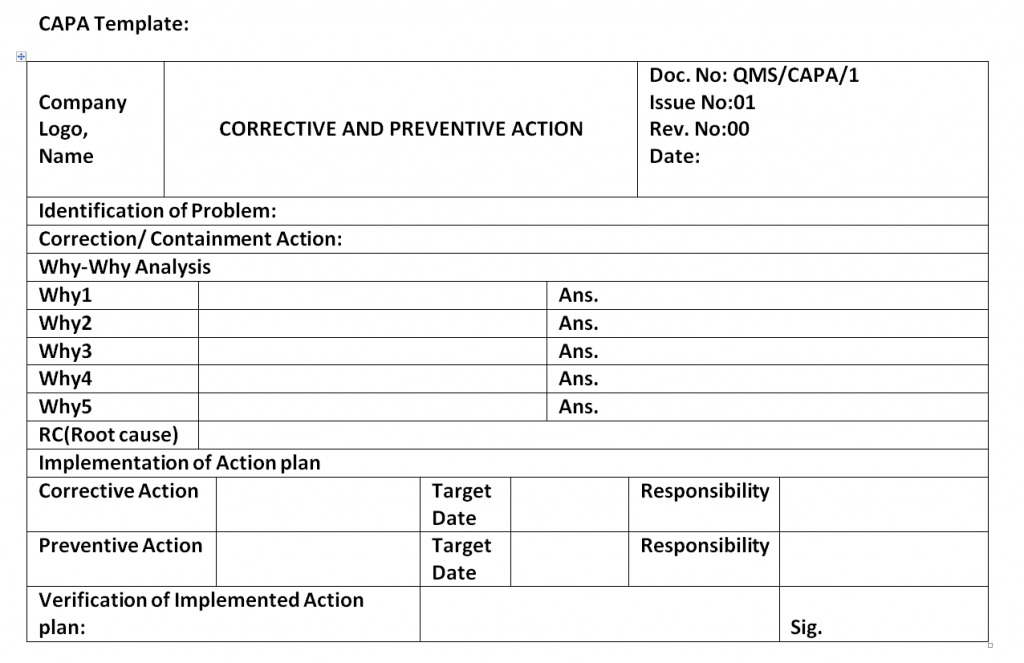
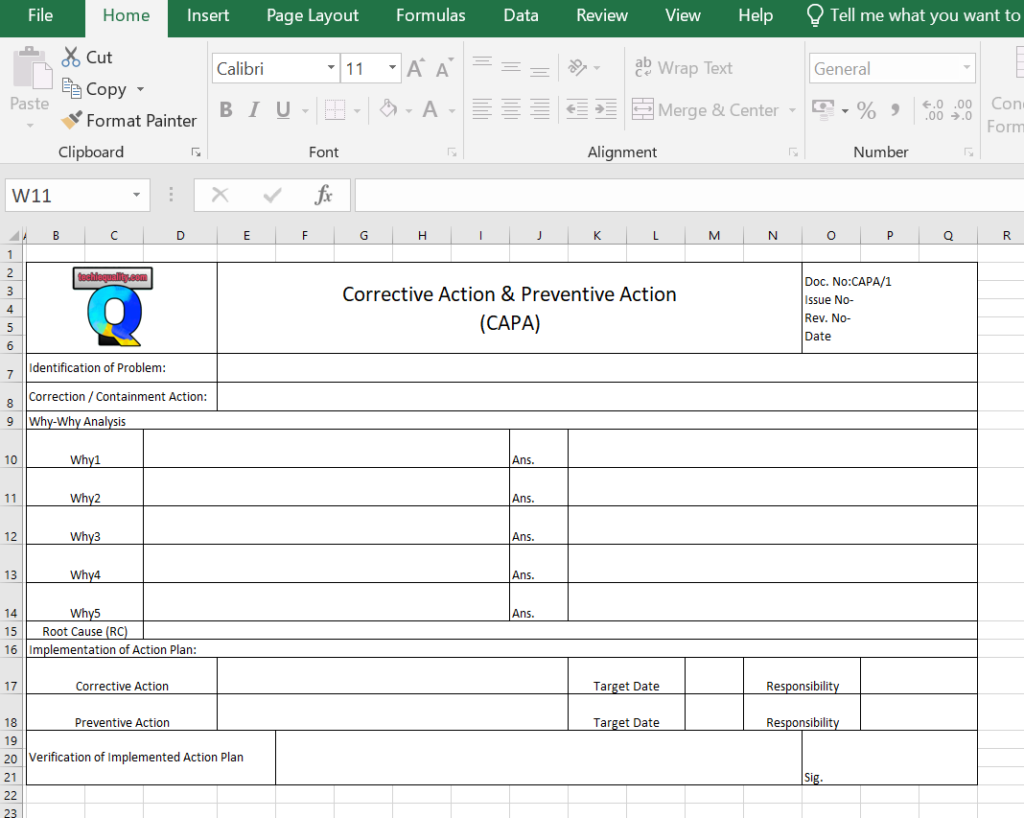
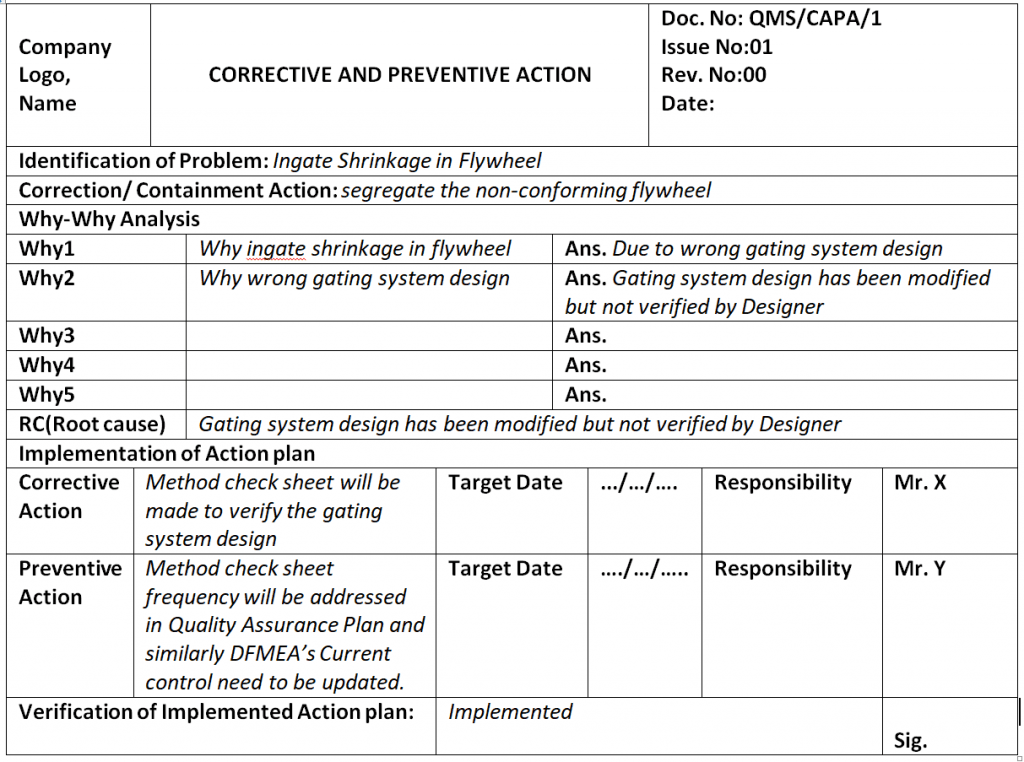
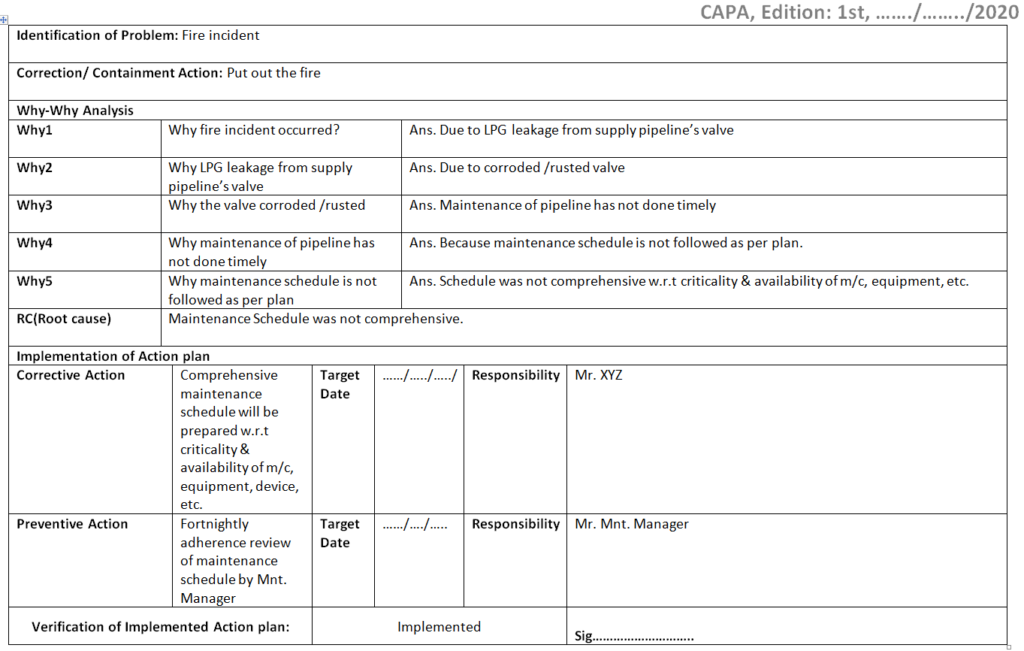
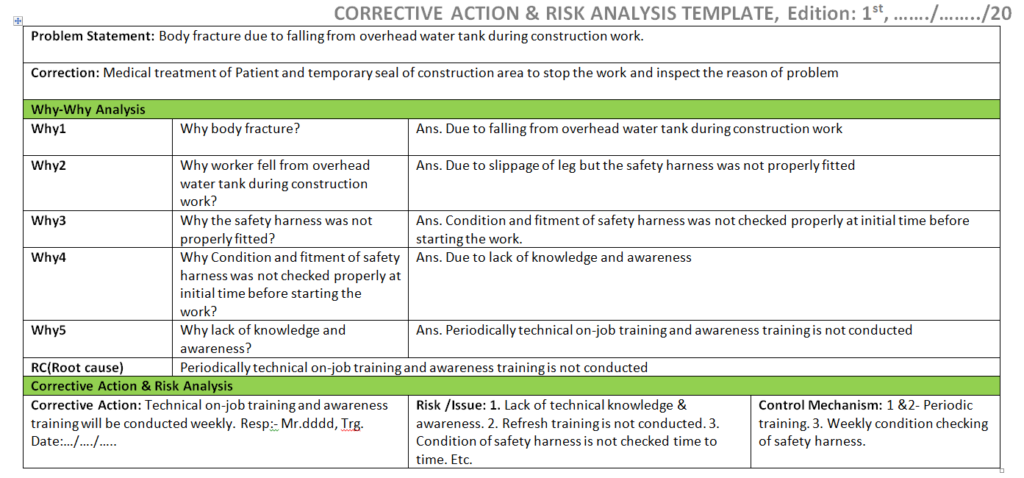
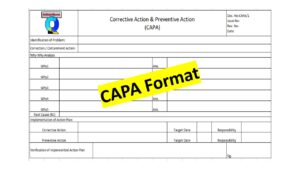
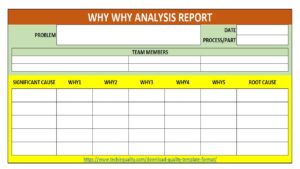
We have mentioned below two important templates or formats for both why why analysis and action plan formation in CAPA form. Let us learn the why why analysis first, as you can see in the first image (5 whys template) which is a very simple format where you have to write some basic information about the problem then you have to start asking “why” multiple times until find out the root cause. Once you identified the root cause then you should formulate a CAPA in CAPA format [see the second image in below].
Ask the first “why” to the problem and record the potential cause in “due to” or “Ans.” Row in the above format.
Again ask “why” to the first potential cause and write down the “due to”.
Repeat the process by asking “why” for each “due to” until you find the root cause.
Once you find out the root cause then, develop actionable solutions in CAPA format.
Manufacturing Example of Why Why Analysis:
Problem: Box sealing production was less than the target value.
Why1: Why did the box sealing production less?
Due to: the sealing machine was shut down.
Why2: why the sealing machine was shut down?
Due to: Malfunction of heater.
Why3: why the heater was not functioning?
Due to: Preventive maintenance of heater was not performed regularly
Why4: Why Preventive maintenance of the heater was not performed regularly
Due to: Lack of awareness.
Root Cause: Lack of awareness.
We have filled up why why analysis template or format of the above example, which is given below for your better understanding.
Now the next process is the CAPA formation, we have already mentioned the CAPA format template in above, and same we are going to use it for action plan formation based on the above example, so let’s get started; if you would like to download the above template then click on the download link given in above.
CAPAFormation:
Problem: Box sealing production was less than the target value.
Root Cause: Lack of awareness.
Correction/ Containment Action: 1) Immediately inform to the maintenance person to attend the B/D maintenance. 2) Informed to the QA inspector for retroactive quality checking of the box.
Corrective Action: Awareness training will be imparted on PM (Preventive maintenance)
Preventive Action: Monthly PM status monitoring /Automatic PM SMS alert by SAP module
Go through the below filled-up format of CAPA format to understand the practical concept of Action plan formation.
Benefits of 5 Why Analysis:
There are several benefits of 5 whys analysis but some important are listed below
Shanti Gopal Pradhan is an experienced professional in Quality Management Systems, QA, Operations, Business Excellence, and Process Improvement. He has strong expertise in international standards including IATF 16949, ISO 9001, ISO 14001, ISO 45001, and ISO 17025, along with methodologies such as TQM, TPM, and Six Sigma.
He holds a degree in Mechanical Engineering along with an MBA, combining strong technical acumen with strategic business insight, he is a Certified Internal Auditor, Lead Auditor, and Six Sigma Black Belt, with a proven track record in driving quality transformation and operational excellence.
AI in Manufacturing Industry | What to upskilled w.r.t AI
Hello readers! Today we will be discussing on AI in Manufacturing Industry. In the future artificial intelligence will be taken vital roles in the manufacturing industry, not only the manufacturing industry any other industry as well. So, it’s most important to upskill ourself with respect to time and the situation of the market. AI will also be taking a very important place in industry revolutions like industry revolution 4.0, 5.0 (Industry 4.0). Hence it is very important to know about the penetration of AI in many domains and functions in the manufacturing industry including advantages, disadvantages, applications, and what we need to upgrade our self w.r.t AI perspective.
Advantages of AI in Manufacturing Industries:
Below are some advantages but not limited to;
Efficiency and effectiveness will be increased
High production and productivity.
Smart factory
Cost reduction.
High business turnover
Less human touch
Best data analysis and decision-making through ML and AI.
Repeated jobs can be done by robots
Smart and digital SRM, SCM, and inventory management.
Advanced and statically QC and QA activities and many more points
The coin has two sides, similarly, everything has advantages and disadvantages inline so here also we will discuss about some disadvantages point but these are not limited to;
Disadvantages of AI in manufacturing industry:
The high initial cost of implementation
Data privacy and security issues
Fully technology dependency
Job losses for the workforce
Production loss if there is a major malfunctioning of technology
As many people know AI is taking penetrating in all the processes of activities in many industries and people are worried about their jobs and activities but you can apply the AI in your work domain to improve productivity and efficiency. You can adopt the and upskill yourself in line with the application or full domain in AI.
We are going to know a little more details about the what and where AI may be taken as a vital point in application in the manufacturing industry in the future.
Some AI application areas in manufacturing industries are like;
Digital operations like SCM, SRM, Logistics, and Inventory management are controlled fully digitally
AI-based Robots
Factory operation through IOT.
IT operation
Design
Smart warehouse management
Process automation
Visual inspection and quality control.
Cyber security
Blockchain, etc.
Automated Tasks
Facial Recognition
Cloud computing
Chatbots, etc.
In one line we can say that AI and Industry 4.0 can change the entire scenario of the factory and its manufacturing operation methods. The repeated job can easily be done by AI-based robots, QA and QC activities will be done by itself machines through AI-based and by ML applications. Accuracy and visual inspection done by the workforce can be improved and advanced. IOT will take the smart area in the factory for connectivity and other factors. But as an employee like us, those who are working in AI-affected areas can easily be replaced but we can take the appropriate action before it affects to our work domain.
What should you do if you think your current job may be replaced by AI in the future?
I personally think that If I will be there in the same situation then, first of all, I need to understand the AI penetration in my work domain. I will look into the application of AI tools and if required then need to upskill myself fully in the AI-based domain. it may be difficult to change my domain into AI-based but for a better future and survival purpose, I have to adopt it.
Shanti Gopal Pradhan is an experienced professional in Quality Management Systems, QA, Operations, Business Excellence, and Process Improvement. He has strong expertise in international standards including IATF 16949, ISO 9001, ISO 14001, ISO 45001, and ISO 17025, along with methodologies such as TQM, TPM, and Six Sigma.
He holds a degree in Mechanical Engineering along with an MBA, combining strong technical acumen with strategic business insight, he is a Certified Internal Auditor, Lead Auditor, and Six Sigma Black Belt, with a proven track record in driving quality transformation and operational excellence.
CAPA Example | Manufacturing examples | CAPA Meaning
Hi Readers! Here, we are going to discuss on the most popular topic of the manufacturing industry is namely termed as CAPA Example. Firstly, we will be knowing details on CAPA meaning. The full form of CAPA is Corrective action and Preventive action. Where problems, issues, and any type of non-confirmative presence, there CAPA is required. In manufacturing units CAPA is most important and commonly used for problem solving and process improvement. Now we are going to discuss several manufacturing practical CAPA examples in different operations like quality, production, maintenance, purchasing, and HR functions.
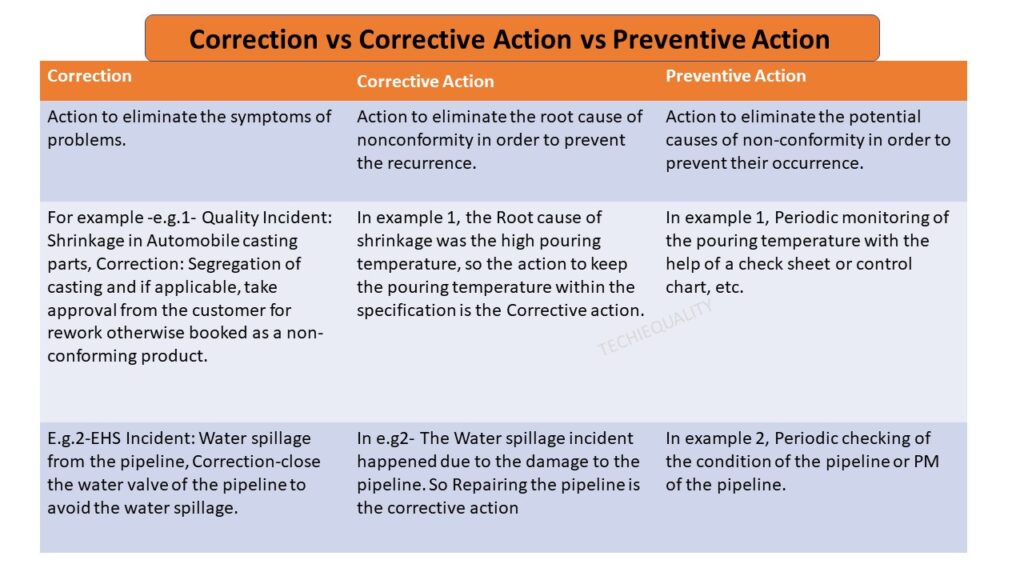
The CAPA means Corrective Action and Preventive Action. The action to eliminate the symptoms of the problem is called a correction. Action to eliminate the root cause of the problem is called corrective action. The action to eliminate the potential cause of the problem is called preventive action.
CAPA Meaning
CAPA Example:
Practice makes you perfect, in line with this sentence, here we are going to practice some CAPA Example in Manufacturing Industry covering with different and different operations like quality activities, SRM, lab activities, purchase activities, etc. The main important part of the CAPA report is the root cause analysis, for doing the RCA the most commonly used tools are the why-why analysis or 5-whys analysis & the 2nd important part is systematic corrective and preventive action. CAPA report is commonly required where there are any issues, problems, risks, defects, warranty, customer complaints, & non-conformities.
Following are the steps that you can follow to write the CAPA report in simple ways.
Identify the problem, issue or non-conformity.
Define and describe the problem for a better understanding of the background of the problem.
RCA -root cause analysis (common tools -why -why analysis or 5 whys)
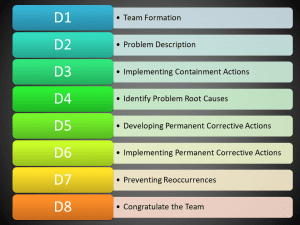
Action plan with a target date and responsibility (Correction, corrective action,, and preventive action, a common format is CAPA format or template, 8D report, etc.)
Implement an action plan.
Effectiveness monitoring.
Document standardisation
If applicable then, horizontal deployment.
Now I am going to discuss here some popular Manufacturing examples in different operations like a laboratory, quality, customer complaints, process issues or problems, etc.
CAPA Example in Laboratory:
Let’s consider that a wrong TC (test certificate) has been generated at the laboratory and the same TC was communicated to the customer. For the same case, you are supposed to submit the CAPA report.
Why3: An Intermediate checking system was not available.
RC (Root cause): An Intermediate checking system was not available.
Corrective Action Plan:
Corrective Action: Intermediate checking system will be developed, Target Date: dd/mm/yy, Responsibility: Mr. SGP.
Preventive Action Plan: [1] Preventive Action: Refresh Training, [2] Two layers checking of TC before releasing to customer. Target Date: dd/mm/yy, Responsibility: Mr. SGP.
Verification of Implemented Action Plan: Checked that SOP has been made and implemented in the lab, Verified by: Mr. P.
Effectiveness Monitoring Status: Monitoring the monthly TC Status of OK or not OK, Remarks: No such error found in the last 3 months report.
Document updation / Standardization:
SOP: X
Check sheet:
Control Plan: X
FMEA: X
R&P record: X
Others:
Remarks: SOP has been made, Control plan, PFMEA, R&P has been updated w.r.t action plan.
If you received any customer complaint and your customer is asking to submit the action plan and they have not mentioned any specified format then you can use the CAPA format or 8D report template for submitting the action plan. But many customers use the digital platform as SRM- supply relationship management portal to upload the action plan in their specified template.
You can follow the above-mentioned steps and can do refer to the above example for formulating the CAPA report in any type of customer complaint. Nevertheless, we are taking a simple customer complaint example for CAPA report formation.
Let’s consider a company manufacturing the automobile part and selling it to OEM customers. Unfortunately, a customer complaint was received due to a machining issue of a part PpP.
Process: Moulding operation
Item: PpP, Date: dd/mm/yy.
Identification of problem: Machining issue of a part PpP.
Correction/ Containment Action: Checked the other produced parts, inspected the dimensions and segregated the NG parts, Target Date: dd/mm/yy, Responsibility: Mr. SGP.
Why2: The machining dimension was less as per the drawing.
Why 3: The core setting at mould operation was not adequate.
Why3: New operator
RC (Root cause): Lack of knowledge of new operators
Corrective Action Plan:
Corrective Action: On-job training will be imparted to new operators, Target Date: dd/mm/yy, Responsibility: Mr. SGP.
Preventive Action Plan: [1] Periodic training evaluation [2] Training effectiveness monitoring [3] Training feedback. Target Date: dd/mm/yy, Responsibility: Mr. SGP.
Verification of Implemented Action Plan: training has been imparted to the operator and the skill matrix is being monitored for performance measurement of operators, verified by: Mr. P.
Effectiveness Monitoring Status: Monitoring the monthly operator’s skill matrix for performance measurement, Remarks: No such error found in the last 3 months.
Document updation / Standardization:
Training SOP:
Check sheet:
Control Plan:
FMEA:
R&P record:
Skill matrix.
4M Change.
Remarks: The above documents are updated but these are not limited to.
I hope the concept is clearly understood and now you can easily prepare the CAPA report.
Shanti Gopal Pradhan is an experienced professional in Quality Management Systems, QA, Operations, Business Excellence, and Process Improvement. He has strong expertise in international standards including IATF 16949, ISO 9001, ISO 14001, ISO 45001, and ISO 17025, along with methodologies such as TQM, TPM, and Six Sigma.
He holds a degree in Mechanical Engineering along with an MBA, combining strong technical acumen with strategic business insight, he is a Certified Internal Auditor, Lead Auditor, and Six Sigma Black Belt, with a proven track record in driving quality transformation and operational excellence.