why why analysis methodology | 5-why analysis step by step guide

why why analysis methodology

why why analysis methodology | 5-why analysis step by step guide:

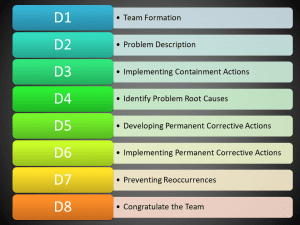
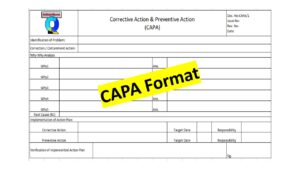
Hello readers! Today we will discuss “why why analysis methodology”. How effectively you can do the 5-why analysis. This analysis is the common tool used in the industry to find out the root cause of the problem but most of the people make mistakes during why-why analysis. So we will talk about the step-by-step methodology of why-why analysis. The why-why analysis is one of the inputs for executing the 8D report, CAPA (Corrective action and preventive action), and RCA (Root Cause analysis). Click on the below-given link to download the 8D and CAPA format.

Download 8D Format , CAPA Format & 5W1H Format.

You may like to read similar topics;    

 Root Cause Analysis | 8 Steps of RCA

8D Report | Free Download of 8D Template | Format

Free Template / Format (QA/ QC)

Decision of process capability analysis |Download Format

How to measure process capability (Cp & Cpk)? Download the Excel Template.

How to measure process performance (Pp & Ppk)?

why why analysis methodology:

Step-1: Identify the Problem.

Step-2: Understand the Problem.

Step-3: CFT team formation.

Step-4: Identify the Potential cause

Step-5: Why-why analysis.

Understanding the why-why analysis methodology by example:

Let Part number 123 find ingate shrinkage after the shot-blasting operation. So this case process-QA engineer started the why-why analysis by using the above methodology.

Identify the Problem:

At the shot-blasting operation, a process-QA engineer identified that two number casting got rejected due to ingate shrinkage.

Understand the Problem:

Understanding the problem means technically knowing what exactly is it? How is it occurring? (potential cause). In the above example, we are supposed to have knowledge on “what is shrinkage?

CFT team formation:

If you think that the problem may be due to issues with the melting parameter, moulding parameter, or design. Then you have to create a CFT team considering with the above departments.

Identify the Potential cause:

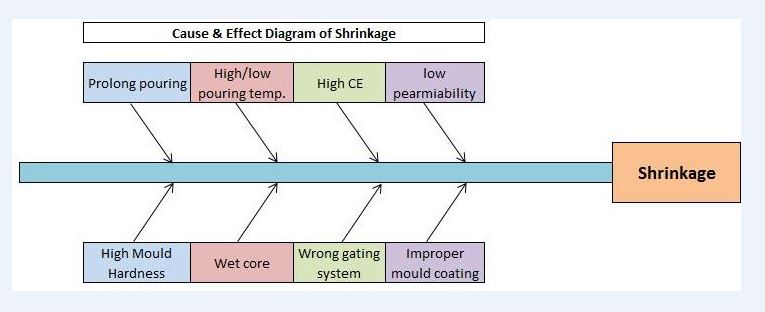
Now initially individual members will identify the potential cause. And then combine all members of the CFT team will identify the potential cause. Let’s see, in case of a shrinkage problem what would be the final list of potential cause.

Why-why analysis:

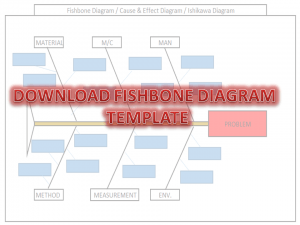
In this section, we are supposed to identify the significant cause of the potential cause. We have already identified the potential cause with the help of the CFT team and represented it through cause and effect diagram.
why why analysis methodology

To identify the significant cause from the above C&E Diagram, we need to use the methodology like brainstorming method, validation method, and hypothesis testing method. With the help of the brainstorming and validation method, we found that the “wrong gating system” is the significant cause. So now we will do the Why-why analysis by CFT team members.

Problem: Wrong gating system.

why why analysis methodology

Why wrong gating system?

Ans.: gating system was modified

5-why

Why gating system was modified?

Ans.: Gating system was modified w.r.t customer complaint but gating system was not validated before mass production.

why why analysis

Why gating system was not validated?

Ans.: There was no time to validate the part because production planning was scheduled without prior consideration of tool validation

root cause

RC: Improper Production planning and Schedule.

Once you completed the analysis you can document these in a 5-whys analysis template.

Funnel Approach of Why-Why Analysis:

Once you identify the potential cause then we could also use the funnel approach to identify the Root cause by 5-why analysis.
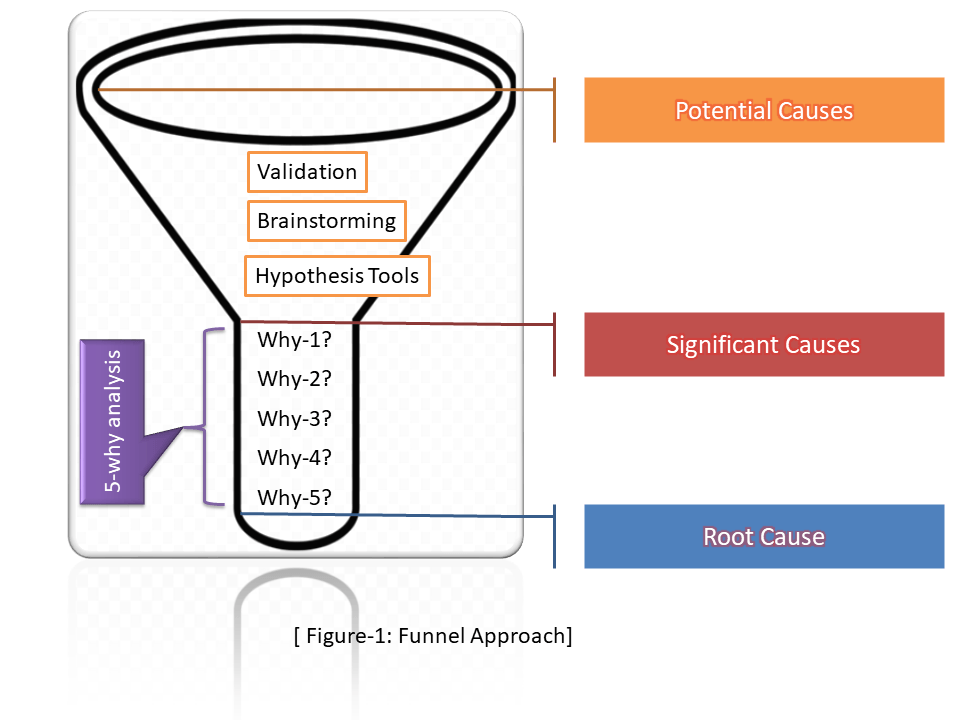
funnel approach why analysis

In the above funnel diagram, we have mentioned three basic stages and applied some tools/ methods/ testing like validation, brainstorming, hypothesis testing, etc. to identify the significant cause in stage-2. and then applied the 5-why analysis to detect the Root cause in stage-3. In this way, we can use this approach to identify the RC.

Why-Why Analysis Methodology to Identify the Multiple Root Cause:

In the above section, we learned the two different methodologies for why-why analysis. and in both case, we found a single root cause. we know that theoretically there will be a single root cause of a problem but technically there will be a minimum one root cause of a problem. So here we have mentioned in the below figure for the methodology to identify the multiple root causes.
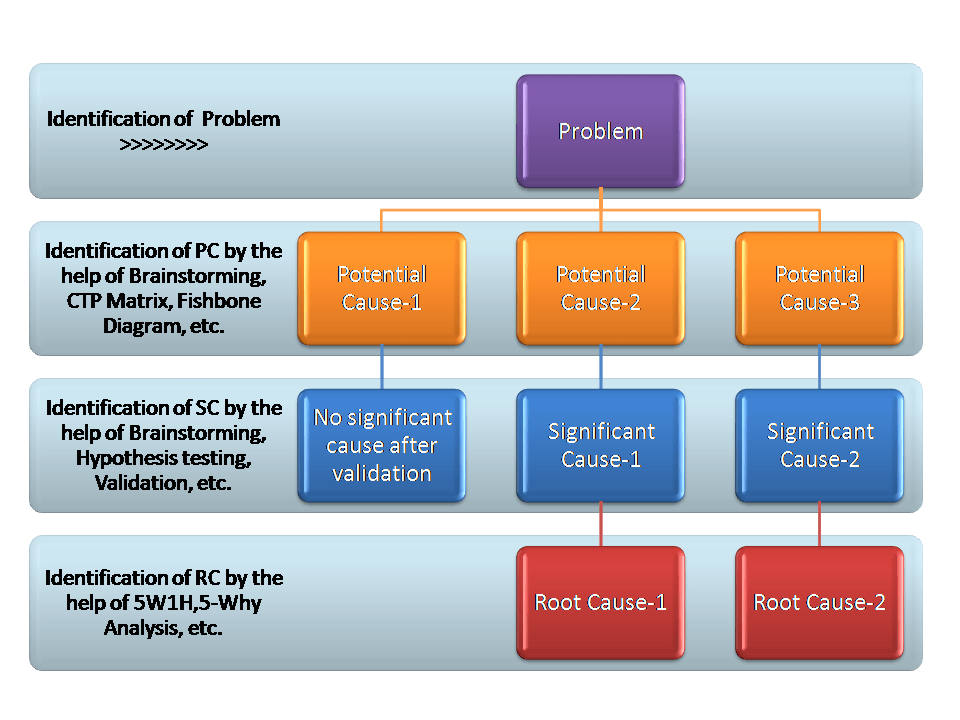
Why-Why Analysis for Multiple Root Cause

Step-1: Identification and Understanding of the Problem

Step-2: CFT Team Formation and list up the Potential Causes by using tools like Brainstorming, CTP Matrix, Fishbone Diagram, etc.

Step-3: Significant Cause identification with the help of Brainstorming, Hypothesis Testing, Validation, etc.

Step-4: Identification of Root Cause by why-why/ 5W1H analysis of each individual Significant Cause.

Similar Post:

8D Report Example | Download Case Study Report:

8D Report | Free Download of 8D Template | Format

What is SPC | SPC Tools.

7QC Tools for Problem Solving | What are 7 QC Tools

How to Plot Pareto Chart in Excel ( with example)

How to plot Histogram in Excel (Step by step guide with example)

More on TECHIEQUALITY

Thank you for reading…Keep visiting Techiequality.Com

Popular Post:

Why Why Analysis | Template | 5 Why Analysis Method with Manufacturing Examples

Why Why Analysis

Why Why Analysis | Excel Template | 5 Why Analysis Method with Manufacturing Examples

Hello readers! Today we are going to discuss and learn a popular topic, which is very useful and needful in the manufacturing industry to identify the root cause and to improve the operations. It’s nothing is called Why Why Analysis. In this topic, we are trying to cover the advanced concept and practical manufacturing examples for better understanding and easy implementation in operations. You can also download the Why Why Analysis excel template from the below given link.

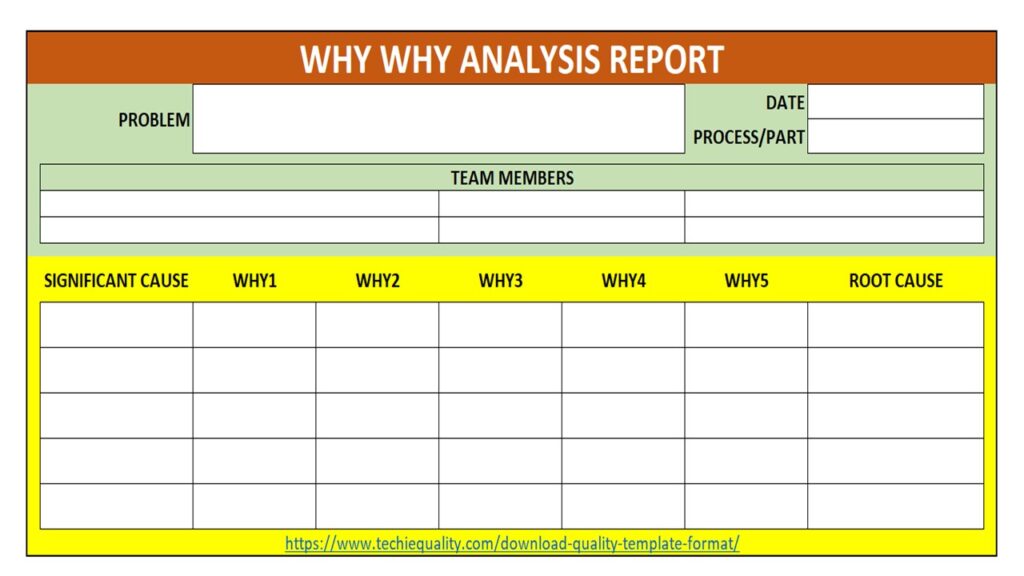
Sample Why Why Analysis excel Template-DOWNLOAD.

5 Whys Excel Template

Why Why Analysis Format-Download

5 Whys Excel Template

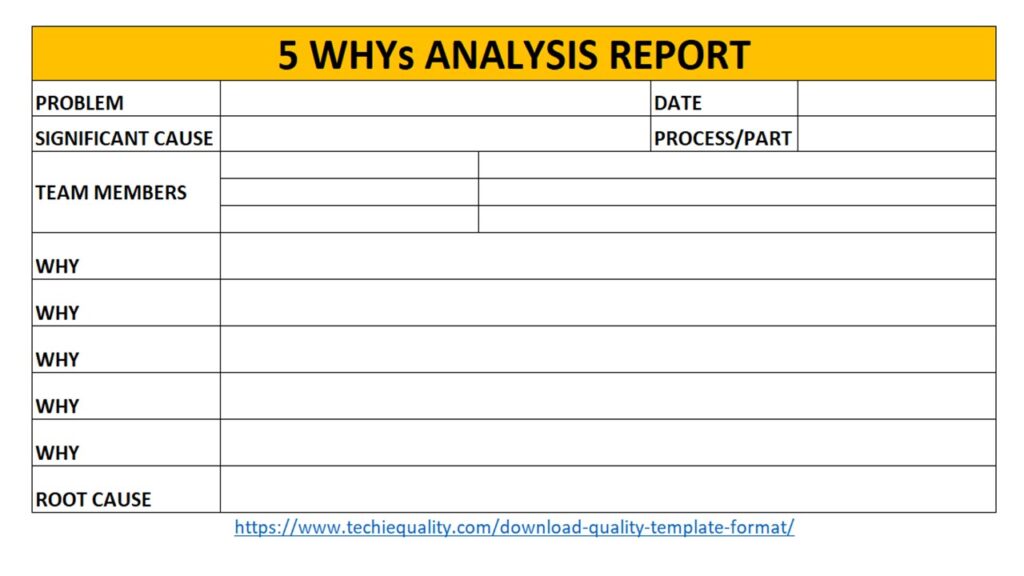
5 Why Analysis Format-Download

5 Whys Excel Template

Why Why Analysis Concept:

A Why Why Analysis is a very useful problem-solving technique and that is also popularly known as the 5-Whys in process, service and manufacturing industries. The purpose of why why analysis is to identify the root cause of a particular problem, issue, defects, wastages, customer complaint, non-conformity, etc. by repeatedly asking the question “why”. The 5 Whys is a simple but effective technique, that is used in numerous areas, particularly in process improvement, Cost Reduction projects, and lean projects. The main aim is to get to the root cause of a problem, issues, defects, non-conformities, etc. so that we can take action to eliminate the root cause of the problem.

How to perform a Why Why Analysis or 5-Whys (Step by Step guide):

As we know that the concept itself indicating the 5 whys means we have to ask multiple times “why” to identify the root cause of a problem or issue. Below is the step-by-step guide on how to perform a why why analysis (5W / 5-whys analysis);

Team Creation:

You have to create a team in such a way that all required possible functions members should be present in the team, for example CFT team.

Problem Identification:

In this process, you have to identify the problem by using tools, techniques, and principles. we use many techniques and statistical tools in manufacturing industries to identify the problem, issue, potential causes, risk, defects, etc. The most popular and commonly used techniques, tools & methods in industries for the identification of problems, issues, defects, risk,s and non-conformity & gaps are inspection, SPC, QMS auditing, product testing, Process & product auditing, maintenance checking, layer auditing, etc. rather than these practices we also use many other methods to identify the risk, issue, problems through Risk and Issue identification, Data analysis, warranty analysis, customer complaint, field failure, etc.

Problem Statement:

Before defining the problem statement, if you have multiple problems then select the problem based on the criticality considering with severity, occurrence, and detection. Then next define the problem statement. The main purpose of the problem statement is to understand the depth and concept of the problem and, if possible represent it in a pictorial manner so that a complete idea will be developed on the problem statement. The importance of problem statement is very crucial in the time of brainstorming of problems for root cause identification. If the problem statement will not be cleared to all team members then, doing why why analysis will not be effective.

 Brainstorming of Why-Why Analysis (5 Whys):

Brainstorming on why why analysis is a creative problem-solving technique that is generally used to identify the root cause of a problem by multiple times asking of “why” and to generate a solution to the root cause. It’s a team activity in which all CFT members will ask why on problem until to get the root cause of the problem.

The effective and general rules for brainstorming of why why analysis are given below but these are not limited to.
  • Assemble the team members from different functions related to problematic areas.
  • Think about a comfortable and conducive environment.
  • Encourages the team members for open and free thinking about the brainstorming of problems.
  • Give always more focus on root cause identification and solution generation.
  • The mentor of the CFT team is supposed to set a specific time limit for the brainstorming section.
  • Record the Root cause and solution ideas.
  • Once you record the Root cause and ideas, if there is more than one solution idea then, prioritize the idea and develop the action plan (CAPA).
  • Validate the action plan by sample trial and if accepted then do the mass trial and after getting the effective result you can implement it as a full phase. In some cases, you can validate by ISIR report also.
  • Documentation: document the action plan, do the updation & standardize in relevant records or documents, for example, control plan, check sheet, FMEA, SOP, etc.
  • Effective monitoring and Measurement.
  • Horizontal deployment.

Steps of Why-Why analysis:

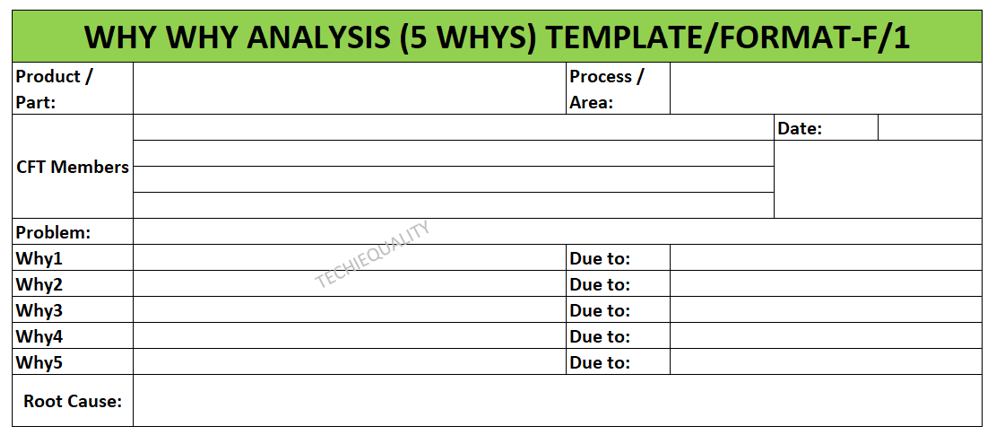
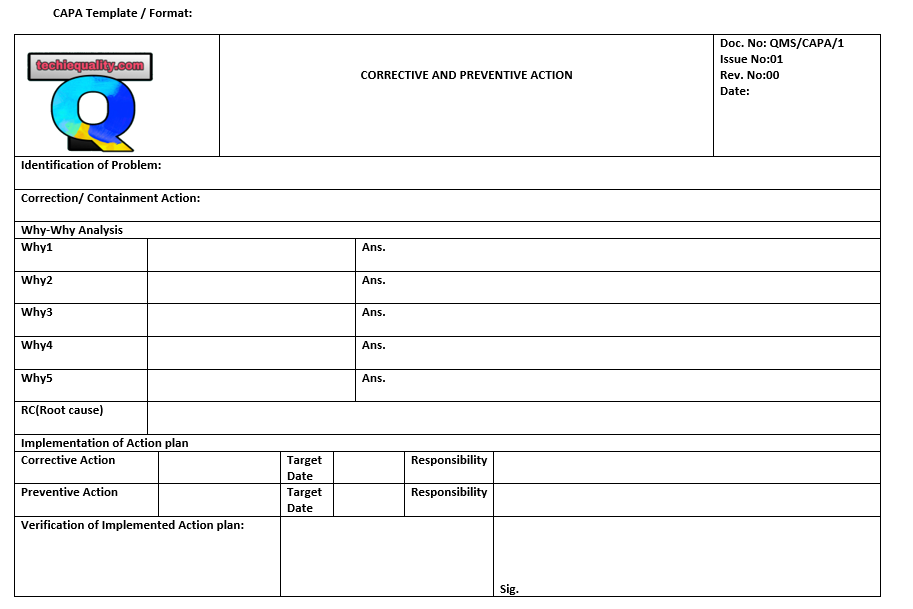
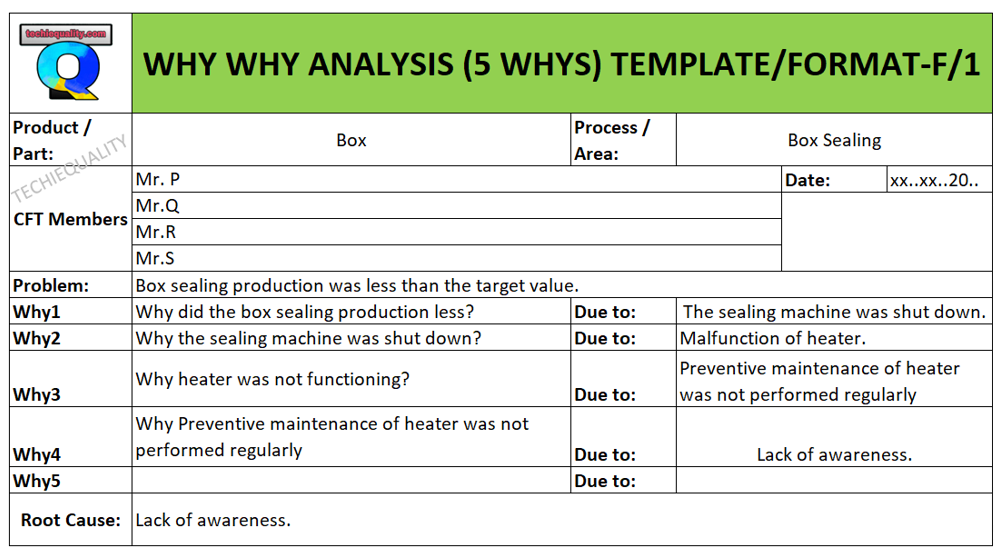
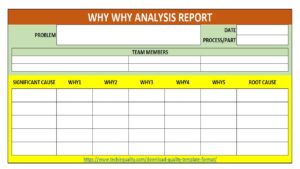
We have mentioned below two important templates or formats for both why why analysis and action plan formation in CAPA form. Let us learn the why why analysis first, as you can see in the first image (5 whys template) which is a very simple format where you have to write some basic information about the problem then you have to start asking “why” multiple times until find out the root cause. Once you identified the root cause then you should formulate a CAPA in CAPA format [see the second image in below].

Why Why Analysis
Why Why Analysis

[ DOWNLOAD – CAPA Format]

Steps of 5 whys analysis:

  • Ask the first “why” to the problem and record the potential cause in “due to” or “Ans.” Row in the above format.
  • Again ask “why” to the first potential cause and write down the “due to”.
  • Repeat the process by asking “why” for each “due to” until you find the root cause.

Once you find out the root cause then, develop actionable solutions in CAPA format.

capa

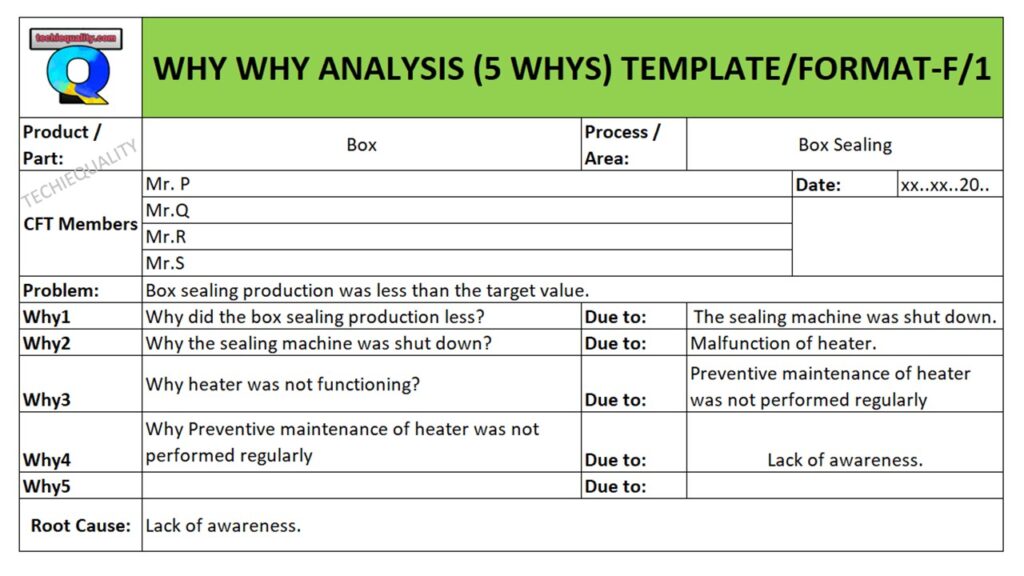
Manufacturing Example of Why Why Analysis:

Problem: Box sealing production was less than the target value.

Why1: Why did the box sealing production less?

Due to: the sealing machine was shut down.

Why2: why the sealing machine was shut down?

Due to: Malfunction of heater.

Why3: why the heater was not functioning?

Due to: Preventive maintenance of heater was not performed regularly

Why4: Why Preventive maintenance of the heater was not performed regularly

Due to: Lack of awareness.

Root Cause: Lack of awareness.

We have filled up why why analysis template or format of the above example, which is given below for your better understanding.

Why Why Analysis

Now the next process is the CAPA formation, we have already mentioned the CAPA format template in above, and same we are going to use it for action plan formation based on the above example, so let’s get started; if you would like to download the above template then click on the download link given in above.

CAPA Formation:

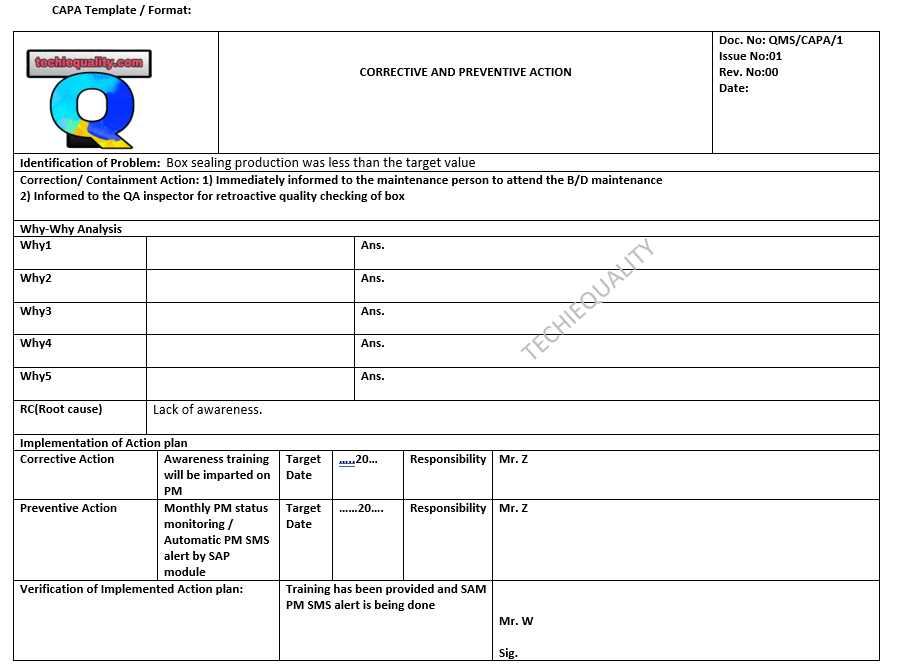
Problem: Box sealing production was less than the target value.

Root Cause: Lack of awareness.

Correction/ Containment Action: 1) Immediately inform to the maintenance person to attend the B/D maintenance. 2) Informed to the QA inspector for retroactive quality checking of the box.

Corrective Action: Awareness training will be imparted on PM (Preventive maintenance)

Preventive Action: Monthly PM status monitoring /Automatic PM SMS alert by SAP module

Go through the below filled-up format of CAPA format to understand the practical concept of Action plan formation.

corrective and preventive record

Benefits of 5 Why Analysis:

There are several benefits of 5 whys analysis but some important are listed below

  • To understand the issues/problems/ defects, etc.
  • Identify the root cause of a problem.
  • Prevent recurrence.
  • Continuous Improvement
  • Enhancing the innovation
  • Helps in decision-making
  • Helps in risk management
  • Enhance customer satisfaction
  • Effective problem solving
  • Process efficiency, etc.

Useful Post:

Normal Distribution Probability Formula, Calculation & Manufacturing Examples

SDCA Cycle understanding with Manufacturing Example | PDCA vs SDCA

Six Sigma Project Charter Template

CAPA Example | Manufacturing examples | CAPA Meaning

More on TECHIEQUALITY