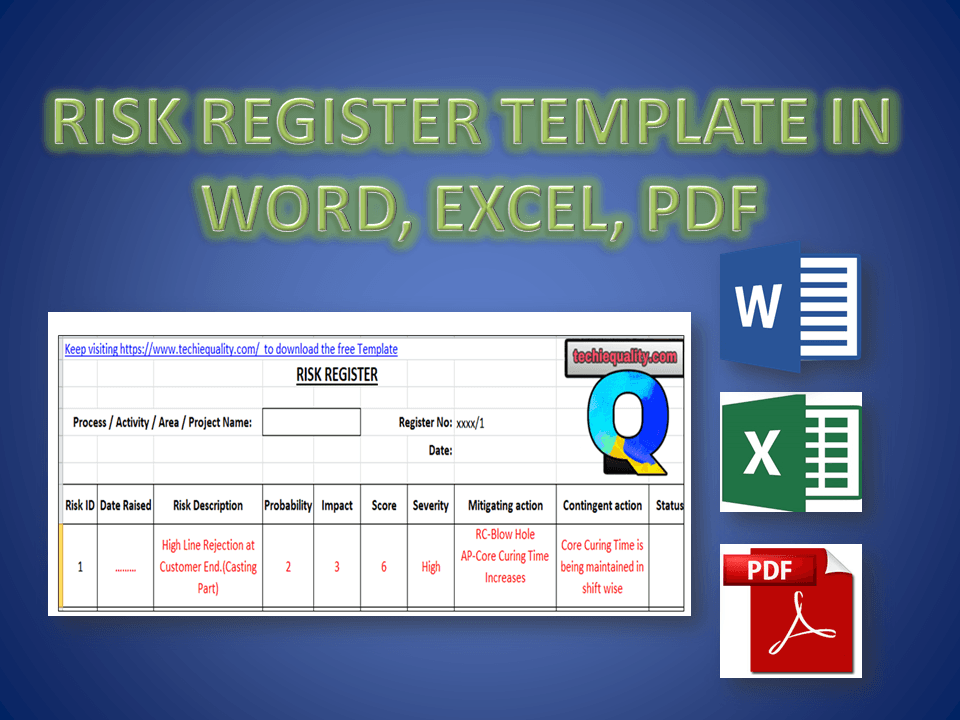
Hi Reader! Today we are going to discuss an important topic, which is called Risk-based thinking and Risk management. The organization uses different types of tools to identify the Risks but here, we will be discussing one of the popular tools, i.e. Risk Register. As we know most probably business standards like QMS, EMS, OH&SMS, etc. are now risk-based thinking approaches. So we will only concentrate on learning how to use the Risk register with Examples.
Step-1: Download the Above Template by simply clicking on the Download link.
Step-2: Read carefully the terminology.
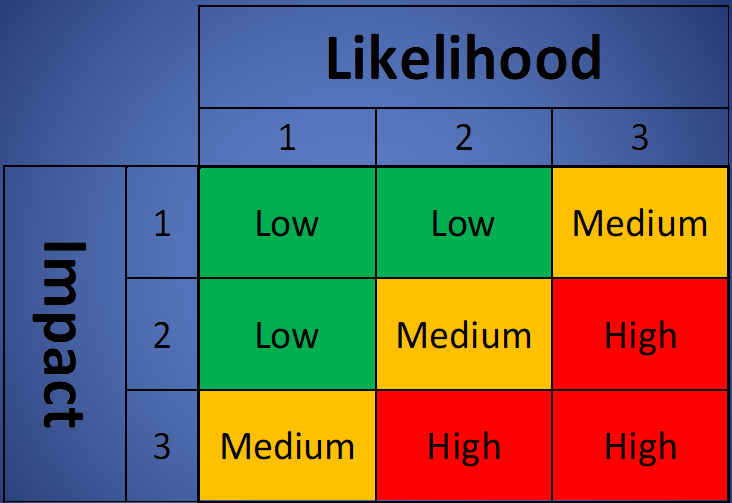
Step-3: The severity Table is given in the Excel Template in a Separate Sheet, So don’t forget to download the Excel Template.
Step-4: Read carefully the sample example written in red colour in Template.
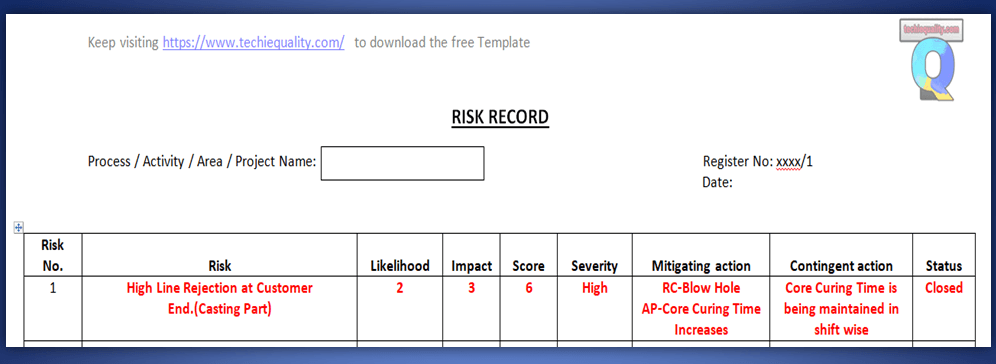
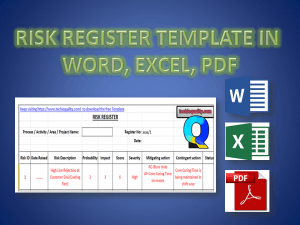
Example: Before I describe the Template, Please go through the below figure.
Risk Register Template
Terminology:
[1] Risk No.: Unique identification of each and every identified risk.
[2] Risk: Details about the Risk.
[3] Mitigating Action: Action to eliminate the Impact of Risk.
[4] Contingent Action: Action to eliminate the re-occurrence of Risk.
Here, in the above Figure, I have taken an Example of Customer complaints. So let’s get started with details about the above complaint.
High Line rejection at the Customer end was the Risk which has the score value 6 and severity is coming under the High Level. The criteria of probability and impact depend upon the organization’s decision. For a sample basis, I have taken the severity ranking according to the below data;
A Mitigation plan has taken w.r.t the Root Cause Analysis, so here Increasing the core curing time was thecorrective action and contingent action is thePreventive action. Which is “Core curing time is being maintained shift-wise”.
FAQ:
Q1: Where can we use this template?
A1: You can use this template in Project management, Risk Management, to identify the QMS, EMS OHSAS, and Business-related risks.
Q2: Who will decide the Criteria of Probability, Impact, and Severity?
A2: The organization itself will decide the criteria as to what it would be.
Our Author is an experienced professional in Quality Management Systems, Quality Assurance, Operations, and Business Excellence, with cross-industry expertise in Automotive, AMR, Robotics, Battery Manufacturing, Foundry, and Sheet Metal industries. He has strong expertise in international standards including IATF 16949, ISO 9001, ISO 14001, ISO 45001, and ISO 17025, along with methodologies such as TQM, TPM, and Six Sigma. He holds a degree in Mechanical Engineering along with an MBA, combining strong technical acumen with strategic business insight, he is a Certified Internal Auditor, Lead Auditor, and Six Sigma Black Belt, with a proven track record in driving quality transformation and operational excellence.
Through TECHIEQUALITY, he shares practical insights, quality tools, and industry best practices to help professionals improve processes and achieve operational excellence.
Control Chart Excel Template |How to Plot Control Chart in Excel | Download Template:
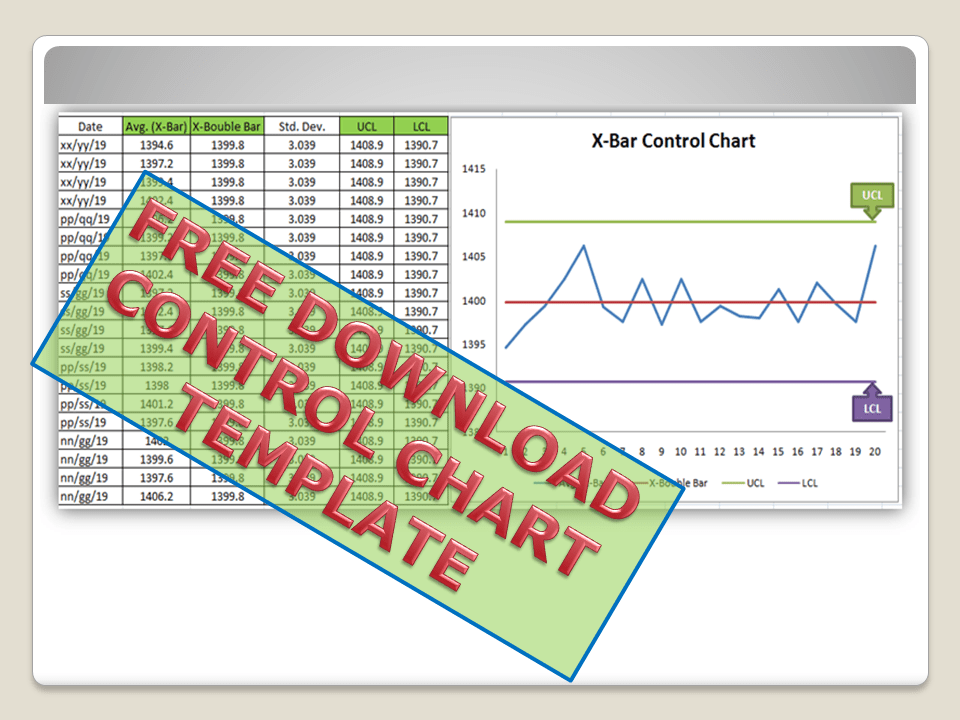
Hi! Reader, today we will guide you on how to plot a control chart in Excel with an example. To take more concentration on Process Improvement, the control chart always takes vital rules to identify the Special causes and common causes in Process Variation. Control Chart Excel Template is available here; just download it by clicking on the below link.
A Control Chart is a graphic representation of a characteristic of a process, showing plotted values of some statistic gathered from that characteristic, a centerline, and one or two control limits. It has two basic uses as an adjustment to determine if a process has been operating in statistical control and to aid in maintaining statistical control.
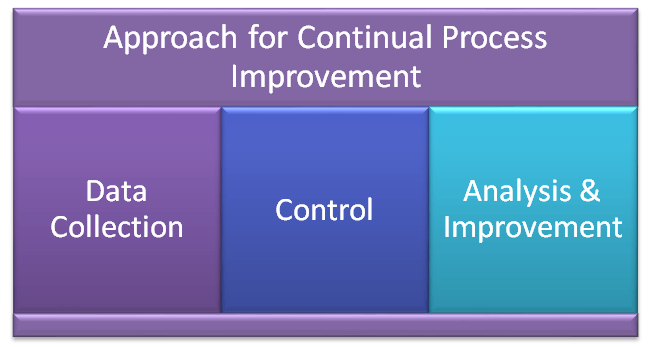
Control Chart Approach
for Continual Process Improvement:
Data Collection.
Control.
Analysis and Improvement.
Data Collection:-
To Collect Data and Plot the Control Chart.
Control:-
Calculate control limits from process data.
Identify Special Causes of Variation and Act upon them.
Analysis & Improvement:-
Quantify Common Cause Variation, and take action to reduce it.
How to Create Control Chart Excel Template| Step-by-Step Guides (X-Bar & Range Chart) with Example:
Step-1: Collect The Data day-wise/shift-wise.
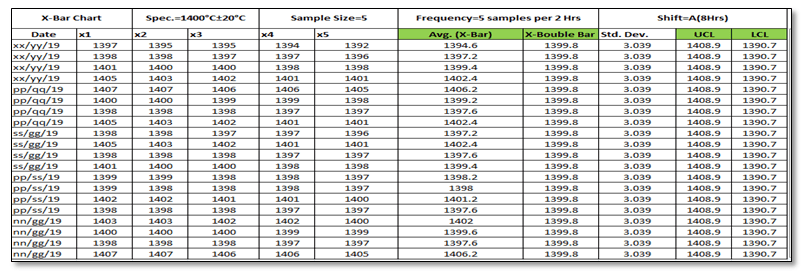
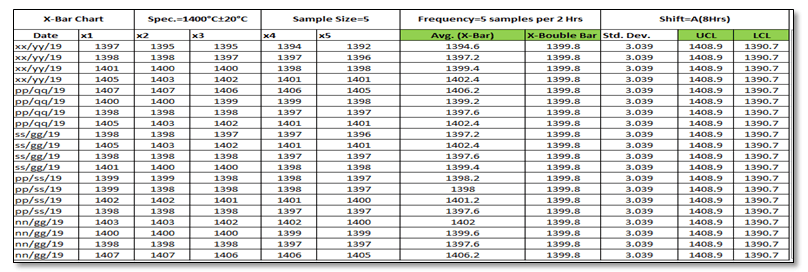
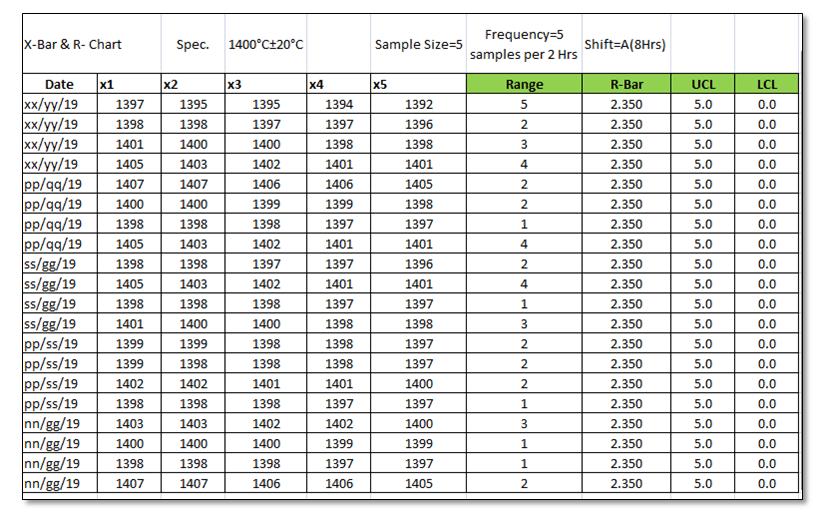
As you can see in the above figure, we have collected data with a sample size of 5 for A-Shift with frequency (5 samples per 2 hours). So we have only one shift data for 5 days. Total 100 number observations. You are supposed to collect the data as per the Control Plan or Quality Assurance Plan.
Step-2: Select
the Data types and applicable Control Chart.
So we have variable type data and the sample size is 5. Hence the applicable Chart is the Average and Range Chart (X-Bar & Range).
Step-3: According to data type and Sample size, presently we are going to plot the X-Bar & R-Chart. So individually we will plot both charts (X-Bar Chart & Range Chart). First, we will plot the X-bar chart and then the R-chart.
3.1 X-Bar Chart:
Before we start, just go through the green highlighted terms in the above figure as [1] Average
[2] X-Double Bar means an average of average. [3] Standard Deviation. [4] UCL. [5] LCL.
Calculation:
[1] Average:
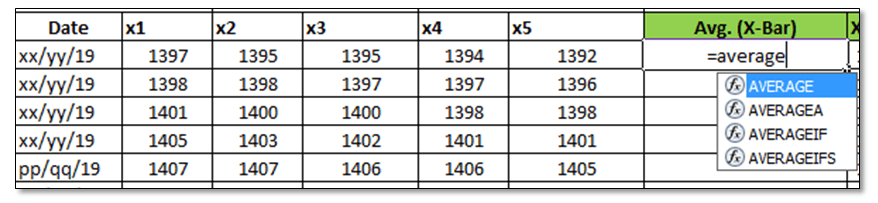
Make sure that your attention is now on the right side corner of the above figure. To calculate the average value of individual subgroup size. You have to type as (=average)and then double click on the average function and next select the sample value from x1 to x5.
[2] X-Double Bar: After calculating the Average value of all Subgroups (Individual Date wise), now we have to calculate the average of Average (Average of X-Bar).
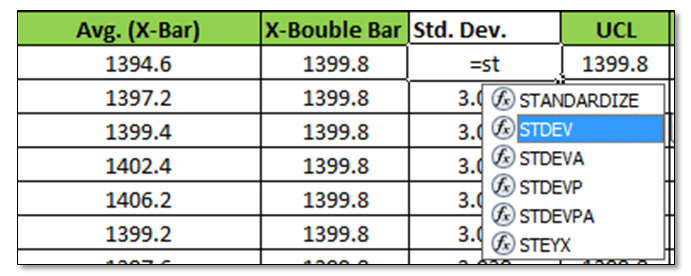
[3] Standard
Deviation: Standard Deviation of Average (X-Bar),
Type as (=Stdev) and select all X-Bar Data to Calculate the
Std. Dev. of Average.
[4] UCL:
UCL=X Double Bar +3*Sigma
UCL= X Double Bar +3*Standard Deviation
For the calculation of the UCL in Excel use the above formula.
[5]LCL:
LCL=X Double Bar -3*Sigma
LCL= X Double Bar -3*Standard Deviation
Use the above Formula in Excel.
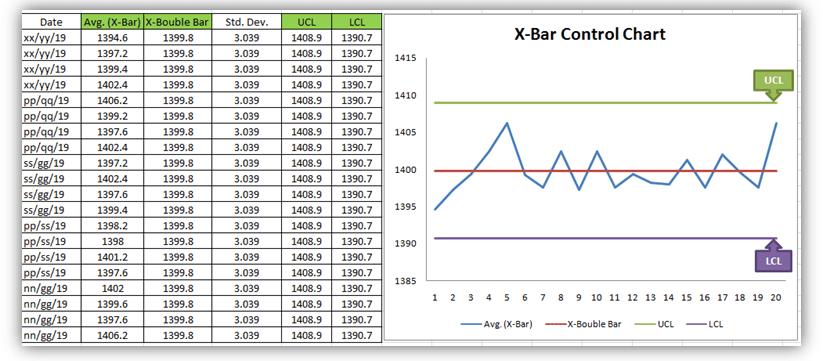
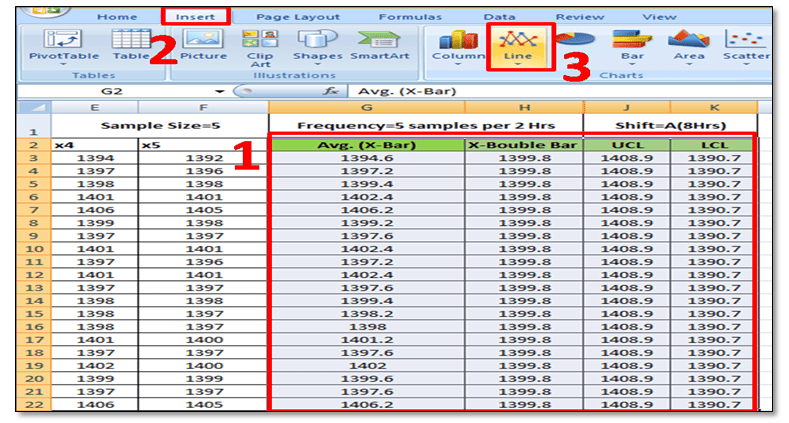
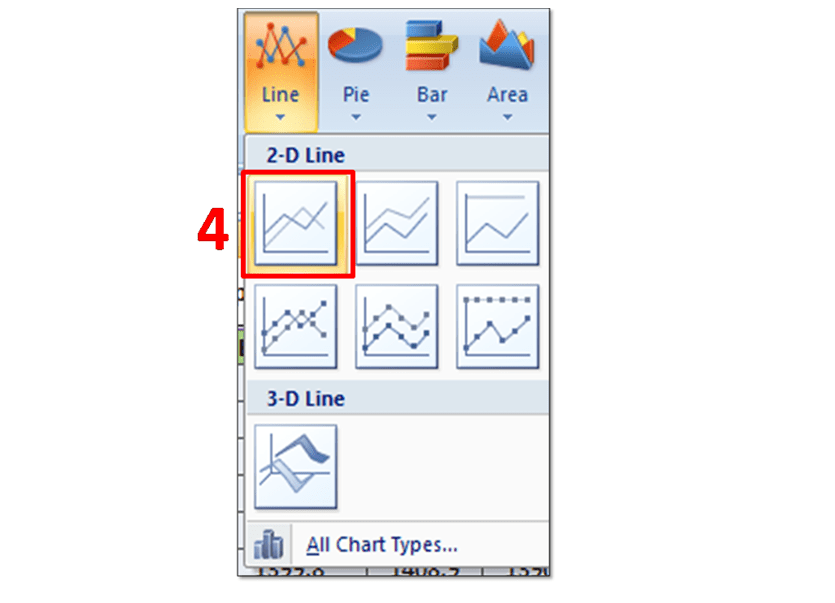
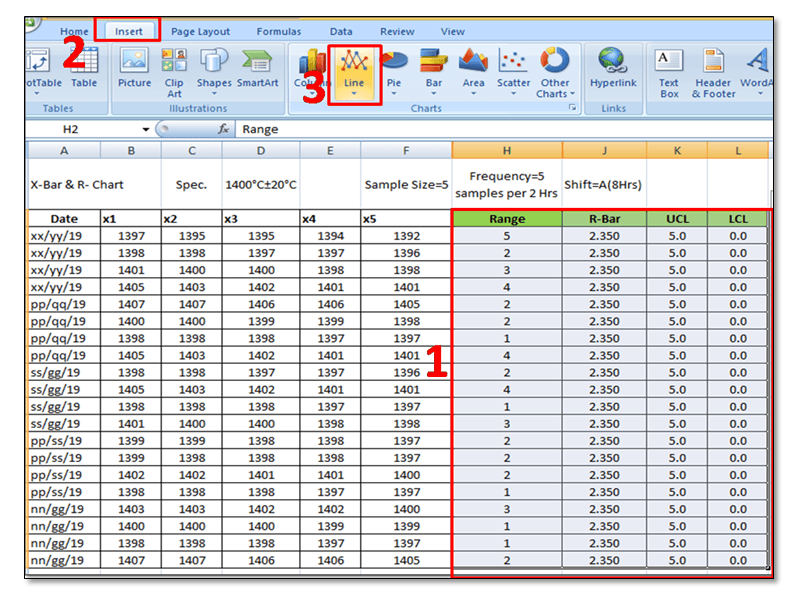
3.11 Plot X-Bar Chart: This is the last step to plot the X-Bar Chart by using Line Graph in Excel, follow the below steps:
Simply Follow Sl. No.1 to 4.
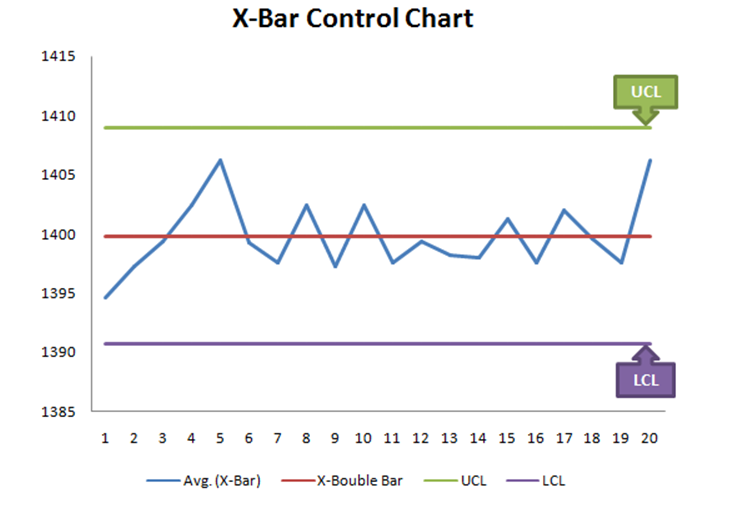
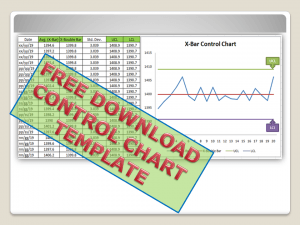
In Sl. No.1, Select X-Bar, X-Double Bar, UCL, LCL, and then select Insert Option and next to Line Chart. After selecting the Line Graph/Chart, The X-Bar Control Chart Excel Template will be ready as below.
3.2 Range Chart:
To Plot the
R-Control Chart, we have to calculate the [1] Range. [2] R-Bar (Average of
Range). [3]UCL. [4]LCL.
[1] Range: R=Max. Value – Min. Value of Subgroup.
[2] R- Bar (Average of Range): Put the Excel formula of average.
[3] UCL:
UCL= D4 x R-Bar
UCL= 2.114 x R-Bar Value of individual Subgroup. (Note for
Subgroup Size 5, D4=2.114).
Use this formula in Excel to calculate the UCL.
[4] LCL:
LCL=D3 x R-Bar
LCL=0 (Note Foe subgroup size 5, D3=0)
Simply put the “0” in the Excel sheet.
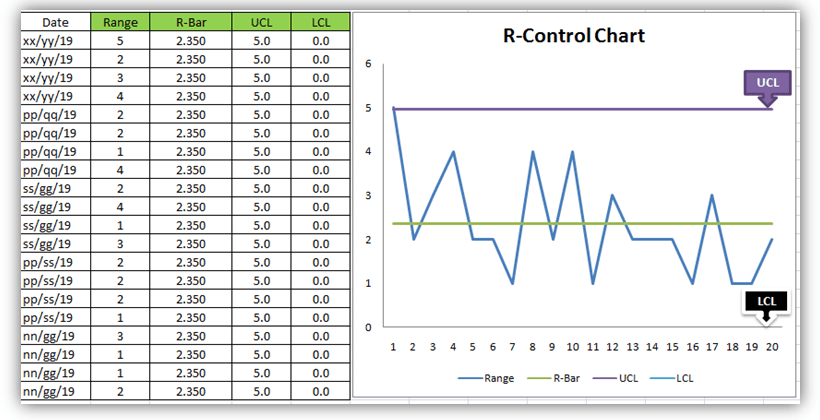
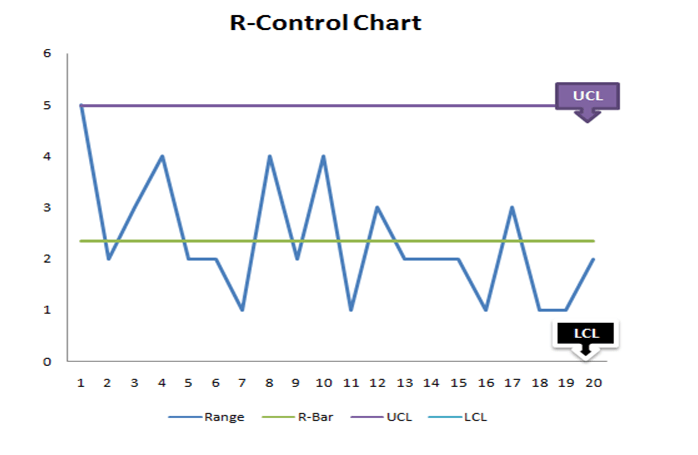
3.22 Plot R-Chart: Just follow steps 1 to 3, and select the line chart.
In step-1, you have to select the “Range, R-Bar, UCL, and
LCL” simultaneously and then select the Line Chart, after selecting the line
chart R-Control Chart Excel Template will be ready as below
Q2: How to add upper and lower control limits in Excel?
A2: Carefully read the aforesaid Articles.
Q3: How to create a control chart in Excel 2013?
A3: Step by Step guide is described above with Statistical process control chart examples. Please go through it.
Q4: How to create a Six Sigma control chart in Excel?
A4: Control charts are classified into two types [1] Variable type and [2] Attribute Type. Both two types are further classified into several as
[1]Variable types
X and MR Chart
X-Bar and Range
X-Bar and S
[2] Attribute Chart
np-chart
p-chart
u-chart
c-chart
In the above articles, we have described only how to create an X-bar and range type Control Chart in Excel with a process control chart example. As you can see all these above types of control charts are used in Six Sigma projects but the applicable chart depends on Data type and Subgroup size (Sample size).
Q5: How to calculate upper and lower control limits (UCL & LCL) in Excel?
A5: For X-Bar
Chart-UCL:
UCL=X Double Bar +3*Sigma
UCL= X Double Bar +3*Standard Deviation
For the calculation of the UCL in Excel, use the above formula.
LCL:
LCL=X Double Bar -3*Sigma
LCL= X Double Bar -3*Standard Deviation
Use the above Formula in Excel.
For R-Chart:
UCL:
UCL= D4 x R-Bar
UCL= 2.114 x R-Bar Value of individual Subgroup. (Note for
Subgroup Size 5, D4=2.114).
Our Author is an experienced professional in Quality Management Systems, Quality Assurance, Operations, and Business Excellence, with cross-industry expertise in Automotive, AMR, Robotics, Battery Manufacturing, Foundry, and Sheet Metal industries. He has strong expertise in international standards including IATF 16949, ISO 9001, ISO 14001, ISO 45001, and ISO 17025, along with methodologies such as TQM, TPM, and Six Sigma. He holds a degree in Mechanical Engineering along with an MBA, combining strong technical acumen with strategic business insight, he is a Certified Internal Auditor, Lead Auditor, and Six Sigma Black Belt, with a proven track record in driving quality transformation and operational excellence.
Through TECHIEQUALITY, he shares practical insights, quality tools, and industry best practices to help professionals improve processes and achieve operational excellence.
How to fill up 8D Report Template |8D Report Example:
Hi. ! Reader, today we will discuss the 8D Report Example, case study, and How to fill up the 8D Report Template, if you have not yet downloaded the 8D Template then download the Format /template /form by clicking on the below link.
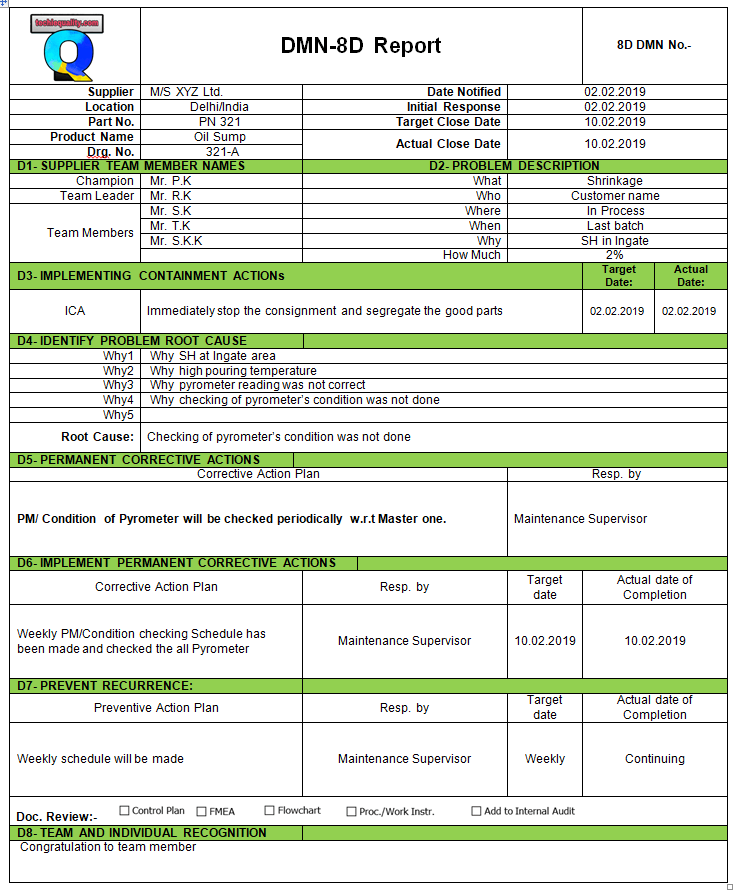
8D Report Example | Step-by-Step Guides: Example-1: There is a Customer Complaint i.e. Shrinkage on the Sump (Automobile casting part). And we have done the case study of said customer complaint and filled up the 8D template. Details are illustrated below
D1- SUPPLIER TEAM MEMBER NAMES: Champion name, Team Leader name, and Team Member name.
D2- PROBLEM DESCRIPTION e.g. Shrinkage Defect.
What
Shrinkage
Who
Customer name
Where
In Process
When
Last batch
Why
SH in Ingate
How Much
2%
D-2 (5W1H Form)
D3- IMPLEMENTING CONTAINMENT ACTION:
Target date
Actual date
Immediate stop the consignment & segregate good parts
2.2.19
2.2.19
D-3-Containment Action Table
D4- IDENTIFY PROBLEM ROOT CAUSE:
Why1
Why SH at Ingate area
Why2
Why high pouring temperature
Why3
Why pyrometer reading was not correct
Why4
Why checking of pyrometer’s condition was not done
Why5
Why-Why Analysis
Root Cause
Checking of pyrometer’s condition was not done
D-4
D5- PERMANENT CORRECTIVE ACTIONS:
Corrective Action Plan
Resp. by
PM/ Condition of Pyrometer will be checked periodically w.r.t Master one.
Maintenance Supervisor
D-5-CAP
D6- IMPLEMENT PERMANENT CORRECTIVE ACTIONS:
Corrective Action Plan
Resp. by
Target date
The actual date of Completion
A weekly PM/Condition checking Schedule has been made and checked all Pyrometer
Maintenance Supervisor
10.02.2019
10.02.2019
D-6
D7- PREVENT RECURRENCE:
Preventive Action Plan
Resp. by
Target date
The actual date of Completion
A weekly schedule will be made
Maintenance Supervisor
Weekly
Continuing
D-7-PR
D8- TEAM AND INDIVIDUAL RECOGNITION: Congratulations to the team member.
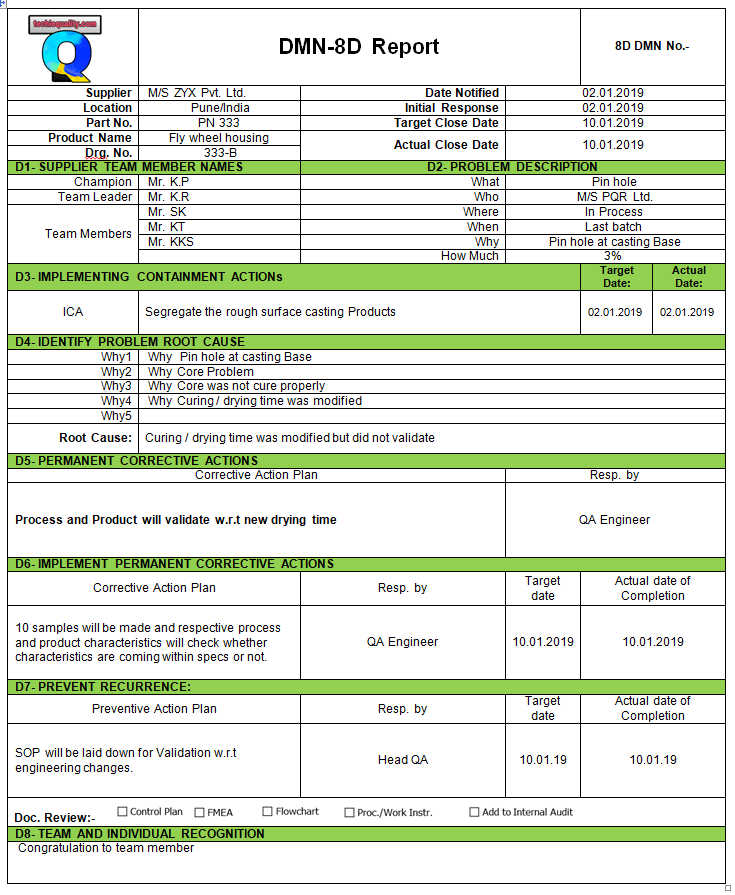
In the first case study, we have discussed in ingate shrinkage of the sump and filled up all the analysis in 8D-Template, and now, we are going to discuss another case study i.e. CS No-2, details of the analysis are illustrated below.
Case Study 2: Pin-hole Defects (Casting)
A Company PQR Ltd found nearly 3% of the last batch of BOP items as defective after machining operation due to a pinhole defect in casting. So the purchase head decided to ask and submit the full analysis of the said problem to their supplier in the 8D report. The same Analysis is illustrated below.
D1- SUPPLIER TEAM MEMBER NAMES: Champion name, Team Leader name, and Team Member name.
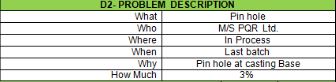
D2- PROBLEM DESCRIPTION e.g. Pin-hole Defect.
What
Pin-hole
Who
M/S PQR Ltd
Where
In-process
When
Last batch
Why
Pin-hole at casting base
How much
3%
5W1H
D3- IMPLEMENTING CONTAINMENT ACTION:
ICA
Segregate the defective part (pin-hole defect)
Containment Action
D4- IDENTIFY PROBLEM ROOT CAUSE:
Why-1
Why pin-hole?
Why-2
Why the core problem?
Why-3
Why core was not cured properly?
Why-4
Why the curing/drying time was not modified?
Why-5
5W Analysis
Root Cause
Curing/drying time was not validated
RC
D5- PERMANENT CORRECTIVE ACTIONS:
Corrective action plan
Resp. by
Process and product will validate w.r.t new drying time
Process QA Engineer
CA
D6- IMPLEMENT PERMANENT CORRECTIVE ACTIONS:
Corrective action plan
Resp. by
Target date
Actual Date
10 samples will be made & respective process & product characteristics will be checked whether the characteristics are meeting the specifications or not.
Process QA Engineer
xx/yy/2020
xx/yy/2020
IPCR
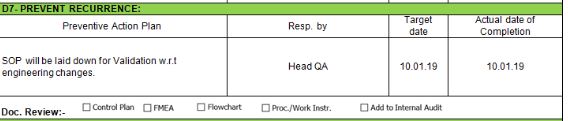
D7- PREVENT RECURRENCE:
Preventive action plan
Resp. by
Target Date
Actual Date
Validation process SOP will be made including change control
QA.Engineer
xx/yy/2020
xx/yy/2020
PR
D8- TEAM AND INDIVIDUAL RECOGNITION: Congratulations to the team member.
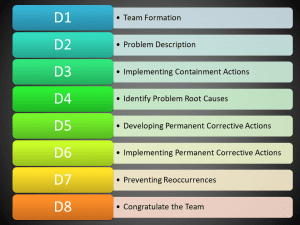
The 8D is eight disciplines of problem-solving, these are mainly, 1-supplier team member names, 2-problem description, 3-implementing containment action, 4-identify problem root cause, 5-permanent corrective actions, 6-implement permanent corrective actions, 7-prevent recurrence, 8-team, and individual recognition.
What are the 8 disciplines of an 8D-DMN report?
The 8D has 8 nos disciplines which makes it a systematic way to resolve the problem and the disciplines are
Team Formation or Establishing the team or creating a team.
Problem Description or defining the problem.
Implementing containment actions or Interim action.
Identify the problem’s root cause or RCA.
Developing permanent corrective actions or corrective action
Implementing permanent corrective actions or implementing & validating corrective actions
Preventing reoccurrences or preventive actions
Congratulate the team or Team & individual recognition.
The 8D-DMN is a very popular methodology that is frequently used in manufacturing industries to resolve the notified defective material in all the stages including customer complaints as well. we have already discussed two no case studies or practical manufacturing examples for a better understanding of the concept, application, and thorough knowledge of 8D template or format.
This concept enhances your depth of knowledge on 8D and its principles on how to fill up the template or format, which is described above. After doing so your confidence in 8D activities for internal application and for application on customer complaints will be enhanced.
Our Author is an experienced professional in Quality Management Systems, Quality Assurance, Operations, and Business Excellence, with cross-industry expertise in Automotive, AMR, Robotics, Battery Manufacturing, Foundry, and Sheet Metal industries. He has strong expertise in international standards including IATF 16949, ISO 9001, ISO 14001, ISO 45001, and ISO 17025, along with methodologies such as TQM, TPM, and Six Sigma. He holds a degree in Mechanical Engineering along with an MBA, combining strong technical acumen with strategic business insight, he is a Certified Internal Auditor, Lead Auditor, and Six Sigma Black Belt, with a proven track record in driving quality transformation and operational excellence.
Through TECHIEQUALITY, he shares practical insights, quality tools, and industry best practices to help professionals improve processes and achieve operational excellence.
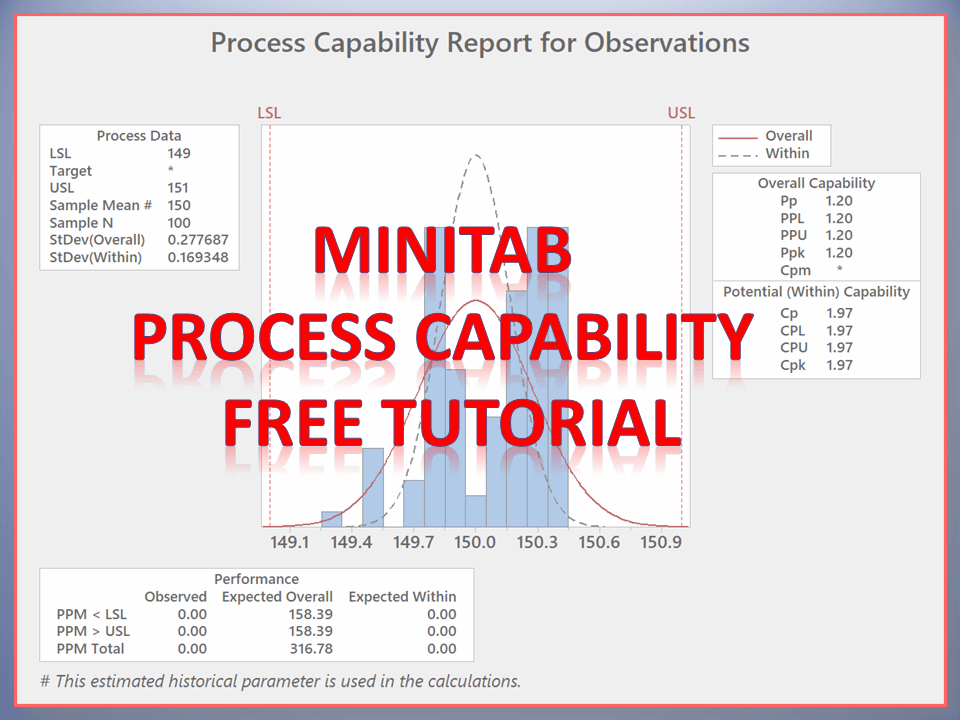
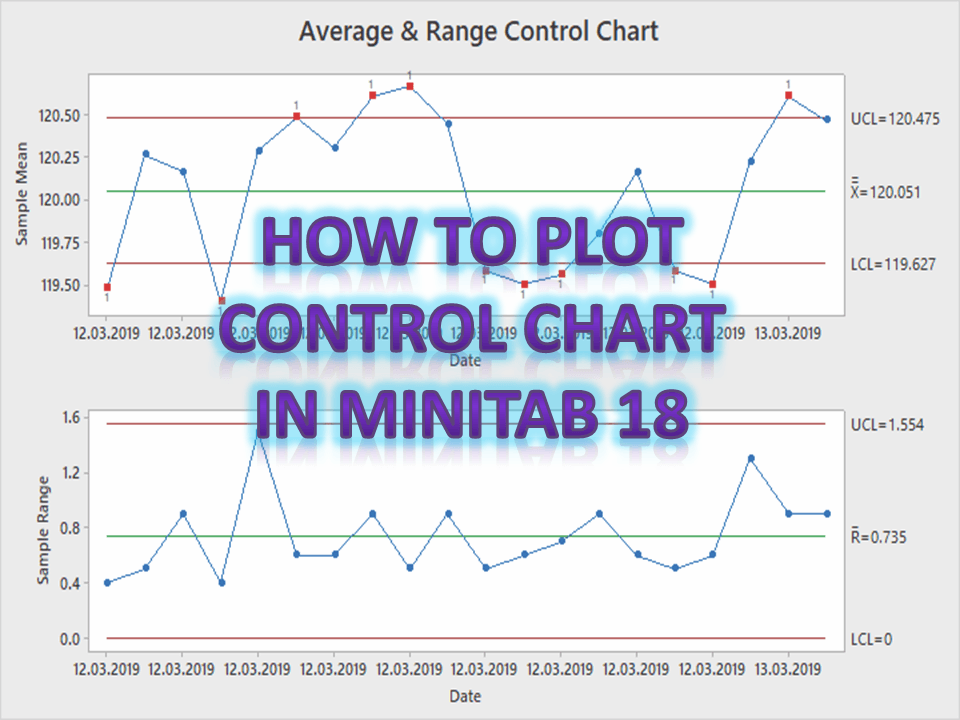
A control Chart is a popular tool to identify the process Variations and causes (Common or Special Cause). If you would like to know more about different types of Control Charts then read “What is SPC?”. You will also like to read on “how to plot a control chart in Excel’.
Steps of how to Create Control Chart in Minitab 18:
Step-1:
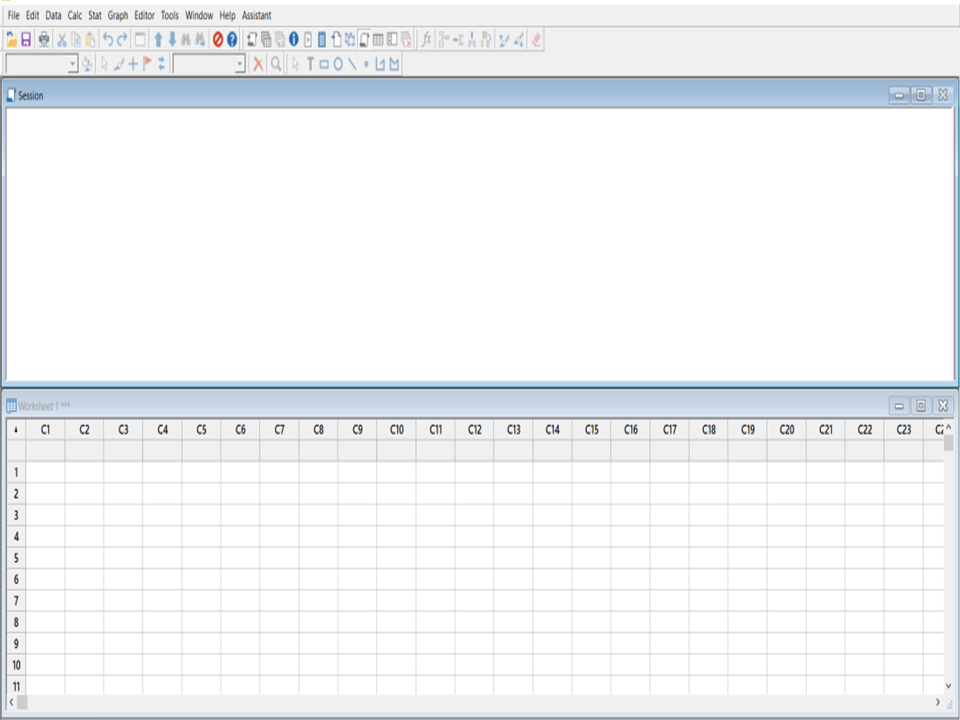
When you will open the Minitab 18, the main screen will appear like below.
Step-2:
Let’s take an example here to understand better. We are having 100
numbers reading of a block’s length as,
Length of Block=120±1mm, Subgroup Size=5, Sample frequency=5 samples per hour.
Date
Observations/Reading
12.03.2019
119.5
12.03.2019
119.3
12.03.2019
119.4
12.03.2019
119.5
12.03.2019
119.7
12.03.2019
120
12.03.2019
120.1
12.03.2019
120.5
12.03.2019
120.3
12.03.2019
120.4
12.03.2019
120.4
12.03.2019
120.6
12.03.2019
120.3
12.03.2019
119.7
12.03.2019
119.8
12.03.2019
119.2
12.03.2019
119.5
…..
….
13.03.2019
121.1
13.03.2019
120.2
13.03.2019
120.3
13.03.2019
120.4
13.03.2019
120.5
13.03.2019
120.9
13.03.2019
120.8
13.03.2019
120
13.03.2019
120.1
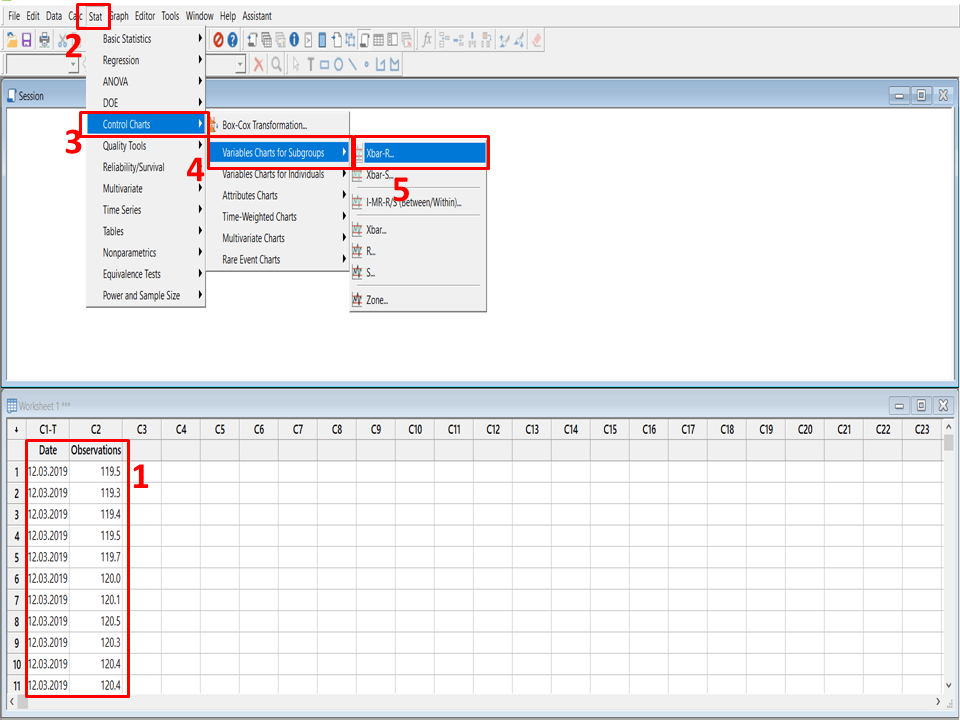
As you can see in the above figure, the same 100-number reading has been entered in box no.1. Now we are supposed to select the Average and range type Chart (because length readings are variable data and we have taken subgroup size is 5). If you would like to know the selection process of different types of Control Charts then read the article “What is SPC?”. Just follow the step-2 to step-5 in the above figure to select the “Average & Range” type control chart.
Step-3:
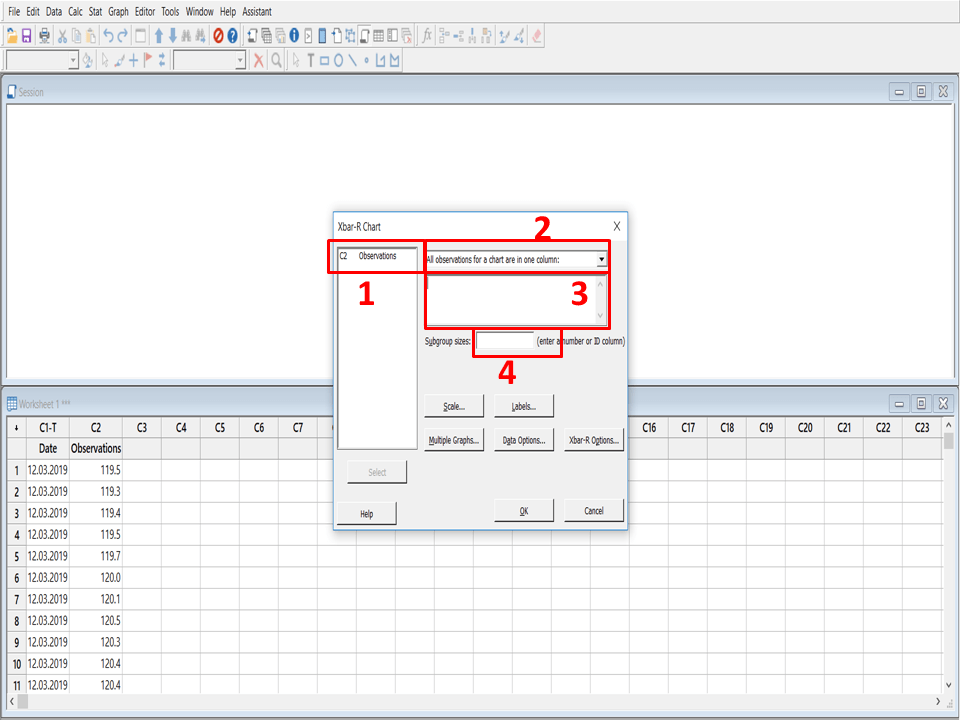
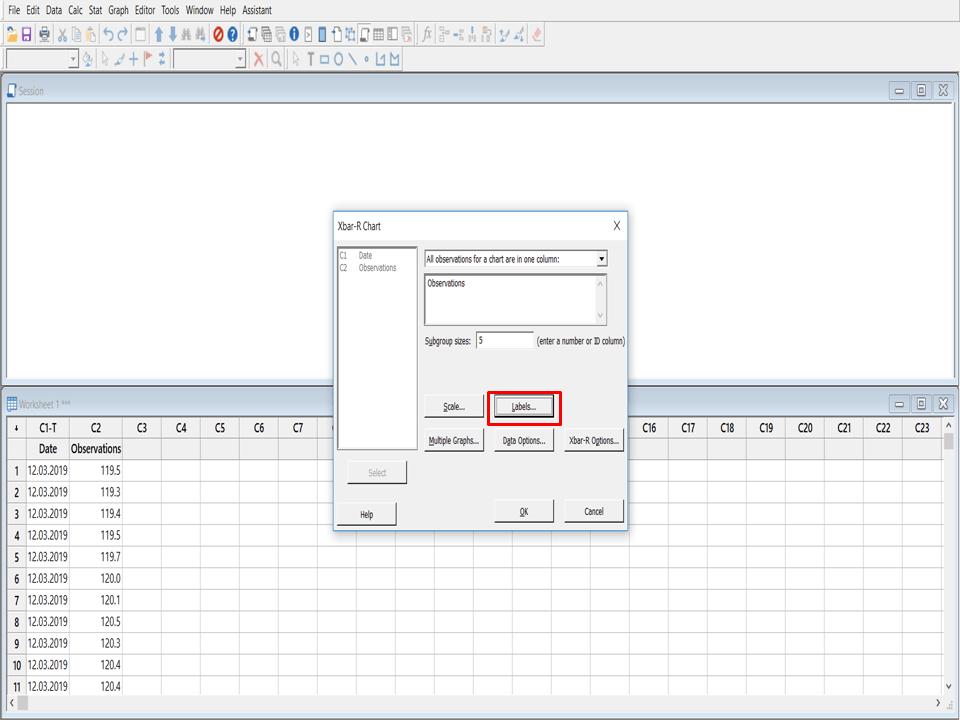
After selecting the “X-bar & Range chart”, such a dialog box will appear on the screen. Now just give more focus on below dialog box, because I will be describing it one by one here. In the box no-1, you can able to see the data point’s column. Now you have to select the data point in box no-3, and then enter “5” in box-4. Next, we have to enter labels to write the Title name.
Step-4:
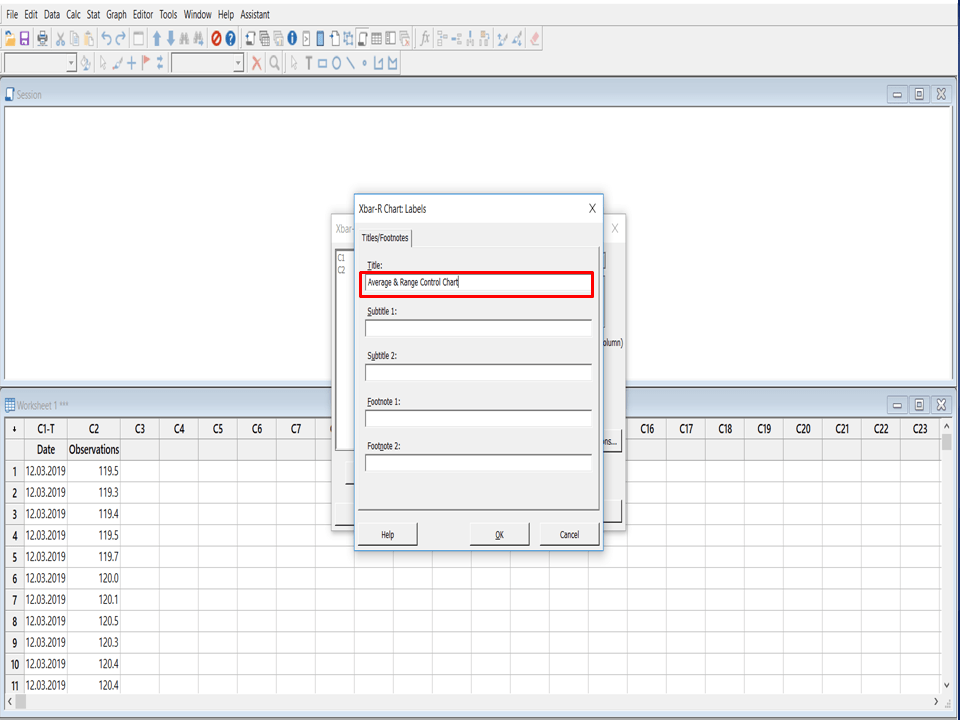
Title name
1. Enter on Labels.
2. Name the title as you wish.
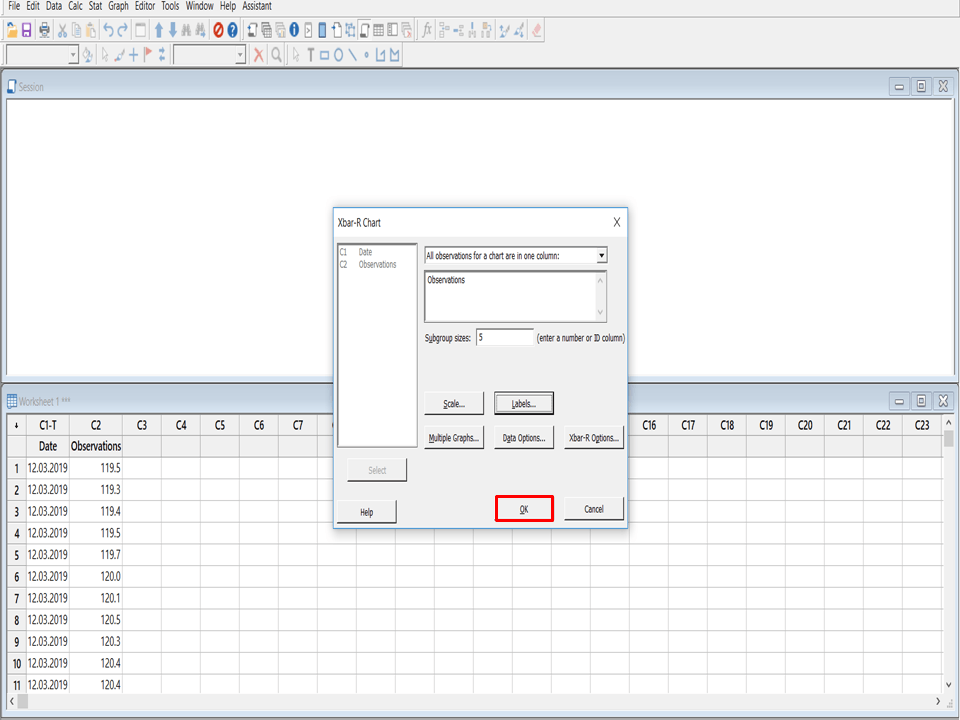
Step-5
After selecting the data point’s column, subgroup size value, and Label, now you have to enter in “ok”. After doing so Control Chart will appear on the screen.
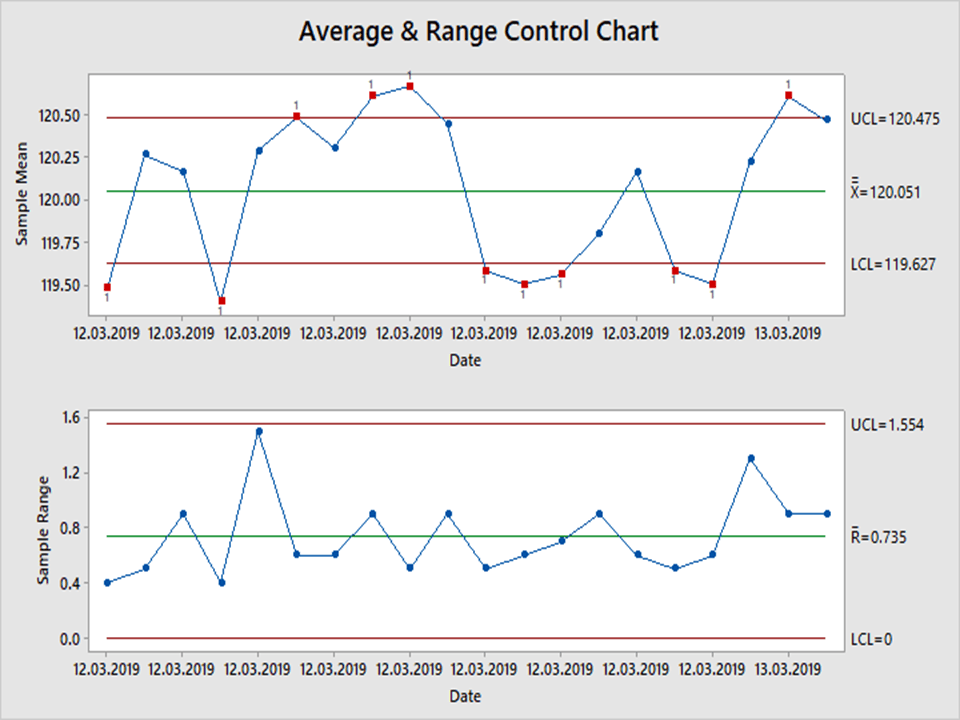
Minitab Control Chart:
FAQ:
Q1: How to change the
“X” axis value?
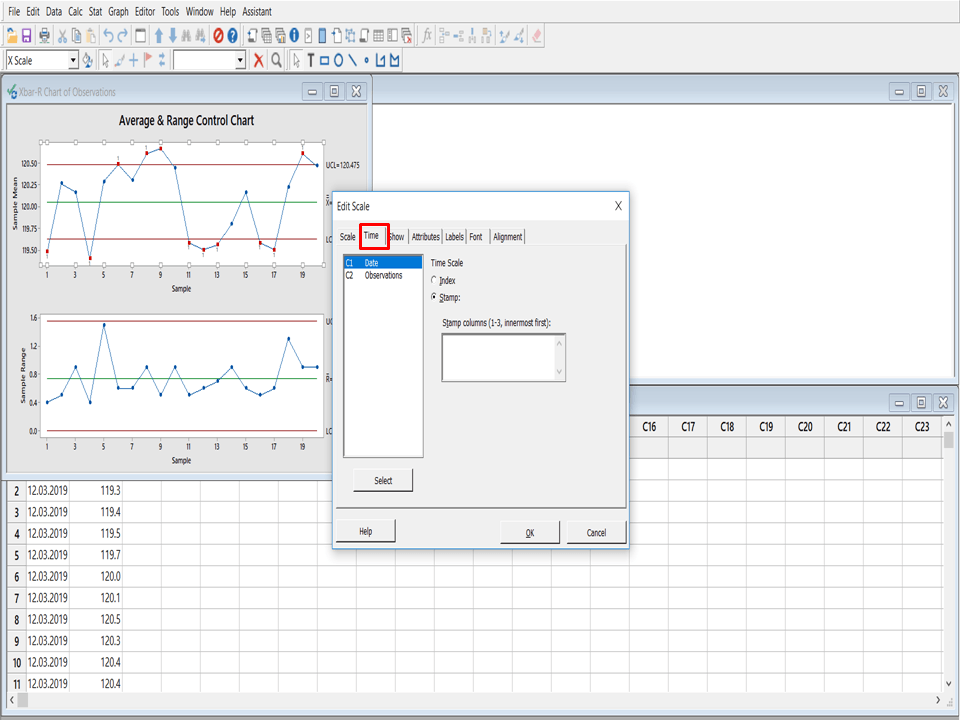
A1: Double click on the “X” axis then you can able to see a dialog box where you have to click on the “time” icon (marked in red color box in below figure) then, select the stamp option, and next to select the column which you would like to add in “X” axis.
Our Author is an experienced professional in Quality Management Systems, Quality Assurance, Operations, and Business Excellence, with cross-industry expertise in Automotive, AMR, Robotics, Battery Manufacturing, Foundry, and Sheet Metal industries. He has strong expertise in international standards including IATF 16949, ISO 9001, ISO 14001, ISO 45001, and ISO 17025, along with methodologies such as TQM, TPM, and Six Sigma. He holds a degree in Mechanical Engineering along with an MBA, combining strong technical acumen with strategic business insight, he is a Certified Internal Auditor, Lead Auditor, and Six Sigma Black Belt, with a proven track record in driving quality transformation and operational excellence.
Through TECHIEQUALITY, he shares practical insights, quality tools, and industry best practices to help professionals improve processes and achieve operational excellence.
MTBF and MTTR Template, Format, Calculation| Manufacturing Example:
What is MTBF?
Hi, readers in this article we will be covering both MTBF and MTTR calculation with a manufacturing example. So read carefully, learn the concept, and implement it in your organization. Mean time between failures (MTBF) is the arithmetic average time between failures. It helps to measure the performance of a machine or assets. In manufacturing industries, we are always worried about the breakdown of machine or equipment failure, which can make a large loss and ultimately increase the downtime (Stop time) of the machine. Uptime is a big factor to enhance productivity. The higher the MTBF means the machine runs a long time before failing.
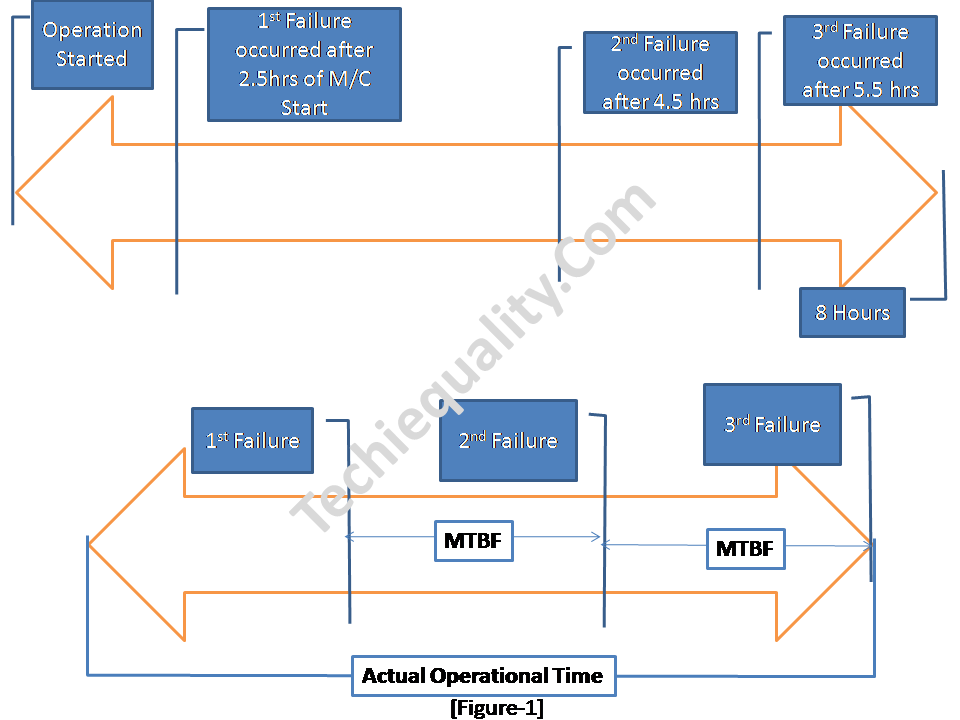
[Figure]
As you can see in the above figure operation has stopped after 8 hours of duration but meanwhile, three failures have occurred. Due to this failure machine was stopped for maintenance. In this case, 8 hours was the available operational time but 6 hours was the total running time. Considering all the above data, the MTBF value is 2 hours. It means the average time between 1st failure & 2nd failure or 2nd failure & 3rd failure is 2 hours. In the manufacturing industry, there are multiple operations and several machines are being used for production. So during the calculation of MTBF, you have to think about multiple factors.
DOWNLOAD– Template of MTBF and MTTR. (mttr, mtbf formula excel)
MTBF Formula:
The total operational time or total run time divided by the total number of failures.
MTBF= (Total Operational Time ÷ Total Number of Failures)
Calculation of MTBF (Mean Time Between Failures):
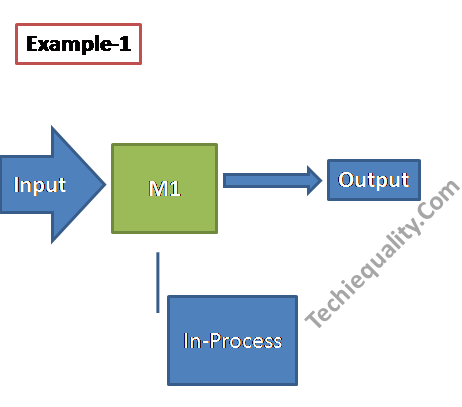
Let, for example, a product “XYZ” has manufactured in a simple method by using a single machine [see the below figure]. This machine runs three shifts per day with monthly 26 working days. But in last month’s operation, the maintenance person had booked the machine’s total number of failures (Breakdown) was 5. And total break-down time was 3 hours. According to all the above data, Monthly MTBF has been calculated and mentioned below;
[Example-1]
MTBF = Total operational time ÷ Total number of failures
Total operational time (Run time):
= Planned production time – Stop time
(624 hours – Stop time)
= (624- 81), here stop time included the lunch time, dinner time, tea time, breakdown time, tool changeovers time)
=543 hours
Now, the Total Operational Time of last month = 543 hours, Total number of failures of last month =5 times.
MTBF of last month = (543÷5) hours
=108.6 hours
Similarly, we have calculated the MTBF of a complex process having multiple numbers of machines.
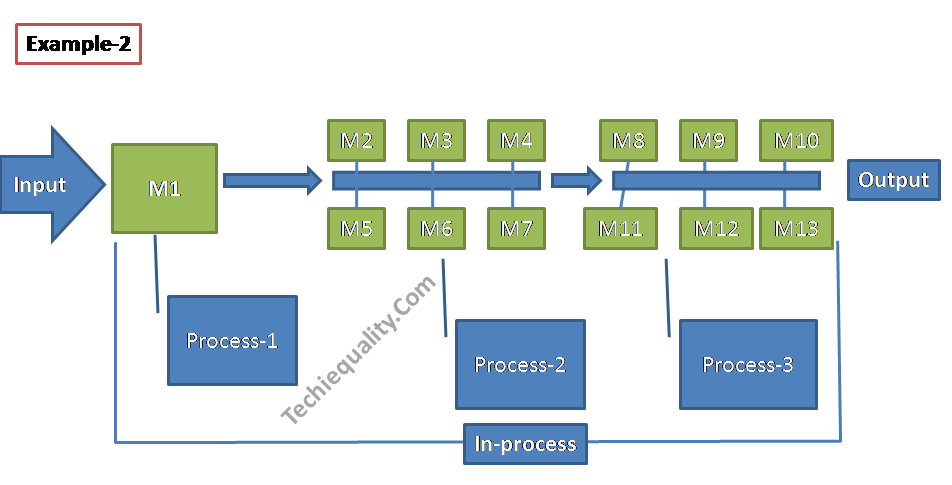
[Example-2]
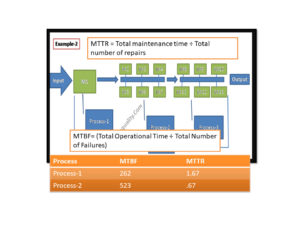
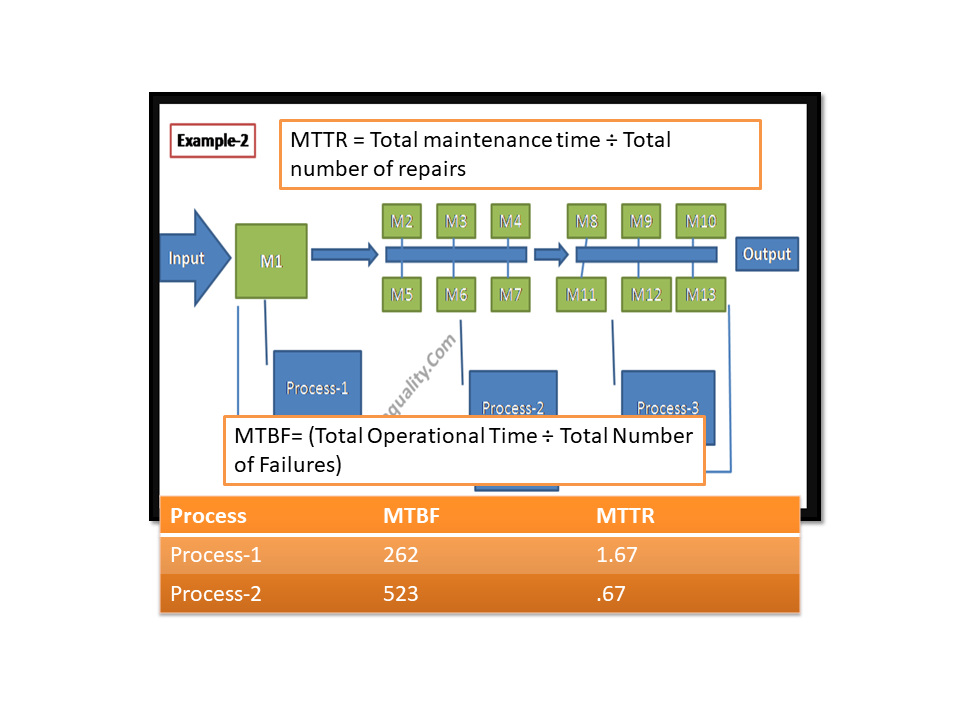
In example 2, all 13 machines run together to produce a product. There is a total of three sub-process i.e. process-1, 2 &3. And process-1 has 1 machine and process-2 &3 have 6 machines each. First of all, we will calculate the MTBF value of each process and then the overall process. Details of data like a machine running time, failure frequency, etc. are given below,
MTBF of Last month:
Total Operation Shift = A, B, C (3 shifts).
Total Number of Machines = 13
Working days of last month = 25 days
Total Number of failures (B/D) =12 times [process-1 =2, process-2 =6, process-3 =4]
Total breakdown time = 10 hours [process-1 =1, process-2 =8, process-3 =1]
Stop time of each machine per day due to Lunch, Dinner, and tea = 3 hours
MTBF of Process-1:
MTBF = Total operational time ÷ Total number of failures
Total operational time (Run time):
= Planned production time – Stop time
(600 hours – Stop time)
= (600- 76)
=524 hours.
Now, Total Operational Time of last month = 524 hours, Total number of failures of last month = 2 times.
MTBF of last month = (524÷2) hours
=262 hours
MTBF of Process-2:
MTBF = Total operational time ÷ Total number of failures
Total operational time (Run time):
= Planned production time – Stop time
(3600 hours – Stop time)
= (3600- 458)
=3142 hours
Now, Total Operational Time of last month = 3142 hours, Total number of failures of last month = 6 times.
MTBF of last month = (3142÷6) hours
=523.666 hours
MTBF of Process-3:
MTBF = Total operational time ÷ Total number of failures
Total operational time (Run time):
= Planned production time – Stop time
(3600 hours – Stop time)
= (3600- 451)
=3149 hours
Now, Total Operational Time of last month = 3149 hours, Total number of failures of last month = 4 times.
It is the average time required to correct and repair a failed component or equipment or device to put it in working order. It reflects how much average time is spent to correct or repair the component.
MTTR Formula:
Total maintenance time or total B/D time divided by the total number of failures.
MTTR = Total maintenance time ÷ Total number of repairs.
MTTR Calculation (Mean time to repair):
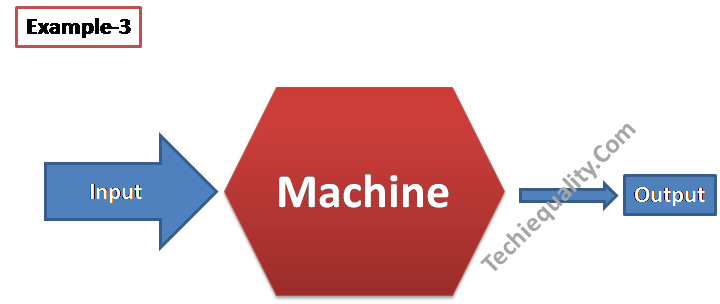
Example-3.
It’s a simple manufacturing process consisting of a single machine. In last month 3 times machine was stopped due to breakdown & the total breakdown or repair time was 2 hours. So here we are going to calculate the MTTR, details of the calculation are given below.
[Example-3]
MTTR = Total maintenance time ÷ Total number of repairs.
= (2 ÷ 3)
= 0.67 hours
Example-4:
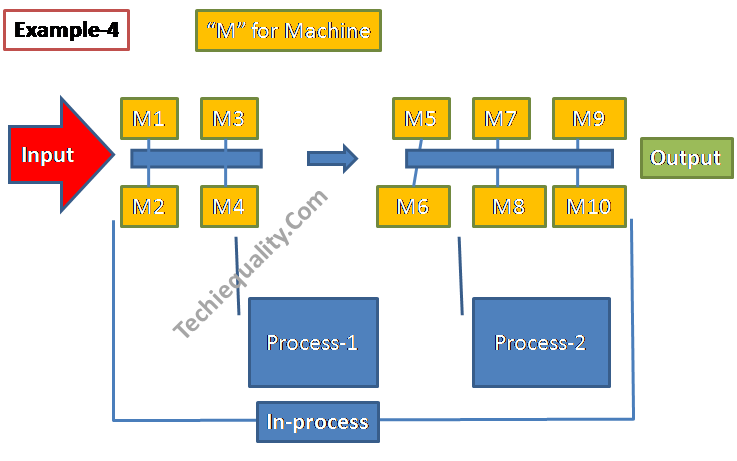
[Example-4]
In Example-4, the whole process is covered by the two sub-process i.e. process-1 and process-2. In first sub-process has a total of 4 machines and similarly, the second process has a total of 6 machines in operation. All data related to breakdown and frequency of failure are given in below table;
Process
Breakdown or Maintenance time
Frequency of failure or total number of repairs
Process-1
5 hours
3
Process-2
4 hours
6
MTTR of Process-1: 1.67 hours
MTTR of Process-2: 0.67 hours
Overall process MTTR = (1.67 + 0.67) ÷2
=1.17 hours
Process
MTTR in Hours
Process-1
1.67
Process-2
0.67
Overall Process
1.17
MTTR-Table
Why MTBF and MTTR are important for manufacturing industries?
MTTR indicates the efficiency of corrective action of machine failure and similarly
MTBF indicates the average machine run time between failures.
Monitoring both indicators can give the idea to control your maintenance method and indicate the opportunity for improvement in the same field. You can easily identify the training needed for your maintenance personnel after analyzing the values. You can also categorize the production loss w.r.t breakdown time.
What is the requirement of IATF 16949 w.r.t MTBF and MTTR?
As per the standard requirement, an organization shall document the maintenance objectives, for example, the objective of MTTR and MTBF.
How do you calculate MTBF and MTTR?
We have calculated the MTBF and MTTR with a manufacturing example, please read the above example.
What is the MTTR formula?
MTTR = Total maintenance time ÷ Total number of repairs.
How do you calculate MTBF?
MTBF= (Total Operational Time ÷ Total Number of Failures)
How to reduce the MTTR hours and How to increase the MTBF hours?
For improving both the parameters, we have to keep the focus on below things, like
Do the periodic CLIT (Cleaning, Lubrication, Inspection, and tightening).
Do the Kaizen on machines.
provide the training to the maintenance team.
Display the OPL for the machine operators for a better understanding of the machine’s operation.
Visual marking on the machine and introducing the poka-yoke
The above points are not limited to the given list but you can do more best practices to improve the MTTR and MTBF.
Free Templates / Formats of QM: we have published some free templates or formats related to Quality Management with manufacturing / industrial practical examples for better understanding and learning. if you have not yet read these free template articles/posts then, you could visit our “Template/Format” section. Thanks for reading…keep visiting techiequality.com
Our Author is an experienced professional in Quality Management Systems, Quality Assurance, Operations, and Business Excellence, with cross-industry expertise in Automotive, AMR, Robotics, Battery Manufacturing, Foundry, and Sheet Metal industries. He has strong expertise in international standards including IATF 16949, ISO 9001, ISO 14001, ISO 45001, and ISO 17025, along with methodologies such as TQM, TPM, and Six Sigma. He holds a degree in Mechanical Engineering along with an MBA, combining strong technical acumen with strategic business insight, he is a Certified Internal Auditor, Lead Auditor, and Six Sigma Black Belt, with a proven track record in driving quality transformation and operational excellence.
Through TECHIEQUALITY, he shares practical insights, quality tools, and industry best practices to help professionals improve processes and achieve operational excellence.
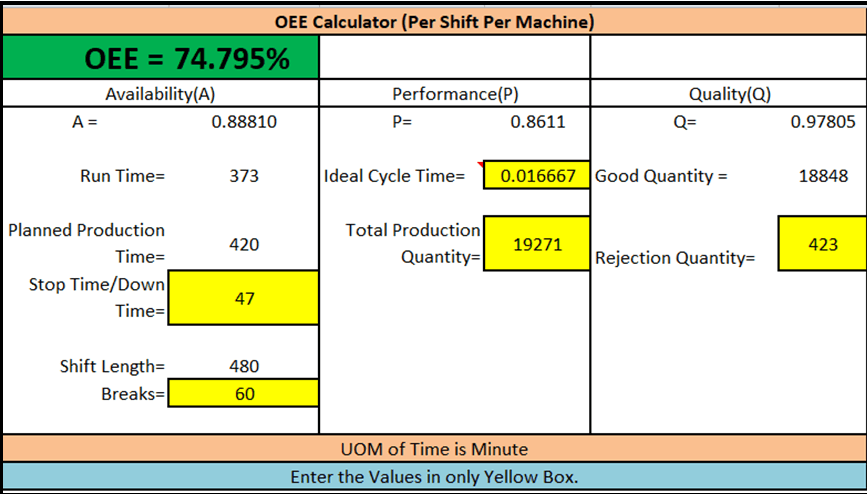
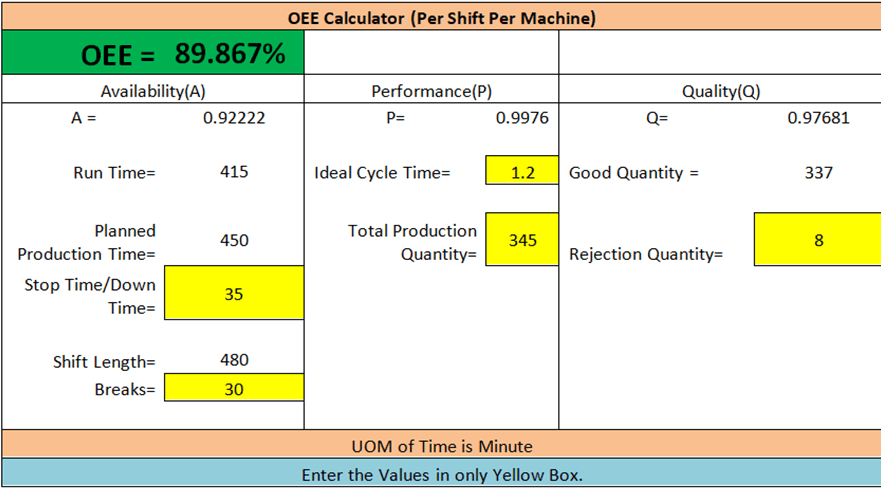
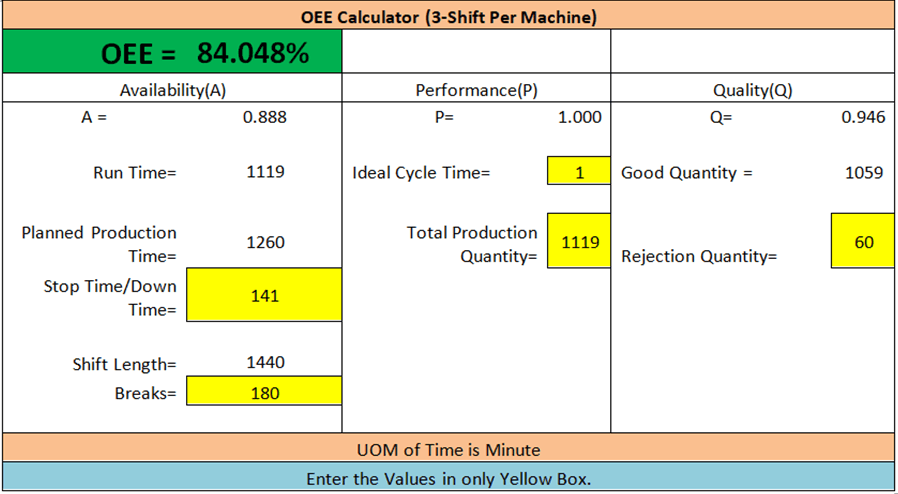
OEE Means, Overall Equipment Effectiveness. Seiichi Nakajima has invented overall equipment effectiveness in the 1960s to evaluate the manufacturing operation how effectively it is utilized.
Overall Equipment effectiveness is a methodology to measure the productivity of Process industries.
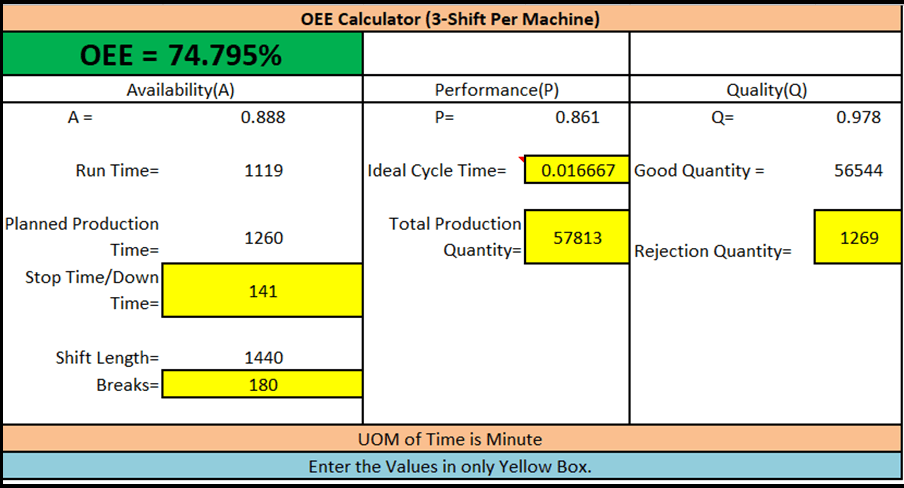
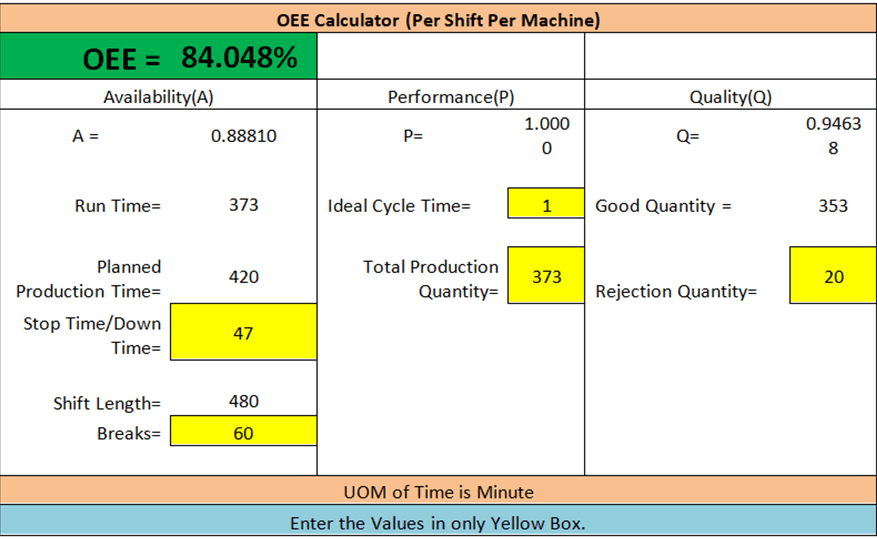
OEE = A x P x Q (A-Availability. P-Performance. Q-Quality). OEE is the main key performance indicator for Total Productive Maintenance and also for IATF 16949.
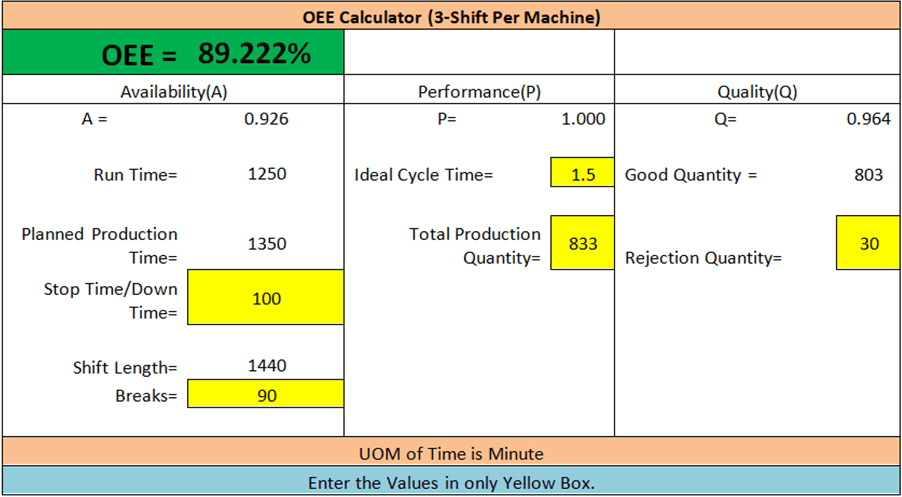
Planned Production Time= 1350, Total Production Quantity= 833 Rejection Quantity= 30 Stop Time/Down Time= 100
Shift Length= 1440
Breaks= 90
UOM of Time is Minute.
Now, I hope it’s clear to all “how to calculate the overall equipment effectiveness” by using the above Template. If you would like to calculate manually and would like to know more about the formula then click here.
I hope you understand the concept of OEE, but I would like to request you calculate the Rate of Quality of the below conditions and match your answer with our solution.
suppose a company produced 50000 quantities of product A and rejected quantities are 200 nos. Calculate the rate of quality and rate of quality percentage.
Solution:
Total parts Produced = 50000 nos
Total parts rejected = 200 nos
Rate of quality = [Total parts produced – Total parts rejected] / Total parts produced
Our Author is an experienced professional in Quality Management Systems, Quality Assurance, Operations, and Business Excellence, with cross-industry expertise in Automotive, AMR, Robotics, Battery Manufacturing, Foundry, and Sheet Metal industries. He has strong expertise in international standards including IATF 16949, ISO 9001, ISO 14001, ISO 45001, and ISO 17025, along with methodologies such as TQM, TPM, and Six Sigma. He holds a degree in Mechanical Engineering along with an MBA, combining strong technical acumen with strategic business insight, he is a Certified Internal Auditor, Lead Auditor, and Six Sigma Black Belt, with a proven track record in driving quality transformation and operational excellence.
Through TECHIEQUALITY, he shares practical insights, quality tools, and industry best practices to help professionals improve processes and achieve operational excellence.
8D Report, Format, or Template is ready for you just click on Download. Here we will describe the 8D Report with a Manufacturing related example.
DOWNLOAD-(8D-DMN Report Template /format /form in Excel Format)
Basic Info. of 8D Report:
It’s a Problem-solving approach followed by Eight Critical Steps. This is used to provide excellent guidelines to identify the Root cause of The Problem or Issue. Moreover, an 8D approach is used to implement the solutions to prevent recurring problems. It was first used in the automotive industry.
Generally, Customer asks their Suppliers / Vendors / External Providers to submit the 8D Report as of and when they find the Defective material at their ends as BOP, Raw Materials, etc.
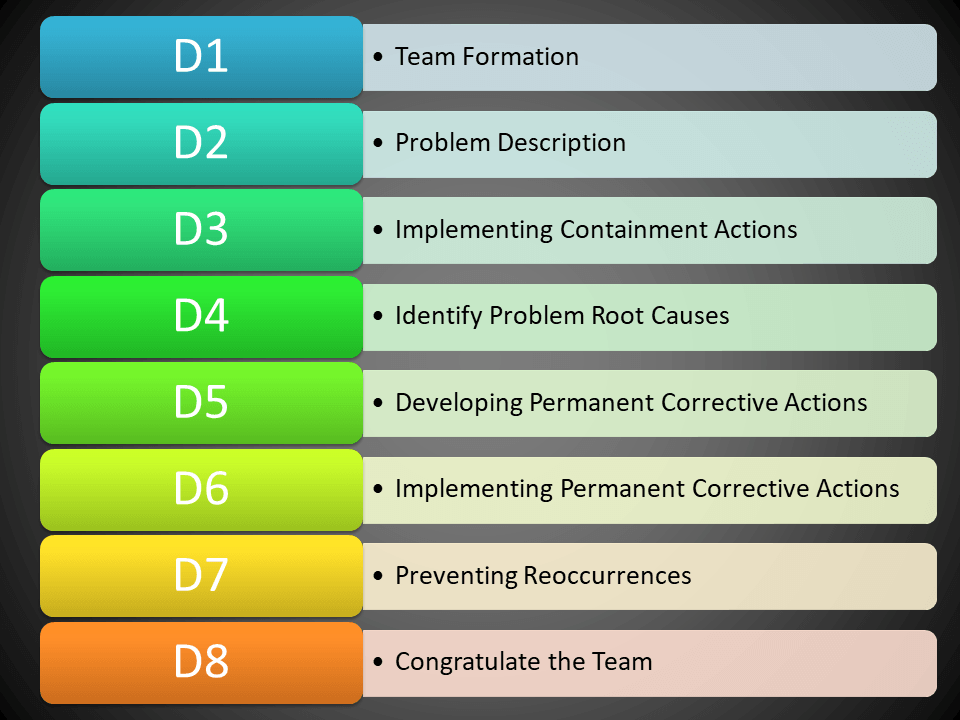
Eight
Steps of 8D Report:
Team
Formation
Problem
Description
Implementing
Containment Actions
Identify
Problem Root Causes
Developing
Permanent Corrective Actions
Implementing
Permanent Corrective Actions
Preventing Re-occurrences
Congratulating the Team
D1:- Team formation
A Cross-Functional team with multi-skilled Members needs to be selected.
D2:- Problem
Description
Describe the Problem in the form of 5W 2H as Who, What When, Where, Why, How, and how much.
D3:- Containment
actions
Temporary Action needs to be implemented until a permanent solution is implemented.
D4:- Identify Problem
Root Cause
After the implementation of Containment Action, We have to do the Root Cause Analysisto find out the Root Cause for the implementation of the permanent solution. The common tool used for RCA is Why-Why Analysis.
D5:- Developing
permanent corrective actions
After getting the Root Cause of a Problem, we have to prepare an Action plan for the Possible solution. From there Permanent Corrective actions need to be selected.
D6:- Implementing
permanent corrective actions
As soon as possible, Developed Permanent Corrective Actions need to be implemented. Implementation Plan / Activity Plan / Milestone Plan will help you better monitor and track the status of Activities.
D7:- Preventive Re-occurrences
Here Preventive Action needs to be taken to minimize the Reoccurrences. In doing so, a review of the Management system, SOP, Control plan, FMEA, and Risk Management, so that it will prevent the Reoccurrence.
D8:- Congratulating
the team
Now, it’s time to congratulate the Recognize your team for the joint effort. It is the most important step among All steps, which will help you to improve the moral part of people’s engagement.
Example-1 Customer asked 8D report for casting pin-hole issue.
D-1: Supplier team member name: Organization is supposed to form a team with a Team leader and Champion.
D-2: Problem Description: You may describe the problem in a 5W1H manner or 5W2H.
D-3: Implementing Containment action:
Immediate action needs to be taken so that the defective product will not be dispatched to the customer.
and also segregate the pinhole casting.
D-4: RCA: You can find out the Root cause by why-why analysis, hypothesis testing, etc.
D-5: Corrective Action:
Action to eliminate the root cause of the problem.
D-6: Implement CA: here in this stage we have to implement the action of the corrective action plan.
D-7: Preventive action:
Action to eliminate the potential cause of the problem. according to the new ISO 9001:2015 standard requirement, Risk analysis is there. but in the above example we have mentioned the PA as;
Example-2:
We have discussed here another practical manufacturing example for your better understanding, For Example, At the customer end, 80% of the last consignment material found a machining problem, so the customer asked their supplier to submit the 8D report. That 8D report has been described below, kindly go through it to know the details.
Illustration of above example-2:
D-1- SUPPLIER TEAM MEMBER NAMES: There should be a team member, leader, and champion. so choose team members smartly covering the several functions as CFT, so that your team’s technical strength will be enhanced.
D-2- PROBLEM DESCRIPTION:
This is the vital step where you have to confirm the problem and similarly need to describe it.
D-3- IMPLEMENTING CONTAINMENT ACTIONS: Take immediate action so that your customer will not receive a non-conforming product/ material /item. In the above example, the supplier has stopped the consignment of the mix-up item ( Good and NG material) to the customer.
D-4- IDENTIFY THE PROBLEM ROOT CAUSE:
You can use several techniques or tools to find out theroot cause, the commonly used technique is the why-why analysis.
D-5- PERMANENT CORRECTIVE ACTIONS: An action to eliminate the root cause of a problem, so whatever the RC will be found by root cause analysis then you have to take action on it. SO here covering the CAPA part is the important part.
D-8- TEAM AND INDIVIDUAL RECOGNITION: Congratulations to your team members.
FAQ:
What are the 8D steps?
The 8D is [1] Team Formation [2] Problem Description [3] Implementing Containment Action [4] Identify Problem Root Cause [5] Developing Permanent Corrective Action [6] Implementing Permanent Corrective Action [7] Preventing Reoccurrence [8] Congratulate the Team.
What is the difference between CAPA and 8D?
The CAPA and 8D are problem-solving approaches. During the RCA (Root cause analysis) of the problem, we generally develop the Action plan and represent it in different and different formats/templates like CAPA, 8D, G10, etc. The main objective or purpose of both methods is to develop the action plan, implement the action plan, and measure the effectiveness of the action plan. I meant to say that both are problem-solving approaches/ methods.
Our Author is an experienced professional in Quality Management Systems, Quality Assurance, Operations, and Business Excellence, with cross-industry expertise in Automotive, AMR, Robotics, Battery Manufacturing, Foundry, and Sheet Metal industries. He has strong expertise in international standards including IATF 16949, ISO 9001, ISO 14001, ISO 45001, and ISO 17025, along with methodologies such as TQM, TPM, and Six Sigma. He holds a degree in Mechanical Engineering along with an MBA, combining strong technical acumen with strategic business insight, he is a Certified Internal Auditor, Lead Auditor, and Six Sigma Black Belt, with a proven track record in driving quality transformation and operational excellence.
Through TECHIEQUALITY, he shares practical insights, quality tools, and industry best practices to help professionals improve processes and achieve operational excellence.
Risk Management related to IATF 16949, 9001, 14001, and 45001 will be discussed here. And also will discuss how to address Risks and its mitigation plan.
Risk Definition: Effects of Uncertainty is called Risk. An effect has two properties, Positive and Negative. Negative effects are also called Risk and Positive Effects are called Opportunity.
All the latest business standards like IATF 16949:2016, ISO 9001:2015, ISO 14001:2015, and ISO 45001:2018 are based on risk-based thinking. To comply with the standard requirement we have to identify the Risks and opportunities and need to do the mitigation plan for those that have the significant effects.
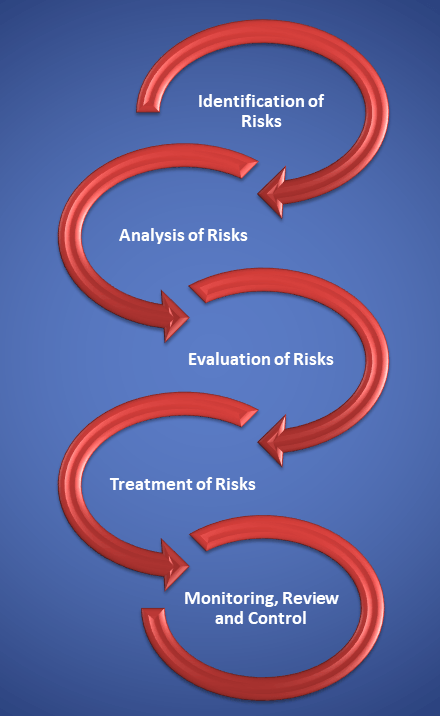
Risk Management Process:
Step-1 :
Identification of Risks
Step-2 :
Analysis of Risks
Step-3 :
Evaluation of Risks
Step-4 :
Treatment of Risk
Step-5 : Monitoring, Review, and Control
Identification of Risks:
Risk Related to ISO 9001:2015 and IATF 16949:2016:
During the identification of Risks, we shall consider the [1] Internal and external issues, [2] Needs and Expectations of Interested Parties, [3] Significant effects of QMS Intended Results like Significant Objectives, Process related Significant Effects, warranty, Field Failure, lacking of technology, Bossiness Competition, market value, Shortage of Raw materials, outsource Process Effects to Organization, etc.
Apart from the above, we shall also include in its risk analysis at a minimum lessons learned from Product recalls, Product audits, Field Returns, and Repairs, Scrap and rework, etc.
Examples of Risks: High Warranty Percentage, Lack of Technology, High Scrap, High B/D, Less Selling Value, etc.
Identified risks are generally represented in the Risk register.
Risk Related to ISO 14001:2015 and ISO 45001:2018:
While Identifying the risks related to ISO 14001, we have to consider the [1] Internal and external issues, [2] Needs and Expectations of Interested Parties, [3] Significant environmental Impacts [4] Compliance Obligations.
When determining the risks related to ISO 45001, we have to address the risk by accounting for [1] hazards [2] OHS risks, [3] Legal and other requirements, [4] Internal and external issues, [5] Needs and Expectations of Interested Parties.
Examples of Risks: High Noise, Water Pollution, Discharge of untreated Water, Solid Waste Spilled at the outside boundary of the factory, etc.
Analysis of Risks:
The main goal of Risk Analysis is to calculate the risk score/ rank and categorize the different types of Risk. In this method, we have to collect the data for the Probability and Impact score.
Example:
[1] High Noise at XYZ Area, let probability is 3 out of 10 scales and
Impact is 5 out of 10 scales.
Risk Score = 15
51-100
High Risk
25-50
Medium Risk
<25
Low risk
In the above example, High noise falls under the Low Risk.
Evaluation of Risks:
The Organization will decide on the Significant Risks Cut-off Value. Let us decide here 51 to 100 is the Cut-off value, then we can surely say the above Risk [High noise] does not come under the Significant Risk.
Here we just need to evaluate the Risk whether significant or insignificant.
Treatment of the Risks:
A mitigation plan has to be taken to bring down the significant Score to an Insignificant Score
Monitoring, Review, and Control:
After the implementation of the Action plan, the Effectiveness of Risk needs to be done by regular monitoring of data.
Our Author is an experienced professional in Quality Management Systems, Quality Assurance, Operations, and Business Excellence, with cross-industry expertise in Automotive, AMR, Robotics, Battery Manufacturing, Foundry, and Sheet Metal industries. He has strong expertise in international standards including IATF 16949, ISO 9001, ISO 14001, ISO 45001, and ISO 17025, along with methodologies such as TQM, TPM, and Six Sigma. He holds a degree in Mechanical Engineering along with an MBA, combining strong technical acumen with strategic business insight, he is a Certified Internal Auditor, Lead Auditor, and Six Sigma Black Belt, with a proven track record in driving quality transformation and operational excellence.
Through TECHIEQUALITY, he shares practical insights, quality tools, and industry best practices to help professionals improve processes and achieve operational excellence.
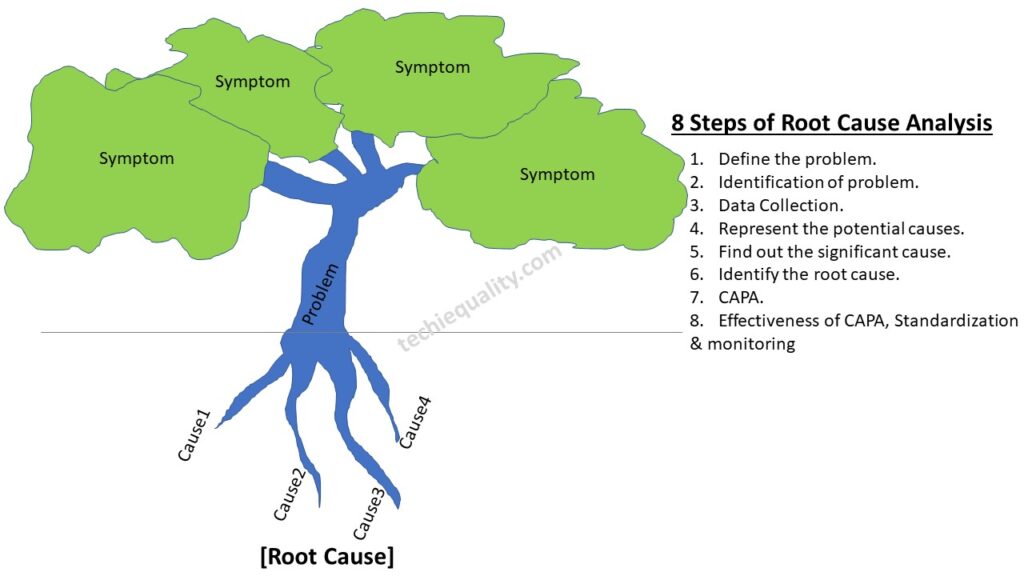
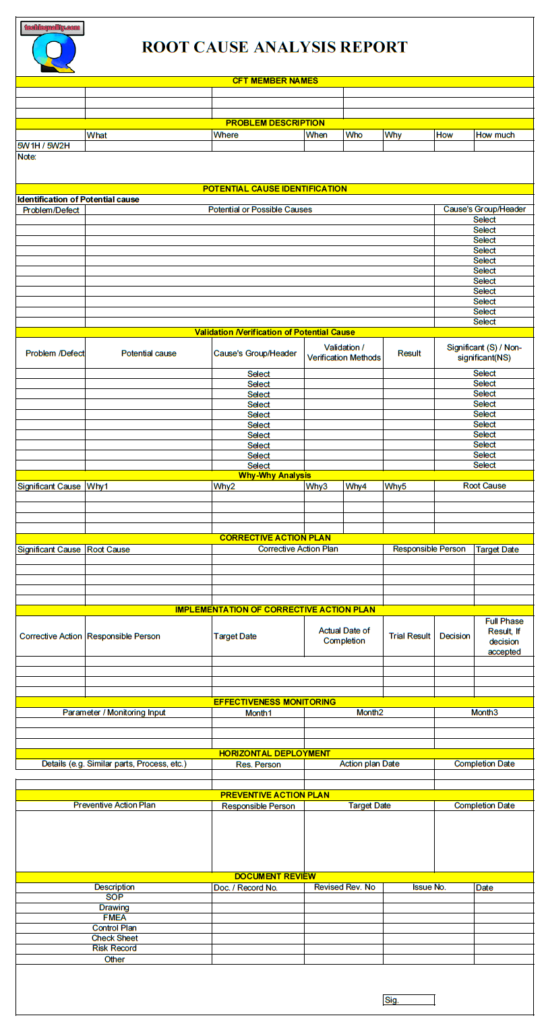
Root Cause Analysis is a frequently used and Popular Method to aid in catching the exact reason for a problem. It will help you to find out the primary cause of the problem so that we can determine what happened, and why it happened and also formulate the Prevention so that the problem will not occur again. It’s a vital part of the Continuous Improvement.
Define the Problem: – This step will
help you to understand the problem definition.
Step Two:
Identification of Problem: – What exactly happening, Where the problem is being occurred and what are the symptoms of the problem?
Step Three:
Collect Data – Before collecting the Data, You have to plot thePareto Chartof Existing Past data for the last six months at least. Then formulate the template according to the higher contributing causes with the help of the Pareto Principle (80/20 rules). Set up the Template machine-wise, process-wise, and shift-wise etc. At least collect the data for three months.
Represent The Potential Cause: – Now you have to plot the Pareto chartwith the Present collecting data. Next, to apply the Pareto principle to identify the Problems among the set, that are coming under the 80% contribution.
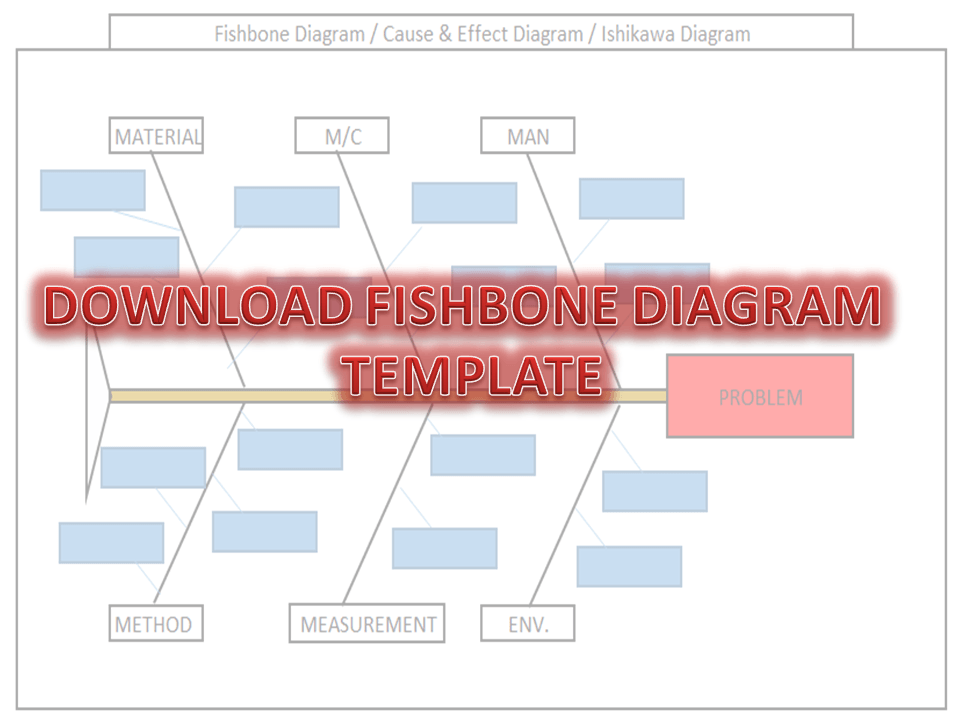
All Problems that are coming under the 80% contribution need to be plotted in the Fishbone Diagramindividually to represent the Potential Causes.
Find out the significant Causes: A hypothesis test needs to be executed here to find out the significant reasons.
For example, let us take the Shrinkage as the problem, which is coming under the 80% contribution (The decision will come from the Pareto chart considering its Principle rules). Let Shrinkage has three potential causes [1] High Pouring Temperature, [2] Wrong Gating System Design, [3] High Carbon Equivalent. To find out the significant causes of the three problems. We have to do the Hypothesis test as per the below pattern as
[1] High Pouring Temperature vs.
Shrinkage.
[2] Wrong Gating System Design vs.
Shrinkage
[3]High Carbon equivalent vs.
Shrinkage.
After doing the hypothesis testing as per the above pattern, one or a number of causes will come to the point as significant Causes.
Now you have to follow step six to identify the Root Cause.
Step Six:
Identify the Root Causes:-
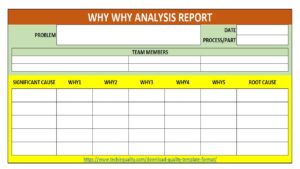
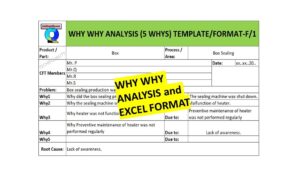
Before you execute the root cause identification. List all significant causes. Thereafter, we have to do the Why-Why Analysis of all individual significant causes until to get the Root Causes. Once you completed the 5-whys analysis try to document these in why why analysis template.
Step Seven:
CAPA: Corrective and Preventive Action
Plan to be Prepared.
Effectiveness of CAPA: – After implementation of CAPA, Trend Analysis needs to be plotted to figure out the effectiveness of CAPA or Action Plan. If the Action Plan is fully effective then the control mechanism and action plan need to the incorporated in relevant documents (e.g. FMEA, SOP, Control Plan, etc.).
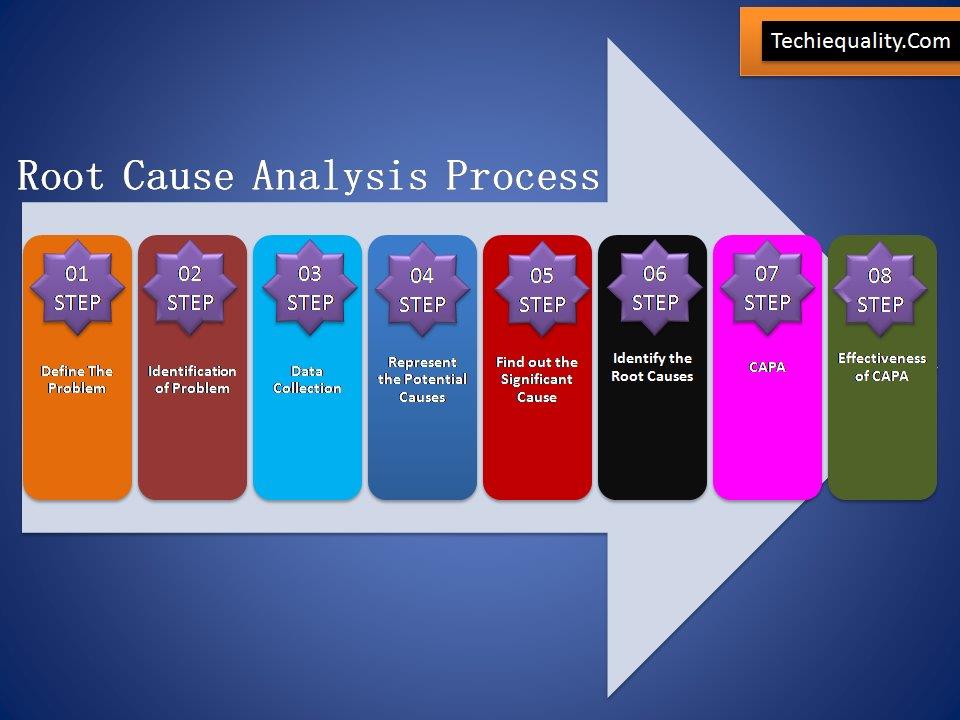
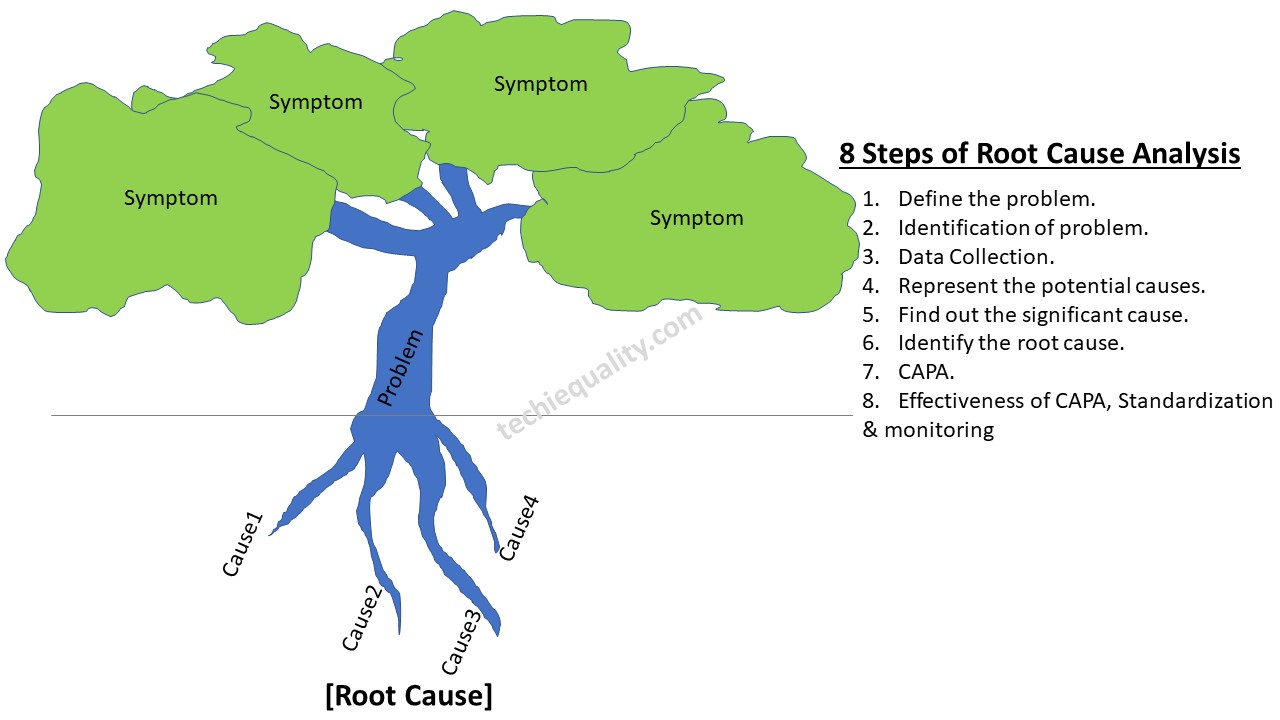
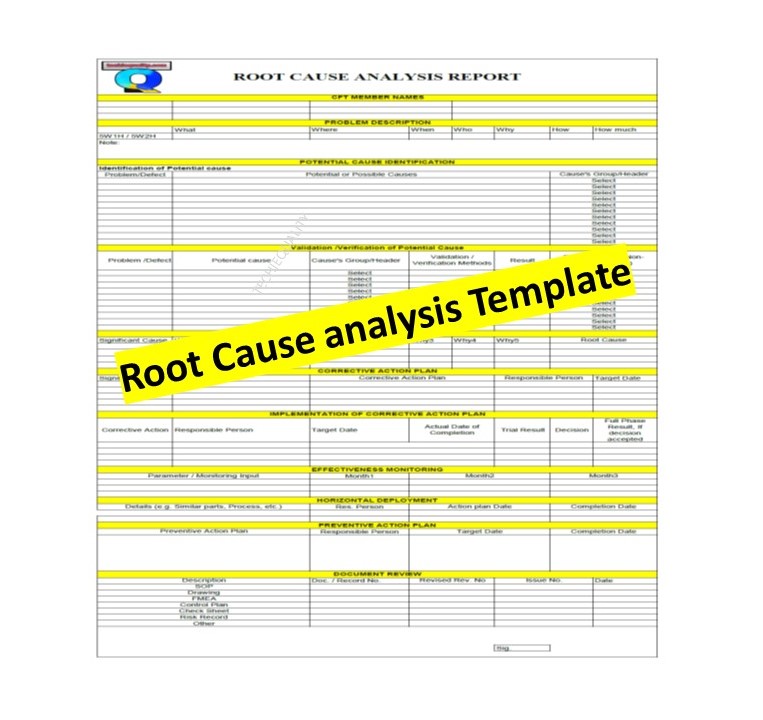
RCA or root cause analysis is a very important methodology to identify the root cause of any problem, issues, defects, non-conformities, customer complaints, warranty analysis, variation, deviation, abnormal activities, etc. There are many improvement projects being implemented in manufacturing industries such as the six sigma project, Quality Circle project, Kaizen, and small group activity project, where RCA is a vital milestone to successfully achieve the project goal. Proper RCA will help you to address the root cause for formulating the action plan to resolve the problem. You can follow the below 8 steps to do the proper RCA.
Root Cause Analysis
Before taking any example, we are going to know the tools used in RCA, for the problem statement i.e. [problem definition and identification] you can use the 5W1H or 5W2H tools. similarly, we have mentioned the tools used in the rest of the RCA steps are given below;
8 steps of RCA
Common Applicable Tools& Template
Define the problem
5W1H or 5W2H
Identification of the problem
5W1H or 5W2H
Data collection
Data collection Format, Pareto chart, etc.
Represent the potential cause
Fishbone or Cause & Effect or Ishikawa diagram
Find out the significant cause
Hypothesis test, validation of potential causes
Identify the root cause
Why-Why analysis [5W analysis]
CAPA
CAPA template, 8D, etc.
Effectiveness of CAPA, standardization & monitoring
Inspection report template, SOP, WI, CP, FMEA, etc.
RCA Examples:
Let’s consider a company manufacturing automobile parts and supplying those parts to OEM customers, but one day one complaint was received from the customer for a blow hole problem. for the same problem, the customer asked for an action plan. To resolve the problem and form an action plan the process QA engineer started the RCA [root cause analysis] of blow hole issues. They have followed the above steps for RCA and the same is given below.
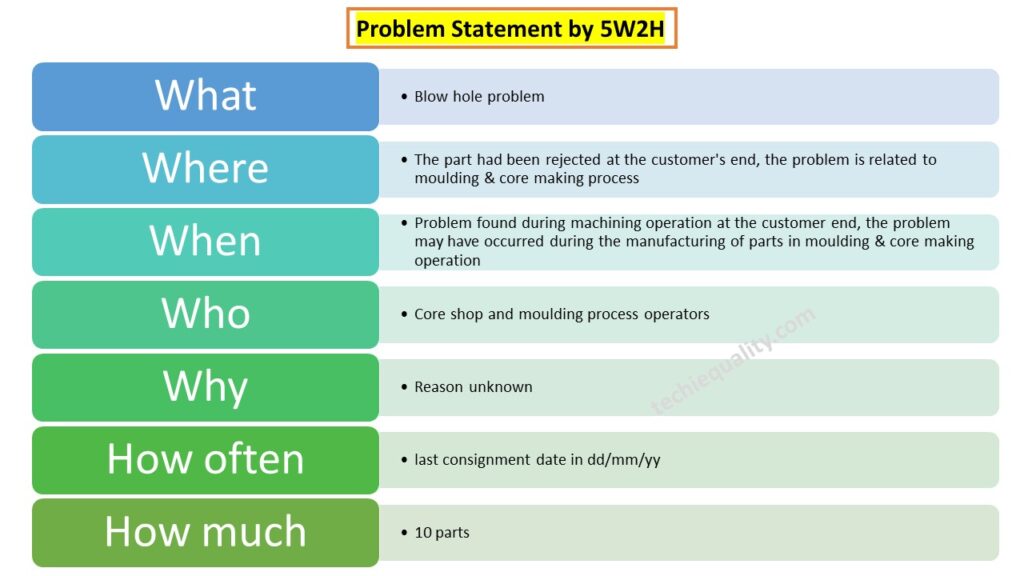
Problem Statement:
What: Blow hole problem
Where: The part had been rejected at the customer’s end, the problem is related to moulding & core making process
When: Problem found during machining operation at the customer end, the problem may have occurred during the manufacturing of parts in moulding & core making operation
Who: Core shop and moulding process operators
Why: Reason unknown
How often: last consignment date in dd/mm/yy
How much: 10 parts
Problem Statement by 5W2H
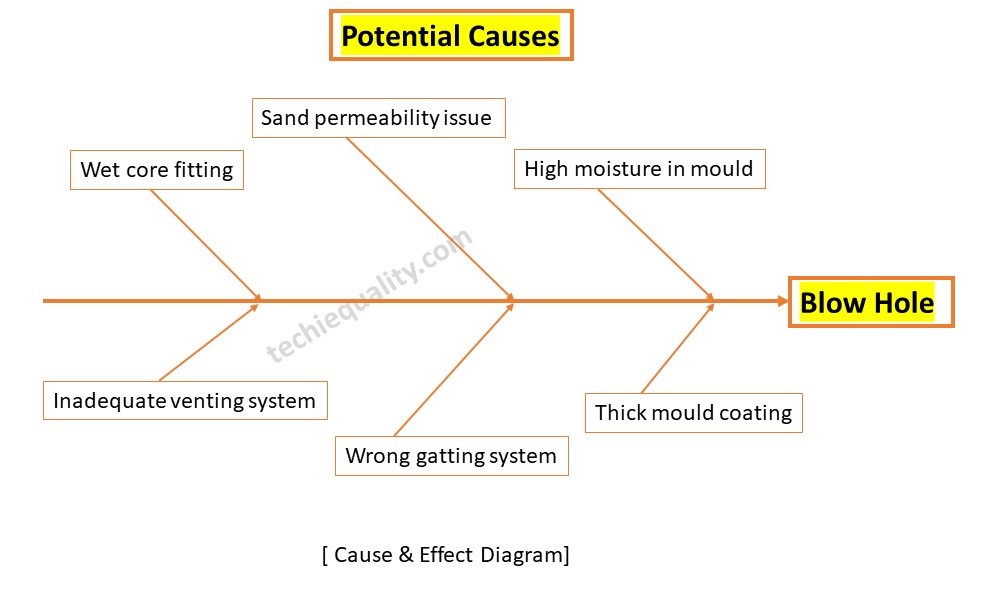
Now, with the help of a cause & effect diagram, we have to identify the potential causes for the blow hole problem, below are the listed potential causes but these are not limited to
Wet core fitted in moulding.
Inadequate venting system.
Wrong gatting system
High moisture in mould
sand permeability issue
Thick mould coating.
We plotted a cause-and-effect diagram using the above potential causes, and we show the diagram below;
Now, we have to find out the significant cause with the help of a hypothesis test or validation of potential causes. after doing the validation of all the above potential causes by following the validation methodology, we found that “wet core” was the significant cause. so the next step is the identification of the root cause.
RCA of blowhole by why-why analysis:
SC: Wet core fitted in moulding
Why: Core was wet
Why: The team did not follow the drying procedure properly.
Root Cause: Lack of awareness
After doing the root cause analysis, you have to formulate the CAPA and need to monitor the effectiveness of the action plan. then you can standardise the document and if applicable you can do the horizontal deployment of the same.
Many tools, techniques, templates, and formats help conduct root cause analysis, but here we will discuss only some common and popular ones listed below.
Root Cause Analysis is a systematic process for identifying the root causes of a problem rather than just addressing symptoms, enabling effective corrective action.
2. Why RCA Matters
RCA matters because it:
Prevents recurrence of problems
Improves process reliability.
Reduces costs from rework, failures, and incidents
Supports continuous improvement and learning
Encourages fact-based decision-making
Strengthens accountability without blame
3. When to Use RCA
RCA should be used when:
A significant incident or failure occurs
There are repeated or chronic problems
A problem has high risk, cost, or impact
Regulatory, safety, or quality requirements demand it
A process deviation leads to undesired outcomes
You need to understand system weaknesses, not just fix an error
4. When RCA is Useful
RCA is especially useful when:
The problem is complex or multi-factorial
The cause is not immediately obvious
Multiple teams or processes are involved
You need long-term corrective actions
Data, evidence, and subject matter experts are available
5. Benefits of RCA
Identifies true root causes, not symptoms
Leads to sustainable corrective actions
Improves process design and controls
Enhances organizational learning
Reduces repeat incidents
Strengthens risk management
Builds a culture of improvement
6. Limitations of RCA
Time- and resource-intensive
Results depend on data quality
Can be ineffective if:
Poorly facilitated
Politicized or blame-focused
Not ideal for:
Simple, one-off issues
Situations requiring immediate action only
May miss causes if the system boundaries are too narrow
7. Best Practices for Effective RCA
a. Define the Problem Clearly
Be specific, factual, and measurable
Focus on what happened, where, when, and the impact
b. Focus on Systems, Not People
Ask why the system allowed the error
Treat human error as a symptom, not a root cause
c. Use Structured Tools
Common RCA tools:
5 Whys
Fishbone (Ishikawa) Diagram
Fault Tree Analysis
Pareto Analysis
Process Mapping
7QC Tools
CAPA
d. Use Evidence and Data
Rely on facts, records, observations, and timelines
Avoid assumptions or opinions
e. Involve the Right People
Include process owners and subject matter experts
Encourage open, blame-free discussion
f. Identify Root Causes, Not Just Contributing Factors
Validate that removing the cause would prevent recurrence
g. Develop Strong Corrective Actions
Effective actions:
Address the root cause directly
Are measurable and realistic
Include ownership and deadlines
Prefer engineering or system controls over training alone
Our Author is an experienced professional in Quality Management Systems, Quality Assurance, Operations, and Business Excellence, with cross-industry expertise in Automotive, AMR, Robotics, Battery Manufacturing, Foundry, and Sheet Metal industries. He has strong expertise in international standards including IATF 16949, ISO 9001, ISO 14001, ISO 45001, and ISO 17025, along with methodologies such as TQM, TPM, and Six Sigma. He holds a degree in Mechanical Engineering along with an MBA, combining strong technical acumen with strategic business insight, he is a Certified Internal Auditor, Lead Auditor, and Six Sigma Black Belt, with a proven track record in driving quality transformation and operational excellence.
Through TECHIEQUALITY, he shares practical insights, quality tools, and industry best practices to help professionals improve processes and achieve operational excellence.
How to Plot Pareto Chart in Excel | Manufacturing example
How to Plot Pareto Chart in Excel ( with example), step-by-step guide and illustration with example is given below, just follow to prepare the Pareto chart in Excel.
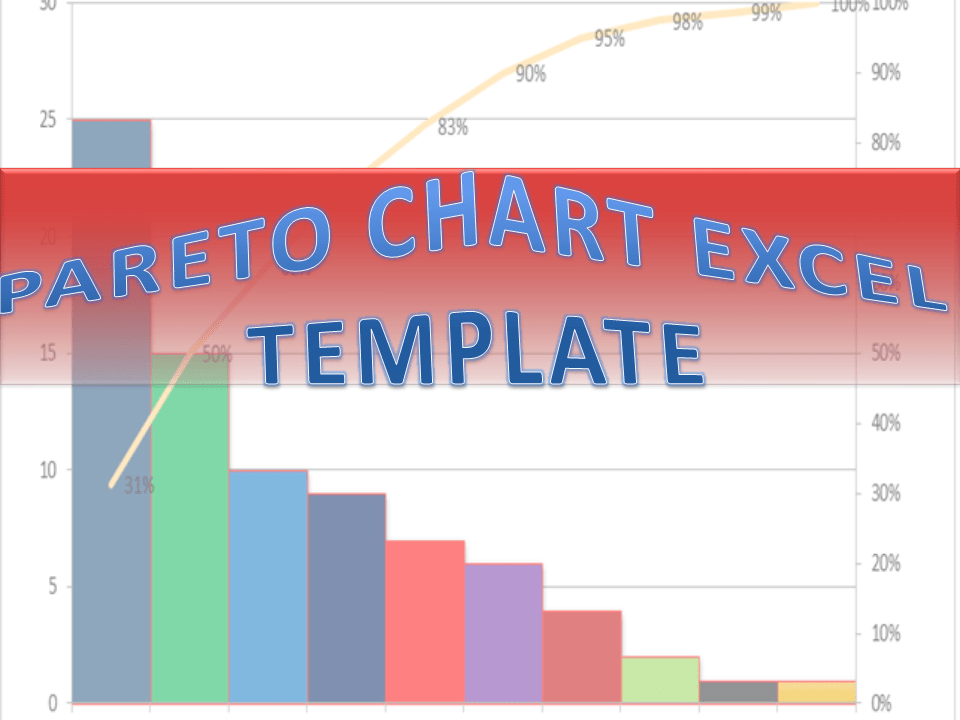
A Pareto Chart is named after the Italian Economist Vilfredo Pareto. It is a type of chart which contains both bars and a line graph, where the individual values are represented in the bar graph in descending order (largest to smallest value) and the cumulative percentage is represented in the line graph.
Purpose of Pareto Chart:
The purpose of the Pareto Chart is to indicate the Contributions among the set of data.
E.g. let us have six types of defects that we would like to know the most cumulative contributions among them those contributing the 90%, in such a scenario, we have to plot the Pareto Chart to know the 90% contribution with the help of line Chart, we simply cover the 90% level of line Chart, those are coming under the line graph will represent the 90% contribution. so simply Pareto Chart is helping here to identify the contribution.
Understanding the Pareto Chart principle (The 80/20 rule):
The Pareto principle is also known as the 80/20 rule derived from the Italian Economist Vilfredo,
The principle is understood as –
20% of the input creates 80% of the results
Or
80 % of the effects come from 20% of the causes.
Illustration of How to Plot Pareto Chart in Excel
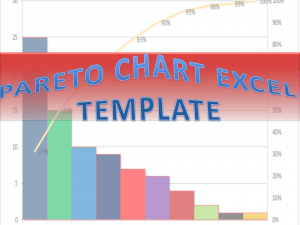
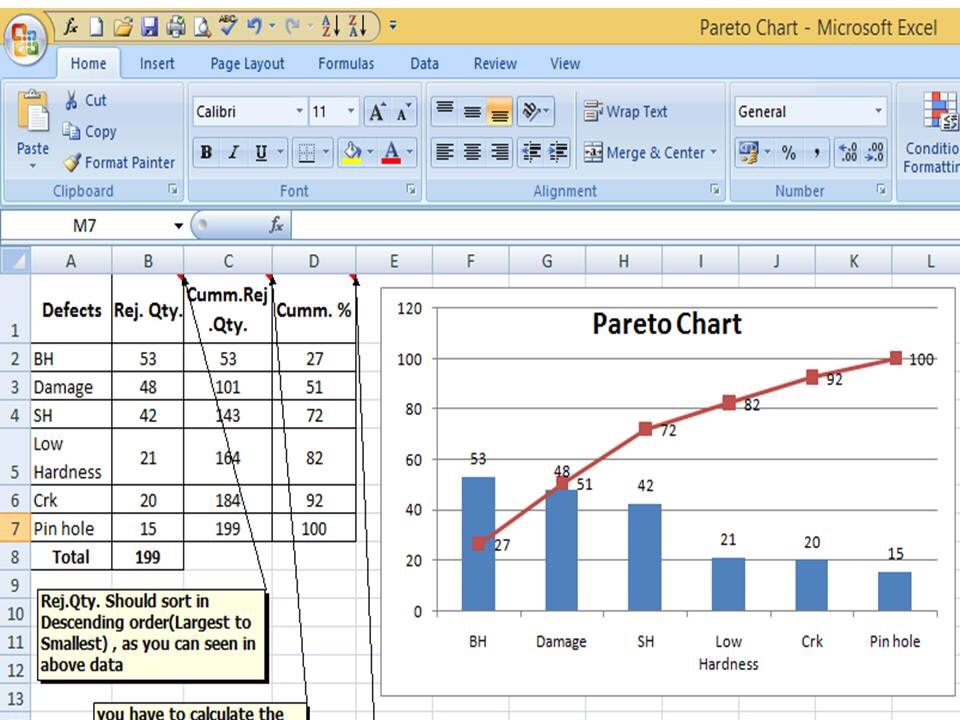
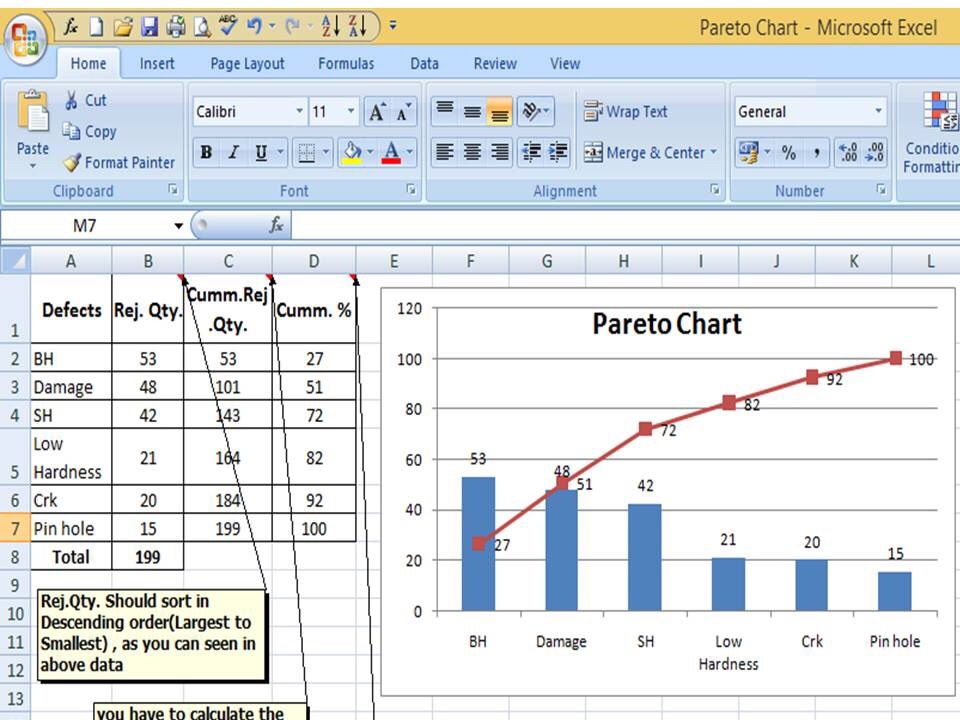
In the above Pareto Chart, we can see the cumulative% in the line graph, According to the Pareto Chart principle 80/20 rule, the 80% cumulative in the line graph is filling under the low hardness, which means BH, Damage, SH and Low hardness defers are coving the 80% of contribution over total types of defects. And those 80 % contributions were due to the 20% of the cause.
Advantages of Pareto Chart:
1. To optimize the production
2. Reduces the Rejections
3. Reduce the COPQ/COQ
4. Improve the quality
5. Improve the performance of the product
6. Improve the customer satisfaction
7. Reduce the rework cost.
Etc.
How to Plot Pareto Chart in Excel ( with example):
Step -1
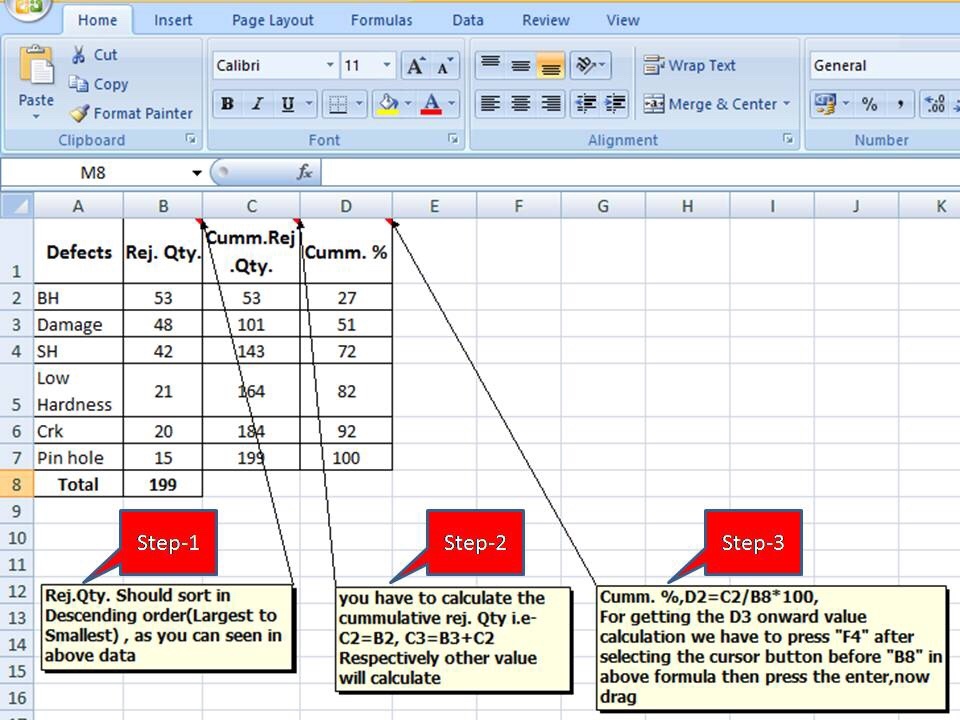
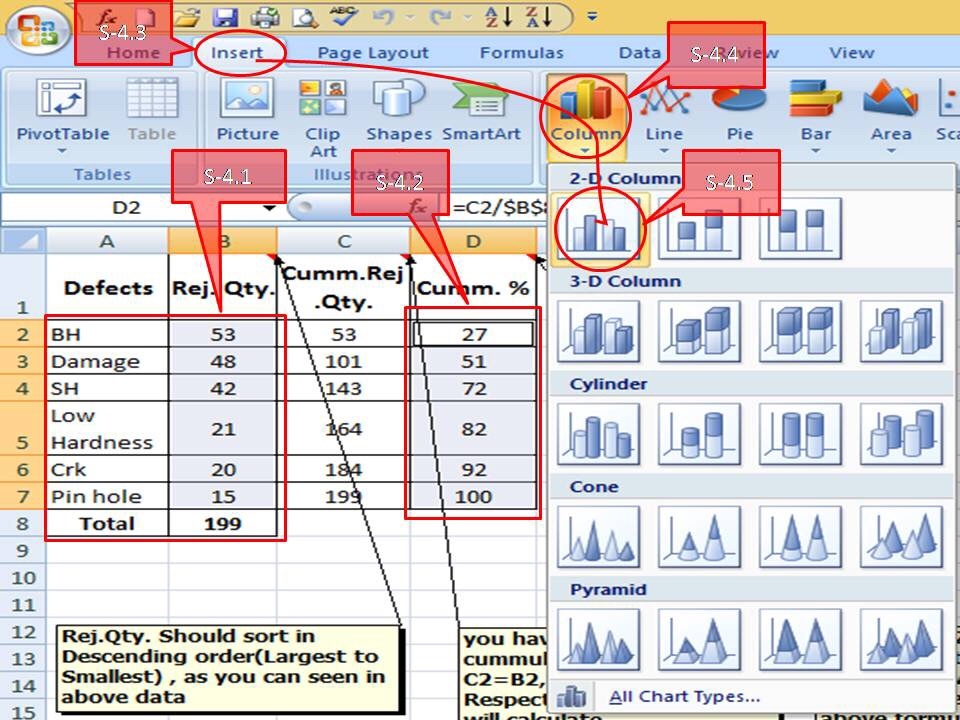
We have six types of defects BH(Blow Hole), Damage, SH(Shrinkage), Low hardness, Crk( Crack), and pinhole, and the total rejection quantity is 199. So now we have to arrange/sort the rejection Quality value in descending order (largest to smallest)
Then we have to calculate the cumulative rejection quantity and cumulative % as per the below step ( from steps 1 to 3)
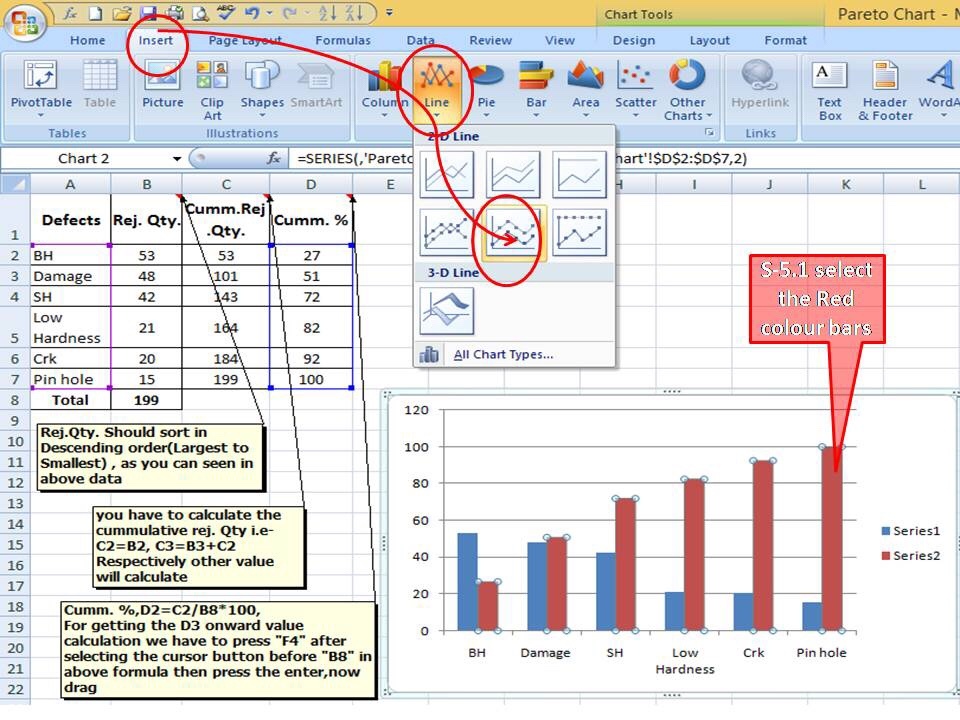
As described above, the Rejection quantity should be sorted in descending order(Largest to smallest), then you have to calculate the cumulative rejection quantity i.e C2=B2, C3=B3+C2, respectively other values need to be calculated, and finally Cumulative %, D2=C2/B8x100, for getting the D3 onward value calculation, we have to press “F4” after selecting the cursor button before “B8” in the above formula then press the enter, now drag.
Step -2
Now you have to select defects, rejection quantity, and cumulative % column as per the above, and then go to the insert column and select the bar chart. Simply follow the steps(From S-4.1 to S-4.5) given in above.
Step -3
After selecting the bar chart, just follow the steps (select “insert” in the Excel sheet then line and finally select the “Line” graph) as described below ( convert the red colour bar into the line Chart )
After the conversation of the secondary red colour bar into the Line Chart, the Pareto Chart will be ready to use as
In the above Pareto chart, you can see the bar represents the defect’s Rejection quantity and the line represents the contribution of the cumulative percentage.
Example:
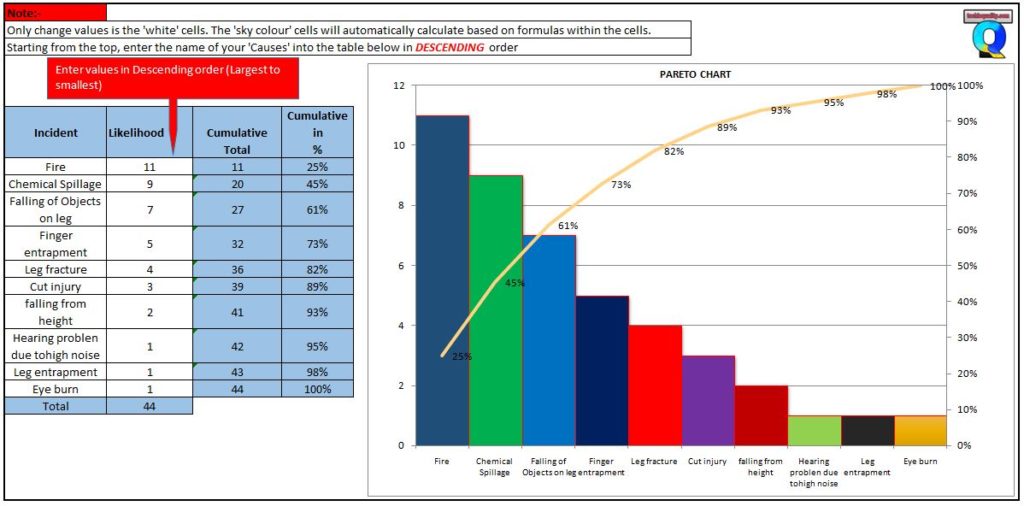
A total of 44 numbers SHE-related incident has been registered in the manufacturing industry in the last couple of financial year. To know the contribution of the individual incidents the SHE officer prepared the Pareto chart. The same Pareto chart is given below.
you can follow the below steps to analyze the Pareto chart;
Collect the data.
plot a Pareto chart with the help of the above steps.
Apply the 80:20 rules/principle.
select the defects under 80% contribution
Brainstorm the potential cause.
Do the hypothesis test or validate the potential cause to find out the significant cause.
Do the RCA
Take the action plan
Implement the plan.
Monitor the effectiveness.
Example-2 of How to Plot Pareto Chart in Excel
Plot the Pareto chart of the given below data.
Defects
Rejection Quantity
A
100
B
80
C
70
D
50
E
30
follow the below steps to plot the Pareto chart
Step-1:
First of all, calculate the cumulative rejection quantity
Defects
Rejection Quantity
Cumulative Rejection Quantity
A
100
100
B
80
180
C
70
250
D
50
300
E
30
330
Step-2:
calculate the cumulative rejection %
Defects
Rejection Quantity
Cumulative Rejection Quantity
Cumulative rejection %
A
100
100
30
B
80
180
55
C
70
250
76
D
50
300
91
E
30
330
100
Step-3:
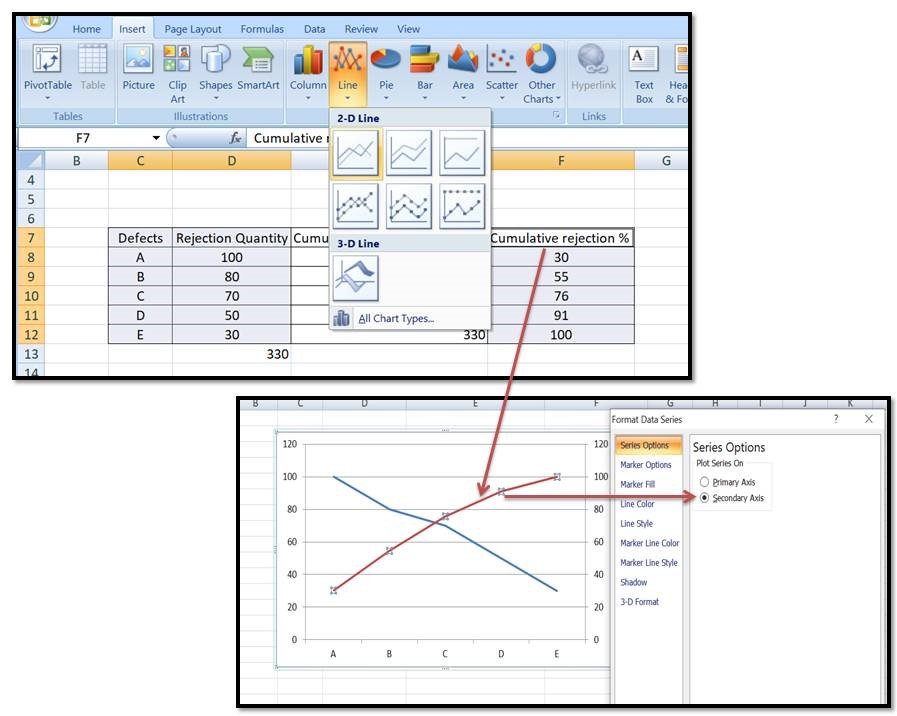
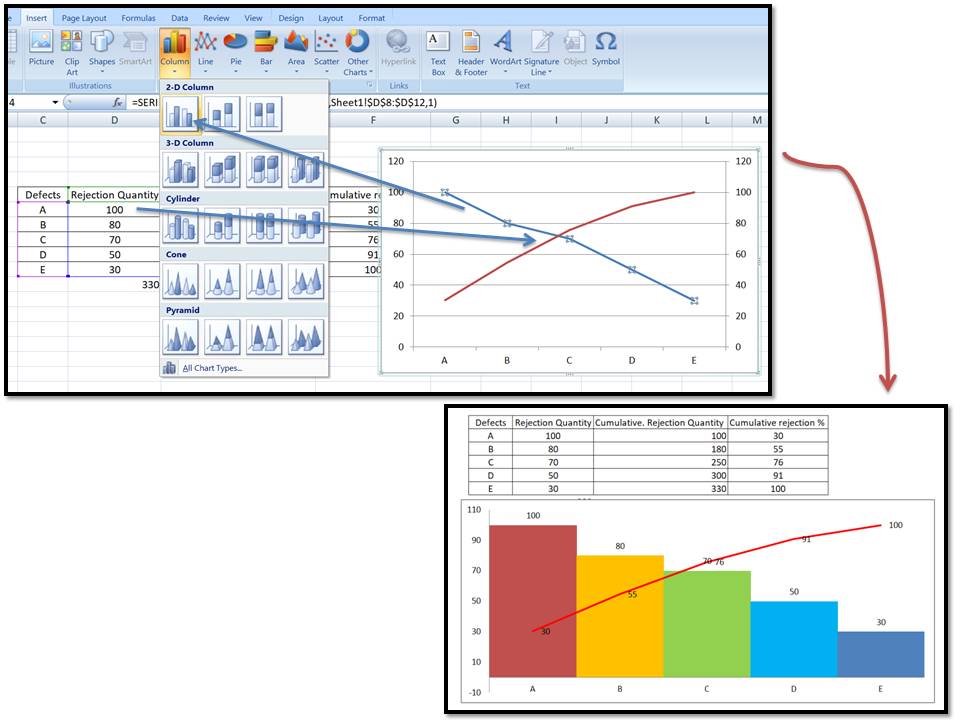
Select the Defects, Rejection quantity, and cumulative rejection % column, and then go to the Insert—>>Line chart. once you select the line chart then, select the cumulative rejection% line chart as the secondary axis. go through the below image for a better understanding.
Step-4:
Select the rejection quantity line chart and then, go to the insert——>>Column chart. now the Pareto chart is ready, if you want to customise the colour, and gap then do it manually for a better visual effect.
Our Author is an experienced professional in Quality Management Systems, Quality Assurance, Operations, and Business Excellence, with cross-industry expertise in Automotive, AMR, Robotics, Battery Manufacturing, Foundry, and Sheet Metal industries. He has strong expertise in international standards including IATF 16949, ISO 9001, ISO 14001, ISO 45001, and ISO 17025, along with methodologies such as TQM, TPM, and Six Sigma. He holds a degree in Mechanical Engineering along with an MBA, combining strong technical acumen with strategic business insight, he is a Certified Internal Auditor, Lead Auditor, and Six Sigma Black Belt, with a proven track record in driving quality transformation and operational excellence.
Through TECHIEQUALITY, he shares practical insights, quality tools, and industry best practices to help professionals improve processes and achieve operational excellence.