Swot Analysis of a Company Challenges

Company Challenges

Swot Analysis of a Company Challenges:

Hello Readers! Today, we will discuss the top challenges of a small company these are often facing. Same we will analyze here through SWOT Analysis. As you know SWOT analysis is a very popular tool and a strategic planning technique, which is generally used to identify strengths, weaknesses, opportunities, and threats. So with the help of that, we will identify the top business challenge’s Weaknesses, threats, and opportunities.  

DOWNLOAD the SWOT analysis report of the top challenges of a company in an Excel file.

Full-form & Basic Information about SWOT Analysis:

Strength: Advantages of Business Characteristics.

Weakness: Disadvantage of Business Characteristics.

Opportunity: Business Element that could be exploited to its advantage.

Threat: The Business element that could cause trouble for the business.

When to use SWOT Analysis:

You can use the SWOT analysis process in the below field but not limited to;

  • To overcome the Business concern types problem.
  • To explore a new opportunity in NPD, Process Defects, Design defects, Manufacturing defects, R/M Defects, Customer End defects, technology up-gradation, etc.

Top 8 Challenges of a Company:

  1. Technology up-gradation
  2. Investment Business Plan
  3. Timely NPD
  4. Manufacturing Process Control
  5. Legal challenges
  6. Raw material crisis
  7. Business Competition
  8. IR

SWOT Analysis:

Company Challenges
Company Challenges
I/PStrengthWeaknessOpportunityThreat
Technology up-gradation not in timelyThe Investment cost is low1. Low Productivity.
2. High COPQ.
3. High conversion cost.
4. Non-fulfillment of customer requirement w.r.t market value.
Re-engineering, value engineering, and NPD with a high-capacity automation system.1. Low sales value
2. Customer Dissatisfaction
3. Business losses.
Investment business PlanLimited products required less time to produce1. Raw material crisis
2. Low Production Volume
3. Non-fulfillment of the statutory and regulatory requirements.
4. IR problem
Comprehensive business plan with contingency plan/ emergency planCompany shut-down
Legal challenges1. Raw material crisis
2. Low Production Volume
3. Non-fulfillment of the statutory and regulatory requirements.
4. IR problem
Fulfillment of statutory and regulatory requirementsCompany shut-down
SWOT Analysis Example

Top 6 Marketing Issues:

  1. Sales Issue.
  2. Reputation Issue.
  3. Operations Issue.
  4. Price Issue.
  5. Demand Issue.
  6. Brand Issue.

For Top 6 Marketing Issues, we have separately written articles, if you are interested in reading then CLICK-HERE.

Useful Articles:

SWOT Analysis Formats

SWOT Analysis Word Template

Histogram Template with example | Download

Histogram Example | Foundry Industries Examples

Pareto Chart Example of Manufacturing Units

Thank you for reading…..Keep visiting Techiequality.com

Please let me know if you have any questions.

Popular Post:

SWOT Analysis Formats

SWOT Analysis Formats

SWOT Analysis Formats:

SWOT Analysis Formats are very useful tools for the identification of Risks in several operations. As you know the SWOT Analysis is a strategic planning technique, which is generally used to identify the strengths, weaknesses, opportunities, and threats related to the context of the organization. So here we have uploaded several customized SWOT Analysis Formats or templates. Just go through the below links and download the Formats.

DOWNLOAD [ SWOT Analysis Template in Excel]

SWOT Analysis Formats [DOWNLOAD Below]

SWOT Analysis Formats
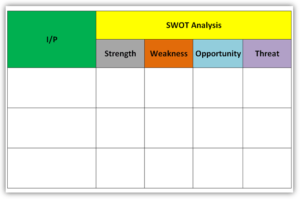
  • I/P: This is the input points that you would like to do the SWOT analysis. For example, several factors and business issues (Internal and External).
  • Internal issues example: policy, Standards, business strategy, labour strikes, Major accidents, Raw material Crisis, etc.
  • External Issues Example: Legal, Customer Contract, Profit loss, loss in share market, etc.
  • Strength: Advantages of Business Characteristics.
  • Weakness: Disadvantage of Business Characteristics.
  • Opportunity: Business Element that could be exploited to its advantage.
  • Threat: The Business element that could cause trouble for the business.

When to use SWOT Analysis:

You can use the SWOT analysis process in the below field but not limited to…;

  • To overcome the Business concern types problem.
  • To explore the new opportunities in NPD, Process Defects, Design defects, Manufacturing defects, R/M Defects, Customer End defectss, technology up-gradation, Socio-political issues, Internal factors, Issues to business strategy, etc.

Note: The SWOT Analysis tool is the best one to use for identifying the Risk and Opportunity of several Business system standards like IATF 16949, ISO 9001, ISO 14001, ISO 45001, ISO 31000, etc.

SWOT Analysis Examples in several Activities:

Swot Analysis of Marketing Operation

Detailed SWOT Analysis Examples

Useful Links:

Repeatability vs Reproducibility | Discussion of Key difference.
5’S Concept | what are 5’S?

Rework vs Repair |IATF Requirement for Control of Reworked/ Repaired Product

How to calculate Cp and Cpk? |Practical Case Study | Process Capability Example

How to plot the Run Chart in Excel | Run Chart Excel Template

Thank you for reading…. Keep visiting Techiequality.Com

Let us know if you have any questions…

Popular Post:

Sales vs Marketing |Top-5 Marketing Issue SWOT Analysis

Sales vs Marketing

Sales vs Marketing:

Hello Readers! Here, we will discuss the key difference between Sales vs Marketing operations. Sales and marketing are interrelated operations. Day by day digital marketing is becoming more effective than traditional marketing. Before doing digital marketing, we are supposed to know the basic difference between sales and marketing.

Top 5 Marketing Issue’s SWOT Analysis Report. [CLICK-HERE]

Sales vs Marketing:

Sales vs Marketing
Sales vs Marketing

MARKETING: It’s the strategic planning and execution of an effort to develop and support a brand name and broadcast offering to a defined audience. Several approaches should be adopted to promote the brand name and products through advertising, web, mail, etc.
  • Protect the brand reputation.
  • Understand customer-specific requirements and create products or services to fulfill their needs.
  • Target on massive population.
  • Marketing always gives focuses on customer needs and expectations.
  • To Promote the brand name, product, and service up to the relevant end users.
  • Long-term strategy on market value.
  • Comprehensive plan for becoming a world no.1 Brand in the market.
  • Marketing has a strong strategy to pull customers towards a company.

SALES: The number of Products or services that a company sells within a stipulated time period. The Best approach for sales operations is client relationship management.

  • Protect the Brand’s Customers.
  • Convince the customer that the product or service fulfills his needs and expectations.
  • Target on an individual traffic.
  • The sales strategy is to push out of the door.
  • Sales itself is an image of the brand.
  • It’s the one-to-one communication path.
  • Price is the most influential parameter w.r.t competitions.
  • The Sales aim is to persuade someone to buy it.

Useful Links:

SWOT Analysis Formats

SWOT Analysis Word Template

Detailed SWOT Analysis Examples

Control Chart in Minitab | How to plot a Control Chart in Minitab 18

8D Report Example | Download Case Study Report:

Thank you for reading…. Keep visiting Techiequality.Com

Let us know if you have any questions…

Popular Post:

Histogram Template with example | Download

Histogram Template

Histogram Template with example | Download

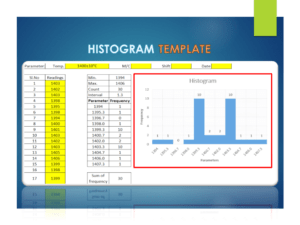
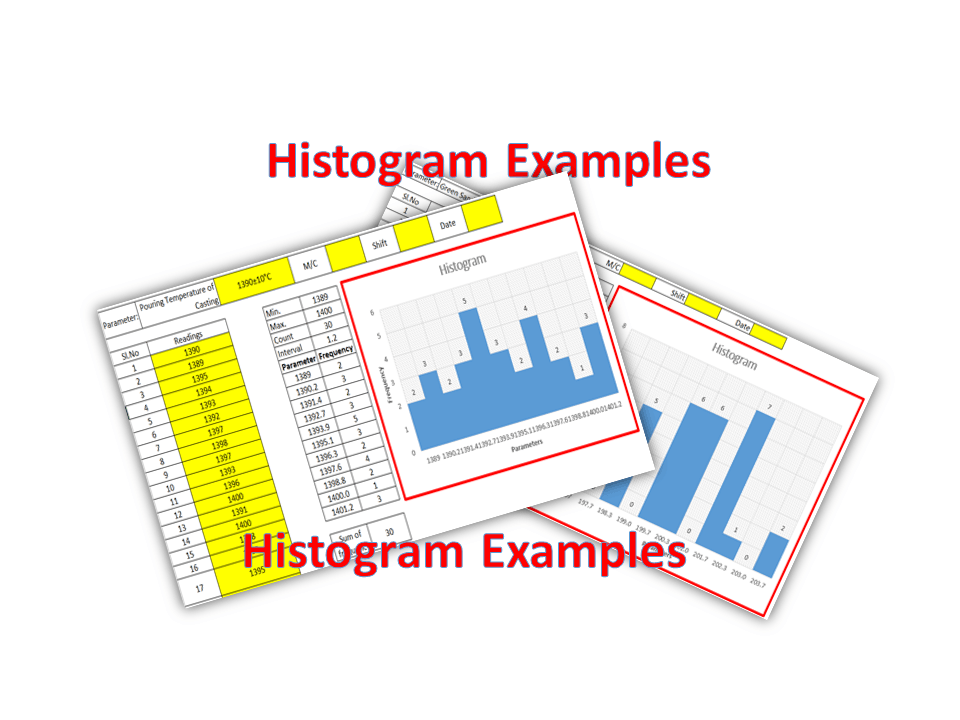
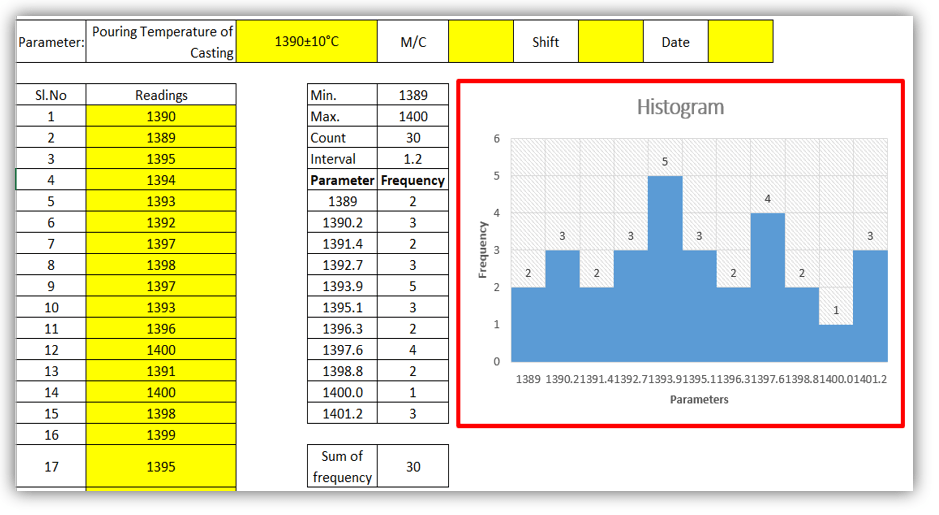
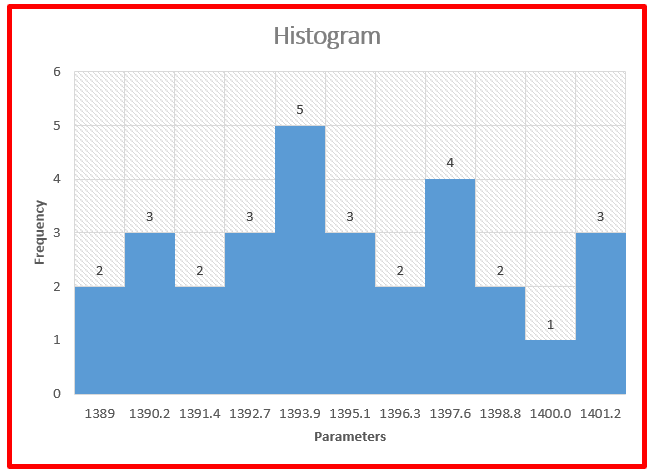
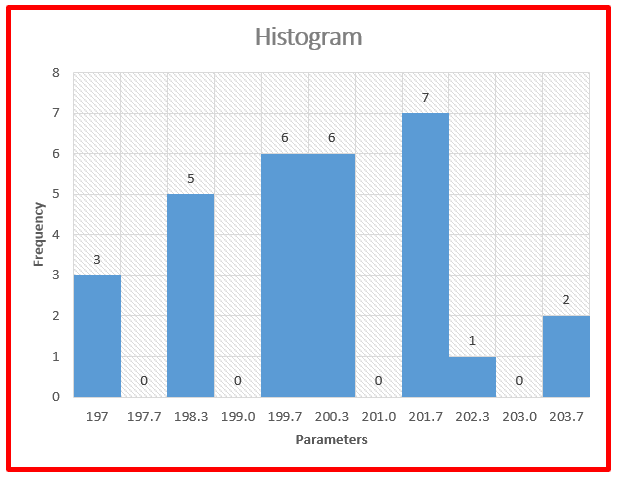
The Histogram Template is prepared in a simple format with an industrial example. We have described the example in below, just go through this article and Download the Template / Format. It’s a very useful tool and is frequently used in manufacturing industries. The main function is to know the frequency distribution, symmetry, and skewness, and it also helps to determine the normality of data by drawing the bell curve.

DOWNLOAD [Histogram Template in Excel format].

Histogram Template
Histogram Template

Basic Information on Histogram:

A histogram is one of the 7QC tools and commonly used graph to show frequency distribution. Helps summarize data from a process that has been collected over a period of time.

A histogram is a representation of the frequency distribution of numerical data. it was first familiarized by Karl Pearson. A histogram is related to merely one type of variable data. You should calculate the interval value to represent the bins. Bins shall give an idea about the how much data falls within the selected data range’s width. Histogram gives the indication about data distribution as normal, skewed, or bi-modal.

How to use our Histogram Template:

Step-1: Download the Histogram Template from the above link.

Step-2: Carefully read the “Note” mentioned in the Excel template.

Step-3: Enter the reading only in the yellow color box. Then other values will calculate automatically and your histogram will be ready for interpretation.

Note:

1. Only yellow colour boxes are changeable

2. Make sure that the sum of frequency is equal to the total count, e.g. sum of frequency in a given example [example is given in histogram excel format, just download and see the example] is 30 and the count is also 30, if not then you have to adjust the parameters and frequency table in frequency distribution format for doing so click on the link given “How to adjust parameters and frequency table in Histogram Template?”.

Useful Links:

How to Plot Pareto Chart in Excel ( with example)

What is SPC | SPC Tools?

Corrective and Preventive Action Format | CAPA with Example.

OEE Calculation-How To Calculate OEE (Overall Equipment Effectiveness) with Example

Implementation of KAIZEN in Industry

Thank you for reading…. Keep visiting Techiequality.Com

Let us know if you have any questions…and drop your comments below.

Popular Post:

Detailed SWOT Analysis Examples

Detailed SWOT Analysis Examples

Detailed SWOT Analysis Examples:

Hello Readers! Today’s topic is a very interesting and useful topic that I am going to describe in detail in the SWOT Analysis process with many more examples. As you know SWOT Analysis is a strategic planning technique, which is generally used to identify strengths, weaknesses, opportunities, and Threats related to the context of the organization. If you would like to download the template with Detailed SWOT Analysis Examples, then go through the given below link.

SWOT Analysis Template / Format.  [DOWNLOAD]

Detailed SWOT Analysis Examples

Strength: Advantages of Business Characteristics.

Weakness: Disadvantage of Business Characteristics.

Opportunity: Business Element that could be exploited to its advantage.

Threat: The Business element that could cause trouble for the business.

When to use SWOT Analysis:

You can use the SWOT analysis process in the below field but not limited to;

  • To overcome the Business concern types problem.
  • To explore new opportunities in NPD, Process Defects, Design defects, Manufacturing defects, R/M Defects, Customer End defects, technology up-gradation, etc.

Note: The SWOT Analysis tool is the best one to use for identifying the Risk and Opportunity of several Business system standards like IATF 16949, ISO 9001, ISO 14001, ISO 45001, ISO 31000, etc.

DOWNLOAD QA & QC Template / Formats

Detailed SWOT Analysis Examples:

Here, we are going to do the SWOT analysis of beneath Examples. So carefully read the Examples.

EXAMPLES:

  1. A Mobile manufacturing company has launched a mobile phone and after six months, the company’s particular product got more customer complaints due to screen issues causing a loss of brand image in the market. And accordingly, the company loses the 10% sales values of the previous.
  2. Rejection percentage of Mobile PCB is increased from 1% to 1.35%.

SWOT Analysis of Example-1

I/PStrengthWeaknessOpportunityThreat
Loss of brand ImageService Centers, Well-developed R&D Centre, QA teams, Latest Technology, QA Testing.Screen issues like a black spot on the screen, Flickering black screen, and Vertical split screen due to manufacturing problems (Special causes).Upgradation of screen quality through value engineering.10% sales loss, Customer Dissatisfaction, and Business losses.
detailed swot analysis examples
 SWOT Analysis of Example-2
I/PStrengthWeaknessOpportunityThreat
High Process RejectionProcess characteristics validation, Inspection, Checking, and Testing.Shortage of highly skilled labors, More variation in the process.Strengthen the on-Job TrainingCustomer dissatisfaction, Profit loss.
Detailed SWOT Analysis Examples

Useful Articles:

Process Capability Analysis |Cp & Cpk Calculation Excel Sheet with Example

Verification vs Validation | What is difference between verification and validation?

Kaizen vs Innovation | Key Differences between Kaizen and Innovation

Corrective Action vs Preventive Action

Thank you for reading…..Keep visiting Techiequality.com

Please let me know if you have any questions.

Popular Post:

SWOT Analysis Word Template

SWOT Analysis Word Template

SWOT Analysis Word, Excel, PDF and PPT Template:

Hello Readers! Download the SWOT Analysis Word Template, and also in Excel, PDF, and PPT from. Links are given below.

DOWNLOAD– QA & QC Format

The SWOT Analysis is a strategic planning technique, which is generally used to identify the strengths, weaknesses, opportunities, and threats related to the context of the organization.

DOWNLOAD the SWOT Analysis Templates / Formats in Word, Excel, PDF, and PPT form:

Illustration of Template / Format:

SWOT Analysis Word Template
  • I/P: This is the input points that you would like to do the SWOT analysis. For example, several factors and business issues (Internal and External).
  • Internal issues example: policy, Standards, business strategy, labor strikes, Major accidents, Raw material Crisis, etc.
  • External Issues Example: Legal, Customer Contract, Profit loss, loss in share market, etc.
  • Strength: Advantages of Business Characteristics.
  • Weakness: Disadvantage of Business Characteristics.
  • Opportunity: Business Element that could be exploited to its advantage.
  • Threat: The Business element that could cause trouble for the business.

When to use SWOT Analysis:

You can use the SWOT analysis process in the below field but not limited to;

  • To overcome the Business concern types problem.
  • To explore the new opportunities in NPD, Process Defects, Design defects, Manufacturing defects, R/M Defects, Customer End defects, technology up-gradation, Socio-political issues, Internal factors, Issues to business strategy,  etc.

Note: The SWOT Analysis tool is the best one to use for identifying the Risk and Opportunity of several Business system standards like IATF 16949, ISO 9001, ISO 14001, ISO 45001, ISO 31000, etc.

EXAMPLES:

A car manufacturing company has lost its car sales 30% of the average of the last six months’ sales. After that, top management decided to do a SWOT analysis to identify the opportunity and their major threats.

SWOT Analysis (Example): 30% reduction in sales

I/PStrengthWeaknessOpportunityThreat
30% reduction in salesOffer in some special car, Low price, Low maintenance, Features w.r.t customer needs, etc.Lack of Digital and traditional marketing, Cost reduction, and old aesthetical view. Old interior designRedesign of Car, Electric car.Company Shut down, Decline in sales turn-over.
example

Useful Articles:

Detailed SWOT Analysis Examples

How to calculate Cp and Cpk? |Practical Case Study | Process Capability Example.

How to plot the Run Chart in Minitab

How to do Capability Analysis by Minitab 18? | Minitab Process Capability Tutorial

Thank you for reading…..Keep visiting Techiequality.com

I hope the above is useful to you.

Popular Post:

Swot Analysis of Marketing Operation

Swot Analysis of Marketing

Swot Analysis of Marketing Operation:

Hello Readers! Today, we will describe marketing-related Top 5 issues through SWOT Analysis.  As you know SWOT Analysis is a strategic planning technique, which is generally used to identify strengths, weaknesses, opportunities, and threats related to the context of the organization.

SWOT Analysis Template – [DOWNLOAD in Excel]  [DOWNLOAD in Word].

Swot Analysis of Marketing

The SWOT:

Strength: Advantages of Business Characteristics.

Weakness: Disadvantage of Business Characteristics.

Opportunity: Business Element that could be exploited to its advantage.

Threat: The Business element that could cause trouble for the business.

When to use SWOT Analysis:

You can use the SWOT analysis process in the below field but not limited to;

  • To overcome the Business concern types problem.
  • To explore a new opportunity in NPD, Process Defects, Design defects, Manufacturing defects, R/M Defects, Customer End defects, technology up-gradation, etc.

Note: The SWOT Analysis tool is the best one to use for identifying the Risk and Opportunity of several Business system standards like IATF 16949, ISO 9001, ISO 14001, ISO 45001, ISO 31000, etc.

Top 6 Marketing Issues:

  1. Sales Issue.
  2. Reputation Issue.
  3. Operations Issue.
  4. Price Issue.
  5. Demand Issue.
  6. Brand Issue.

SWOT Analysis of the above major top marketing Issues are illustrated below;

list
Swot Analysis of Marketing

Sales Issue:

SWOT Analysis of  Sales Issue:

I/PStrengthWeaknessOpportunityThreat
Sales IssueHigh-performing salesperson, Traditional Marketing, Digital marketing, Strong supply ChainLimited product range w.r.t market demand, High competitive product, High Product cost.A Variety range of products needs to be introduced in the marketA Drop down of sales quantities, Profit Loss, and The Company shut down.

Reputation Issue:

SWOT Analysis of  Reputation Issue:

I/PStrengthWeaknessOpportunityThreat
Reputation IssueA good relationship with the customer, High Customer Satisfaction, Excellent Vendor performancePoor customer ServicesTo enhance customer service through supply chain management.Profit loss, A drop-down of sales quantities

Operation Issue:

SWOT Analysis of  Operation Issue:

I/PStrengthWeaknessOpportunityThreat
Operation IssueAdvanced R&D Centre, Quick New Product development, Strong QC TeamSupply chain problem, Poor inventory levels.Strengthen the supply chain managementProfit loss, A drop-down in sales quantities, Loss in the Brand image, Loss in market demand

Useful Articles:

SWOT Analysis Word Template

SWOT Analysis Examples

Verification vs Validation | What is difference between verification and validation?

Kaizen vs Innovation | Key Differences between Kaizen and Innovation

Thank you for reading…..Keep visiting Techiequality.com

Please let me know if you have any questions.

Popular Post:

Repeatability vs Reproducibility | Discussion of Key difference.
Repeatability vs Reproducibility

What is the difference between Repeatability & Reproducibility?

Hello…Readers! Today here we will discuss the frequently used terms in an industry i.e. Repeatability vs Reproducibility. These two wards are more familiar with Measurement system analysis. So don’t waste your time and go through the below article and enhance your knowledge. If you are further looking for a similar type of article, then click on below links/ topic.
Reproducibility vs Repeatability :

Repeatability vs Reproducibility

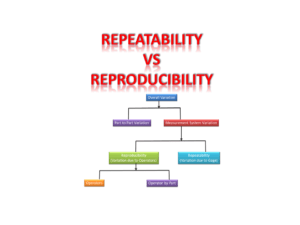
Repeatability: Variation due to Gage.

As per the MSA Manual, The common cause, random variation resulting from successive trials under defined conditions of measurement. Often denoted to as equipment variation (EV), although this is misleading. The best term for repeatability is within-system variation when the conditions of measurement are fixed and defined the fixed part, instrument, standard, method, operator, environment, and assumptions. In addition to within equipment variation, repeatability will include all within variations from the conditions in the measurement error model.

It’s an Equipment variation.

Reproducibility: Variation due to Operators.

As per the MSA Manual, The variation in the average of measurements is caused by a normal condition(s) of change in the measurement process. Naturally, it has been defined as the variation in average measurements of the same part between different operators using the same measuring instrument & method in a stable environment. This is frequently true for manual instruments influenced by the skill of the operator. It is not true, however, for measurement processes (automated systems) where the operator is not a major source of variation. For this reason, reproducibility is mentioned as the average variation between systems or between conditions of measurement.

It’s a variation due to the operators, measuring the same part using the same measuring instrument and method in a stable environment.

Useful Articles:

5’S Concept | what are 5’S?

The Key difference between Corrective Action and Preventive Action.

Process Capability Analysis |Cp & Cpk Calculation Excel Sheet with Example.

How to calculate Cp and Cpk? |Practical Case Study | Process Capability Example

Repeatability vs Reproducibility
DOWNLOAD FREE FORMAT

Thank you for reading…..Keep visiting Techiequality.com

If you require any further information, feel free to contact us.

Popular Post:

Verification vs Validation | What is difference between verification and validation?

What is difference between verification and validation

What is difference between verification and validation?

Hi readers! Today we will discuss an important topic i.e. What is difference between verification and validation.

Verification: Am I building the product right?

  • Evaluating the process and product in the developing stage.
  • It is performed to build a product in the right way.
  • The verification process generally comes first done before validation.
  • It is the process, to ensure whether we are manufacturing the product according to drawing/ Standard/ specification or not.
  • It is a low-level activity.
  • Example: Inspection, Document review, Checking, etc.

Example of Verification:

Let us say that you are producing the mobile case covers, and you are checking the dimension of 100% product at the molding section and ensuring that the product is manufactured according to the Drawing.

Validation: Am I building the right product?

  • A process of seeing whether the product satisfies the customers’ requirements or not.
  • It is performed to build the right product.
  • The validation process is generally followed after verification.
  • It is the process of validating whether the product which we have developed is right or not.
  • It is a high-level activity.
  • Example: In-process testing, final product testing.

      Example of Validation:

After verification of the Mobile case cover, now the Test Team member will do the appropriate test to validate such products that meet the customer needs like fitment, color testing, drop testing, etc.

I hope that the above example is useful to you and you understand well. And if are searching for a similar type of topic to enhance your knowledge then the below articles will help you to enrich and enlarge your ken.

Useful Articles:

5’S Concept | what are 5’S?

Kaizen vs Innovation, Differences between Kaizen and Innovation.

The Key difference between Corrective Action and Preventive Action.

Rework vs Repair |IATF Requirement for Control of Reworked/ Repaired Product.

Process Capability Analysis |Cp & Cpk Calculation Excel Sheet with Example.

How to calculate Cp and Cpk? |Practical Case Study | Process Capability Example

What is difference between verification and validation
DOWNLOAD FREE TEMPLATE/ FORMAT

What is difference between verification and validation?

Thank you for reading…..Keep visiting Techiequality.com

If you require any further information, feel free to contact us.

Popular Post:

5’S Concept | What are 5’S?

Hi readers! today we will discuss a popular and important topic that is widely used in the industry i.e. 5’S Concept

What is 5’S Concept

5’s are the techniques for organizing the work effectively and safely. It helps people to do their jobs without wasting time or injury. 5’S is the base pillar of TPM (Total productive maintenance) and TPS (Toyota Production System).

What are 5’S?

Five Japanese words In English
1-S: Seiri 1-S: Sort
2-S: Seiton 2-S: Set in Order
3-S: Seiso 3-S: Shine
4-S: Seiketsu 4-S: Standardize
5-S: Shitsuke 5-S: Sustain
5’S Concept
5’S Concept

History:

The concept 5’S was initiated as part of the TPS [Toyota Production System] at the Toyota Motor Company in the early and mid-20th century. This system is often used in Lean manufacturing and TPM [Total Productive Maintenance].

Advantages of 5’S Concept:
  • Easy Accessing.
  • Better work environment.
  • Reduced costs
  • High quality
  • Increased productivity
  • A safer work environment

Illustration of 5’S:

1-S: Sort:

The first step of 5’S is the “Sort”, simply in this process, we have to remove the unwanted materials and to determine what needs to be present. If required for any situation to take the decision together with the lime manager at that situation we can use the Tag system (Red tag and yellow tag).

The below questions will help you to do the sorting in your work areas.

Q1: Does it really need to be here or not?

Q2: What is the tenacity of this item?

Q3: How often is it used?

Ask these questions during the sorting operation and make also a work layout.  

2-S: Set in Order:

It means neatness. Always follow the golden rule of “Place for everything and everything in its place”

Follow the below steps to “set in order”:

  • Identify each and every item.
  • Lay down the Work layout of each workstation/zone.
  • Keep the items nearest to the point of use.
  • Ensure easy accessibility, and easy retrieval, Minimize the inventories.
  • Mark the gangway and foot stoppage on the shop floor for safe and easy movement of men and materials.

In this way, you can easily store the essential material in the appropriate location. You will get so many advantages after the effective implementation of 2-S as;

  • Improves workplace utilization.
  • Reduce the inventory level.
  • Create a safe work environment.
  • Helps reduce time consumed in searching for materials for use.
3-S: Shine:

Cleaning is not a job; it is a frame of mind.

In many places, cleaning is considered as a separate job. A workman feels that it is not his job to clean the machine. So to overcome their thinking, the culture has to come from top management to the bottom-most designation. First of all, we have to clean our table, and chairs without waiting for the sweeper or peon. We have to follow the three-step approach as Macro level, Individual Level, and Micro Level. During the 3-S operation, we can also put the tag, if we will find the Problems like electrical, mechanical, civil, etc. in the workplace.

4-S: Standardize:

The 4-S is the Standardization, this means ensuring whatever cleanliness and orderliness have been achieved through improvement in Sort, Set in Order, and Shine have to be standardized.

You can follow the below-mentioned methodology to achieve standardization:

  • Prepare a 5-S SOP or Manual.
  • Lay down the Work Layout of every work zone.
  • Standardize the cleaning kits.
  • Visual management.
5-S: Sustain:

This is the last step but not the least, it’s a Sustain.

Define the rules and responsibilities of each zone member and make them aware of the 5-S benefit. If some practices are not followed, analyze the root cause of failure. Carry out the 5-S audit on a periodic basis and appreciate the best zone.

Useful Articles:

5’S Concept
DOWNLOAD FREE FORMAT

Thank you for reading…..Keep visiting Techiequality.com

I think the article “5’S Concept” is useful to you…If you require any further information, feel free to contact me.

Popular Post: