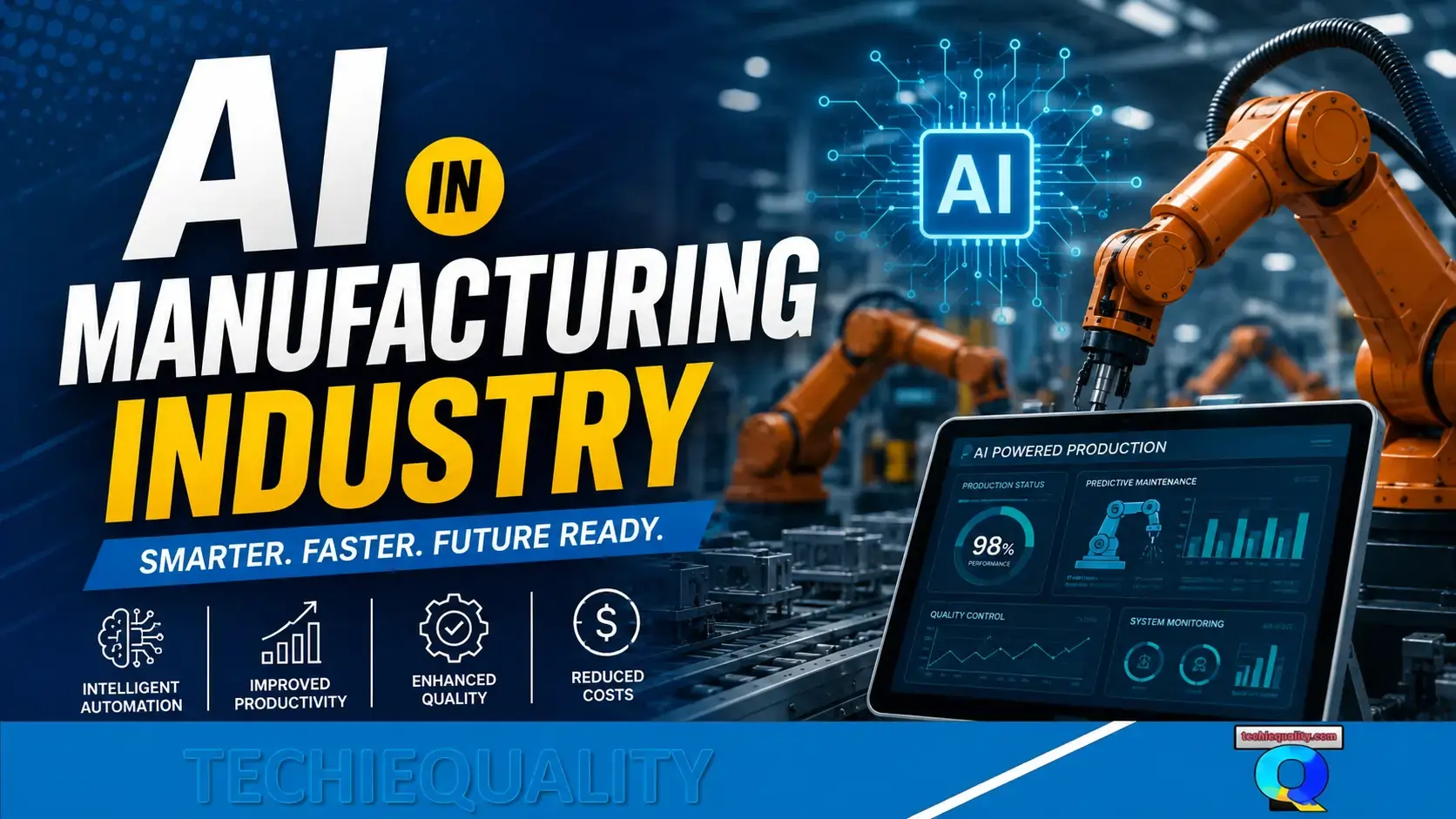
AI in Manufacturing Industry | What to upskilled w.r.t AI
Hello readers! Today we will be discussing on AI in Manufacturing Industry. In the future artificial intelligence will be taken vital roles in the manufacturing industry, not only the manufacturing industry any other industry as well. So, it’s most important to upskill ourself with respect to time and the situation of the market. AI will also be taking a very important place in industry revolutions like industry revolution 4.0, 5.0 (Industry 4.0). Hence it is very important to know about the penetration of AI in many domains and functions in the manufacturing industry including advantages, disadvantages, applications, and what we need to upgrade our self w.r.t AI perspective.
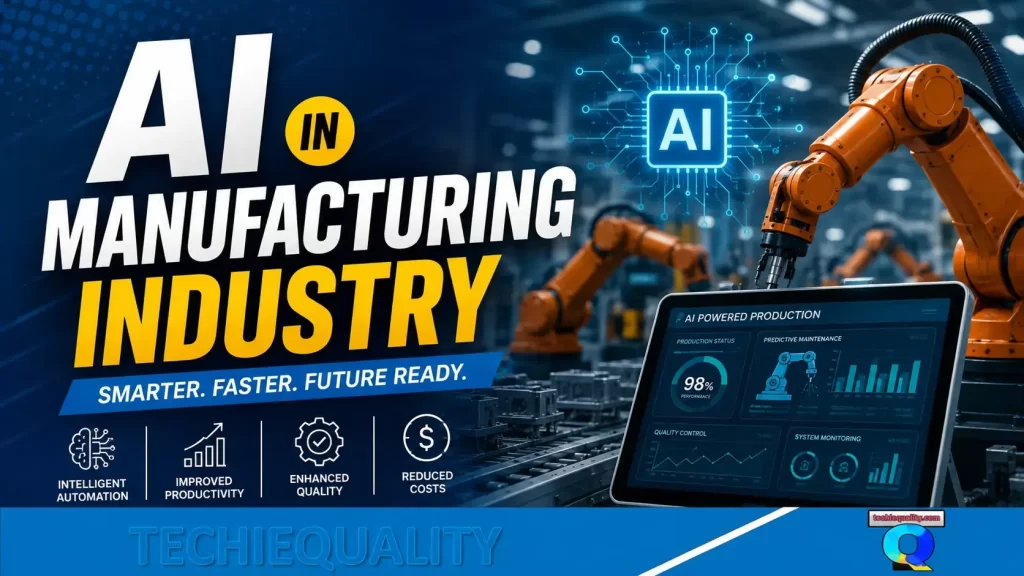
Advantages of AI in Manufacturing Industries:
Below are some advantages but not limited to;
- Efficiency and effectiveness will be increased
- High production and productivity.
- Smart factory
- Cost reduction.
- High business turnover
- Less human touch
- Best data analysis and decision-making through ML and AI.
- Repeated jobs can be done by robots
- Smart and digital SRM, SCM, and inventory management.
- Advanced and statically QC and QA activities, and many more points
The coin has two sides, similarly, everything has advantages and disadvantages inline so here also we will discuss about some disadvantages point but these are not limited to;
Disadvantages of AI in manufacturing industry:
- The high initial cost of implementation
- Data privacy and security issues
- Fully technology dependent
- Job losses for the workforce
- Production loss if there is a major malfunction of technology
As many people know, AI is penetrating in all processes of activities in many industries and people are worried about their jobs and activities but you can apply the AI in your work domain to improve productivity and efficiency. You can adopt the and upskill yourself in line with the application or full domain in AI.
We are going to know a little more details about the what and where AI may be taken as a vital point in application in the manufacturing industry in the future.
Some AI application areas in manufacturing industries are like;
- Quality checking and QA (Quality 4.0, 5.0, etc.)
- ML application.
- Smart factory
- Big data application
- Data science- analysis
- Digitalization (Digital factory)
- Digital operations like SCM, SRM, Logistics, and Inventory management are controlled fully digitally
- AI-based Robots
- Factory operation through IOT.
- IT operation
- Design
- Smart warehouse management
- Process automation
- Visual inspection and quality control.
- Cyber security
- Blockchain, etc.
- Automated Tasks
- Facial Recognition
- Cloud computing
- Chatbots, etc.
In one line we can say that AI and Industry 4.0 can change the entire scenario of the factory and its manufacturing operation methods. The repeated job can easily be done by AI-based robots, QA and QC activities will be done by itself machines through AI-based and by ML applications. Accuracy and visual inspection done by the workforce can be improved and advanced. IOT will take the smart area in the factory for connectivity and other factors. But as an employee like us, those who are working in AI-affected areas can easily be replaced but we can take the appropriate action before it affects to our work domain.
What should you do if you think your current job may be replaced by AI in the future?
I personally think that If I will be there in the same situation then, first of all, I need to understand the AI penetration in my work domain. I will look into the application of AI tools and if required then need to upskill myself fully in the AI-based domain. it may be difficult to change my domain into AI-based but for a better future and survival purpose, I have to adopt it.
FAQ:
1. What is AI in Manufacturing?
AI in manufacturing refers to the use of intelligent systems and machine learning algorithms to automate processes, analyse data, predict failures, and optimize production operations.
Example:
- Predicting machine failure before breakdown
- Detecting product defects using cameras
- Automating warehouse movement using AMRs/AGVs
- Optimizing production scheduling
2. What are the major applications of AI in manufacturing?
The major applications include:
- Predictive Maintenance
- Quality Inspection
- Robotics & Automation
- Demand Forecasting
- Process Optimization
- Supply Chain Management
- Energy Optimization
- Autonomous Mobile Robots (AMR)
Practical Example:
A factory installs vibration sensors on motors. AI analyses vibration patterns and predicts bearing failure before the machine stops.
Application of AI Agent for routine and repeated work flow.
AMR application for material movement.
Cobot and robot application for process job
QA and QC monitoring and data pattern analysis.
3. Explain Predictive Maintenance with an example.
Predictive Maintenance uses AI and sensor data to predict machine failures before they occur.
Sensors Used:
- Temperature
- Vibration
- Current
- Noise
- Pressure
Example:
A conveyor motor normally operates at 60°C. AI detects a gradual increase to 78°C along with abnormal vibration. The system generates an alert to replace the bearing before failure.
Benefits: Reduced downtime, Lower maintenance cost, Increased machine life
4. How does Computer Vision help in manufacturing?
Computer Vision uses AI cameras to inspect products automatically.
In a battery manufacturing line, AI cameras detect:
- Surface scratches
- Missing labels
- Improper welding
- Color mismatch
Instead of manual inspection, AI checks faster products with higher accuracy.
5. What is the role of AI in Quality Control?
AI improves quality control by:
- Detecting defects
- Reducing human error
- Performing real-time inspection
- Analysing production trends
Example:
An AI system compares a product image with a reference model and rejects defective parts automatically.
6. What is a Digital Twin?
A Digital Twin is a virtual replica of a machine, process, or factory.
Example:
A factory creates a digital model of an AMR system to simulate:
- Traffic flow
- Battery performance
- Route optimization
Before implementing changes physically, engineers test them virtually.
7. Difference between Automation and AI?
| Automation | AI |
| Follows fixed rules | Learns from data |
| Repetitive tasks | Intelligent decisions |
| No learning capability | Self-improving |
| Example: PLC Logic | Example: Predictive Analytics |
Practical Example:
- Conveyor ON/OFF using PLC = Automation
- AI predicting conveyor failure = Artificial Intelligence
8. What data is required for AI implementation in manufacturing?
AI requires:
- Sensor data
- Machine logs
- Production reports
- Quality records
- Maintenance history
- Operator inputs
Example:
For predictive maintenance:
- Temperature history
- Motor current
- RPM
- Vibration data
are collected continuously.
9. What challenges are faced while implementing AI in factories?
Common challenges include:
- Poor data quality
- High implementation cost
- Resistance from the workforce
- Legacy machine integration
- Cybersecurity risks
- Lack of AI expertise
Example:
Old machines without sensors cannot provide real-time data for AI systems.
10. What is Machine Learning in manufacturing?
Machine Learning allows systems to learn patterns from historical data and improve performance automatically.
Example:
An AI model studies past production defects and predicts which process settings may create future defects.
11. How is AI used in AMR (Autonomous Mobile Robots)?
AI helps AMRs:
- Navigate autonomously
- Avoid obstacles
- Optimize routes
- Manage battery usage
Practical Example:
An AMR carrying pallets in a warehouse changes route automatically when a worker blocks the path.
12. What KPIs improve after AI implementation?
Important KPIs include:
- OEE (Overall Equipment Effectiveness)
- Downtime Reduction
- First Pass Yield
- Production Throughput
- MTBF (Mean Time Between Failures)
- Energy Efficiency
Example:
AI-based predictive maintenance reduced downtime by 30%.
13. Explain AI-based defect detection.
AI-based defect detection uses:
- Cameras
- Deep learning
- Image processing
to identify product defects automatically.
Example:
AI detects:
- Cracks
- Misalignment
- Missing components
- Incorrect assembly
with higher accuracy than manual inspection.
14. What is Industry 4.0?
Industry 4.0 is the integration of:
- AI
- IoT
- Robotics
- Cloud Computing
- Big Data
- Smart Automation
into manufacturing operations.
Goal:
Create smart factories with autonomous decision-making.
15. A production machine suddenly stops frequently. How would AI help solve this issue?
Sample Answer:
First, sensor data such as vibration, temperature, and motor current would be collected. AI algorithms would analyse historical breakdown patterns and identify abnormal behaviour before failure occurs. Predictive maintenance alerts would notify maintenance teams in advance, reducing unexpected downtime.
16. How would you implement AI in a warehouse using AMRs?
Sample Answer:
I would:
- Identify repetitive material movement tasks
- Deploy AMRs with Lidar and AI navigation
- Integrate fleet management software
- Use AI for route optimization and traffic control
- Monitor battery health and utilization data
Expected Result:
- Reduced manpower
- Faster material movement
- Improved safety
- Higher efficiency
17. What skills are required for AI in manufacturing roles?
Key skills:
- PLC/SCADA basics
- Sensor knowledge
- Data analysis
- Python basics
- Machine learning fundamentals
- Industrial networking
- Robotics understanding
- Problem-solving
- DS
- AI Agent
- Deep Learning
18. Future of AI in Manufacturing
AI will continue to drive:
- Fully autonomous factories
- Human-robot collaboration
- Smart supply chains
- Self-healing machines
- AI-driven production planning
Expected Industry Trend:
Factories will move toward “Lights-Out Manufacturing” where minimal human intervention is required.
19. What is the role of AI in Quality Assurance?
1. Automated Defect Detection
AI systems use cameras and computer vision to identify defects automatically during production.
Example:
In battery manufacturing, AI cameras can detect:
- Surface scratches
- Improper welding
- Missing labels
- Colour mismatch
- Alignment issues
Benefit:
- Faster inspection
- Higher accuracy
- Reduced manual inspection effort
2. Predictive Quality Analysis
AI analyses historical production data to predict quality issues before defects occur.
Example:
If temperature and pressure variation normally cause product rejection, AI can identify the pattern early and alert operators.
Benefit:
- Prevents batch rejection
- Reduces scrap and rework
3. Real-Time Process Monitoring
AI continuously monitors:
- Machine parameters
- Sensor data
- Process stability
- Production trends
Example:
If a motor vibration exceeds the normal range, AI alerts the quality team before product quality is affected.
Benefit:
- Early issue detection
- Improved process stability
4. Root Cause Analysis
AI helps identify the actual cause of repeated defects by analysing large amounts of data quickly.
Example:
AI correlates:
- Shift timing
- Operator data
- Machine settings
- Material batch
to determine why a defect occurs repeatedly.
Benefit:
- Faster troubleshooting
- Reduced downtime
5. Intelligent Decision Making
AI supports QA teams by recommending corrective actions based on previous data.
Example:
If certain humidity conditions create packaging defects, AI suggests adjusting environmental settings automatically.
6. Reduction of Human Error
Manual inspections can miss small defects due to fatigue or inconsistency. AI provides consistent inspection performance.
Benefit:
- Standardized quality checks
- Better reliability
7. Statistical Quality Control Enhancement
AI improves traditional SPC (Statistical Process Control) by detecting hidden trends and abnormal patterns.
Example:
AI can predict process drift before products go out of specification.
8. AI in Predictive Maintenance for QA
Machine health directly impacts product quality. AI predicts equipment failures that could affect quality.
Example:
A worn-out roller causes dimension variation in products. AI predicts the issue before defects increase.
Future of AI in Quality Assurance
Future AI systems will provide:
- Self-learning inspection systems
- Autonomous quality control
- Digital quality twins
- AI-driven process optimization
- Zero-defect manufacturing
AI is becoming a core part of Industry 4.0 smart factories and modern manufacturing quality systems.
More on Techiequality









Shanti Gopal Pradhan is an experienced professional in Quality Management Systems, QA, Operations, Business Excellence, and Process Improvement. He has strong expertise in international standards including IATF 16949, ISO 9001, ISO 14001, ISO 45001, and ISO 17025, along with methodologies such as TQM, TPM, and Six Sigma.
He holds a degree in Mechanical Engineering along with an MBA, combining strong technical acumen with strategic business insight, he is a Certified Internal Auditor, Lead Auditor, and Six Sigma Black Belt, with a proven track record in driving quality transformation and operational excellence.