why why analysis methodology | 5-why analysis step by step guide

why why analysis methodology

why why analysis methodology | 5-why analysis step by step guide:

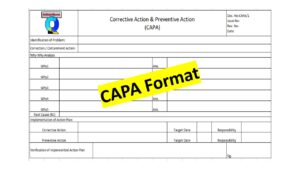
Hello readers! Today we will discuss “why why analysis methodology”. How effectively you can do the 5-why analysis. This analysis is the common tool used in the industry to find out the root cause of the problem but most of the people make mistakes during why-why analysis. So we will talk about the step-by-step methodology of why-why analysis. The why-why analysis is one of the inputs for executing the 8D report, CAPA (Corrective action and preventive action), and RCA (Root Cause analysis). Click on the below-given link to download the 8D and CAPA format.

Download 8D Format , CAPA Format & 5W1H Format.

You may like to read similar topics;    

 Root Cause Analysis | 8 Steps of RCA

8D Report | Free Download of 8D Template | Format

Free Template / Format (QA/ QC)

Decision of process capability analysis |Download Format

How to measure process capability (Cp & Cpk)? Download the Excel Template.

How to measure process performance (Pp & Ppk)?

why why analysis methodology:

Step-1: Identify the Problem.

Step-2: Understand the Problem.

Step-3: CFT team formation.

Step-4: Identify the Potential cause

Step-5: Why-why analysis.

Understanding the why-why analysis methodology by example:

Let Part number 123 find ingate shrinkage after the shot-blasting operation. So this case process-QA engineer started the why-why analysis by using the above methodology.

Identify the Problem:

At the shot-blasting operation, a process-QA engineer identified that two number casting got rejected due to ingate shrinkage.

Understand the Problem:

Understanding the problem means technically knowing what exactly is it? How is it occurring? (potential cause). In the above example, we are supposed to have knowledge on “what is shrinkage?

CFT team formation:

If you think that the problem may be due to issues with the melting parameter, moulding parameter, or design. Then you have to create a CFT team considering with the above departments.

Identify the Potential cause:

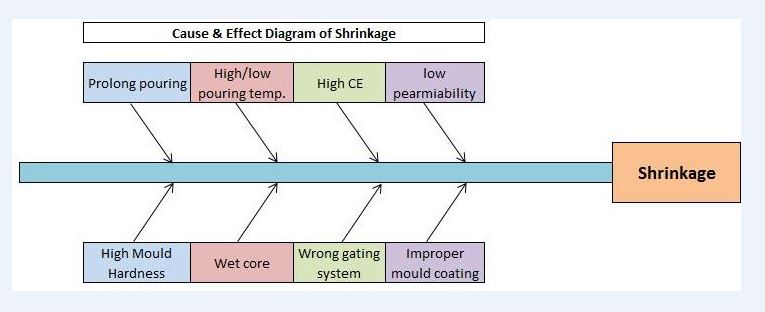
Now initially individual members will identify the potential cause. And then combine all members of the CFT team will identify the potential cause. Let’s see, in case of a shrinkage problem what would be the final list of potential cause.

Why-why analysis:

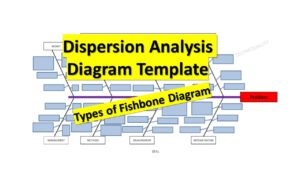
In this section, we are supposed to identify the significant cause of the potential cause. We have already identified the potential cause with the help of the CFT team and represented it through cause and effect diagram.
why why analysis methodology

To identify the significant cause from the above C&E Diagram, we need to use the methodology like brainstorming method, validation method, and hypothesis testing method. With the help of the brainstorming and validation method, we found that the “wrong gating system” is the significant cause. So now we will do the Why-why analysis by CFT team members.

Problem: Wrong gating system.

why why analysis methodology

Why wrong gating system?

Ans.: gating system was modified

5-why

Why gating system was modified?

Ans.: Gating system was modified w.r.t customer complaint but gating system was not validated before mass production.

why why analysis

Why gating system was not validated?

Ans.: There was no time to validate the part because production planning was scheduled without prior consideration of tool validation

root cause

RC: Improper Production planning and Schedule.

Once you completed the analysis you can document these in a 5-whys analysis template.

Funnel Approach of Why-Why Analysis:

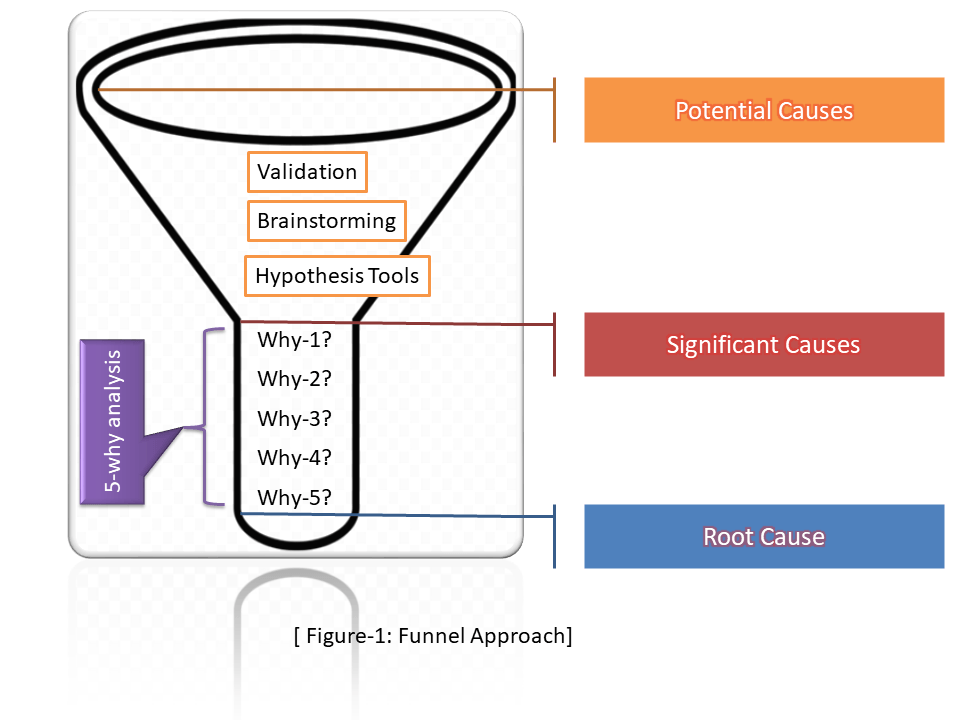
Once you identify the potential cause then we could also use the funnel approach to identify the Root cause by 5-why analysis.
funnel approach why analysis

In the above funnel diagram, we have mentioned three basic stages and applied some tools/ methods/ testing like validation, brainstorming, hypothesis testing, etc. to identify the significant cause in stage-2. and then applied the 5-why analysis to detect the Root cause in stage-3. In this way, we can use this approach to identify the RC.

Why-Why Analysis Methodology to Identify the Multiple Root Cause:

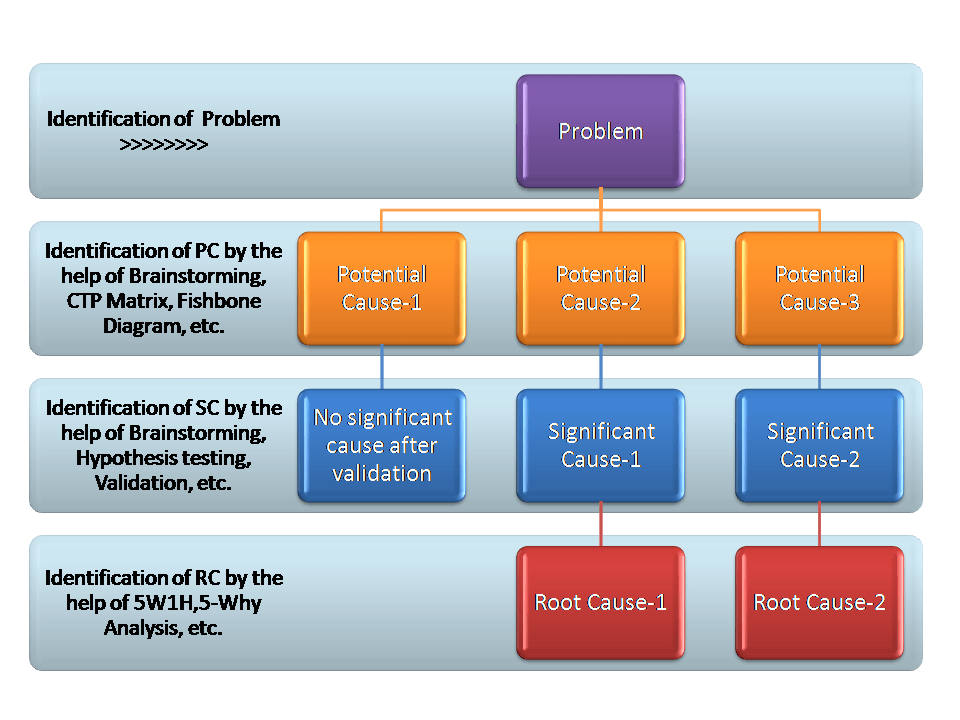
In the above section, we learned the two different methodologies for why-why analysis. and in both case, we found a single root cause. we know that theoretically there will be a single root cause of a problem but technically there will be a minimum one root cause of a problem. So here we have mentioned in the below figure for the methodology to identify the multiple root causes.
Why-Why Analysis for Multiple Root Cause

Step-1: Identification and Understanding of the Problem

Step-2: CFT Team Formation and list up the Potential Causes by using tools like Brainstorming, CTP Matrix, Fishbone Diagram, etc.

Step-3: Significant Cause identification with the help of Brainstorming, Hypothesis Testing, Validation, etc.

Step-4: Identification of Root Cause by why-why/ 5W1H analysis of each individual Significant Cause.

Similar Post:

8D Report Example | Download Case Study Report:

8D Report | Free Download of 8D Template | Format

What is SPC | SPC Tools.

7QC Tools for Problem Solving | What are 7 QC Tools

How to Plot Pareto Chart in Excel ( with example)

How to plot Histogram in Excel (Step by step guide with example)

More on TECHIEQUALITY

Thank you for reading…Keep visiting Techiequality.Com

Popular Post:

Corrective and Preventive Action Format | CAPA with Example

Corrective and Preventive Action Format, capa format, capa format in word, capa format in excel

Corrective and Preventive Action Format | Download CAPA Format:

Corrective and Preventive Action Format with an example is illustrated below. CAPA has generally eliminated the causes of nonconformity. It is usually a set of actions i.e corrective action and preventive action, An Action to eliminate the Root cause of Non-conformity is called corrective action, and an action to eliminate the potential cause of non-conformity is called Preventive action.

Download CAPA Format / Template.

Free Download QMS & EHS Template/Format.

Download Corrective Action Format 

You could like to read the below post:

why why analysis methodology | 5-why analysis step by step guide.

Free Download (QA, QC & 7-QC Tools Template /Format /form).

If you would like to learn more details on the CAPA Process & CAPA manufacturing example then read two important articles;

Corrective and Preventive Action (CAPA):

After knowing the symptom of the Problems why-why analysis plays a major part in identifying the root cause of the symptom of the problem.

In Industry CAPA is used to bring about improvement in process operation and to eliminate the causes of Problems.  Corrective and preventive action is also a part of the Quality management system. CAPA is fully followed by the PDCA cycle for the implementation of the action plan and for monitoring the effectiveness of the action plan.

Corrective action implemented w.r.t the Customer Return, field failure, Manufacturing Process defects, warranty failure, Product design failure, server failure, etc.

Preventive action is implemented in reaction to identifying the potential cause of nonconformity. Common preventive actions in industries are given below, but are not limited to:

  • Process/ potential failure Mode and Effects Analysis.
  • Design Failure mode and effects analysis
  • Quality Assurance Plan/ Control Plan
  • Standard Operating Procedure / Work Instruction.
  • Error Proofing/ Poka-yoke/ Mistake Proofing
  • Reaction plan
  • Risk mitigation plan
  • Alarms System
  • Process Validation
  • Product validation
  • Process layout.
  • Process feasibility study
  • Education and Training (Class Room / On-job-Training)
  • Preventive maintenance.
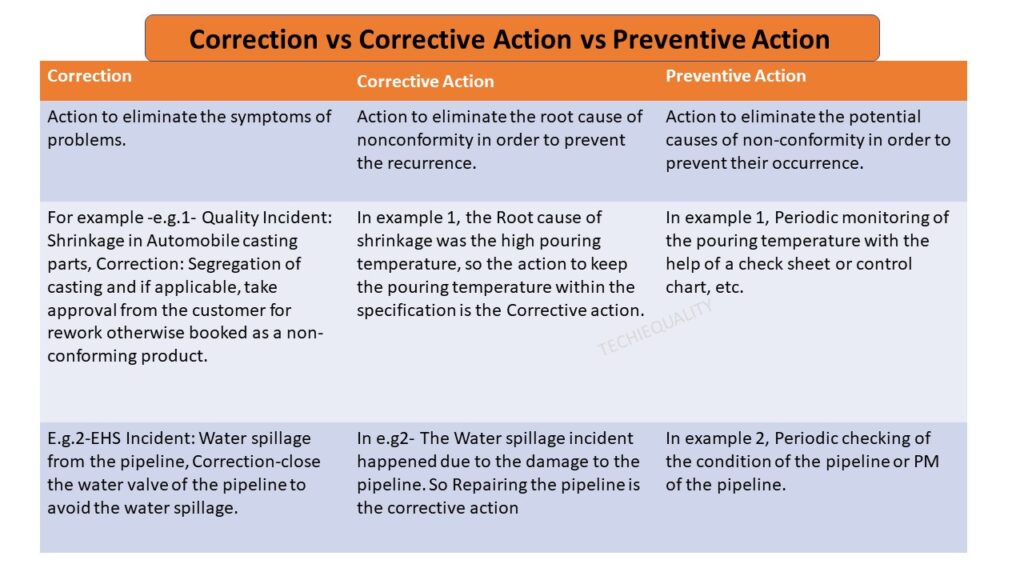
Corrective Action vs Preventive Action:
CorrectionCorrective ActionPreventive Action
Action to eliminate the symptoms of problems.Action to eliminate the root cause of nonconformity in order to prevent the recurrence.
The action to be taken in order to eliminate the root cause.
Action to eliminate the potential causes of non-conformity in order to prevent their occurrence.
To eliminate the potential cause of problems.
The action to be taken in order to avoid root cause recurrence.
For example -e.g.1- Quality Incident: Shrinkage in Automobile casting parts, Correction: Segregation of casting and if applicable, take approval from the customer for rework otherwise booked as a non-conforming product.In example 1, the Root cause of shrinkage was the high pouring temperature, so the action to keep the pouring temperature within the specification is the Corrective action.In example 1, Periodic monitoring of the pouring temperature with the help of a check sheet or control chart, etc.
E.g.2-EHS Incident: Water spillage from the pipeline, Correction-close the water valve of the pipeline to avoid the water spillage.In e.g2- The Water spillage incident happened due to the damage to the pipeline. So Repairing the pipeline is the corrective actionIn example 2, Periodic checking of the condition of the pipeline or PM of pipeline.
Correction vs Corrective action vs Preventive action
Corrective Action vs Preventive Action
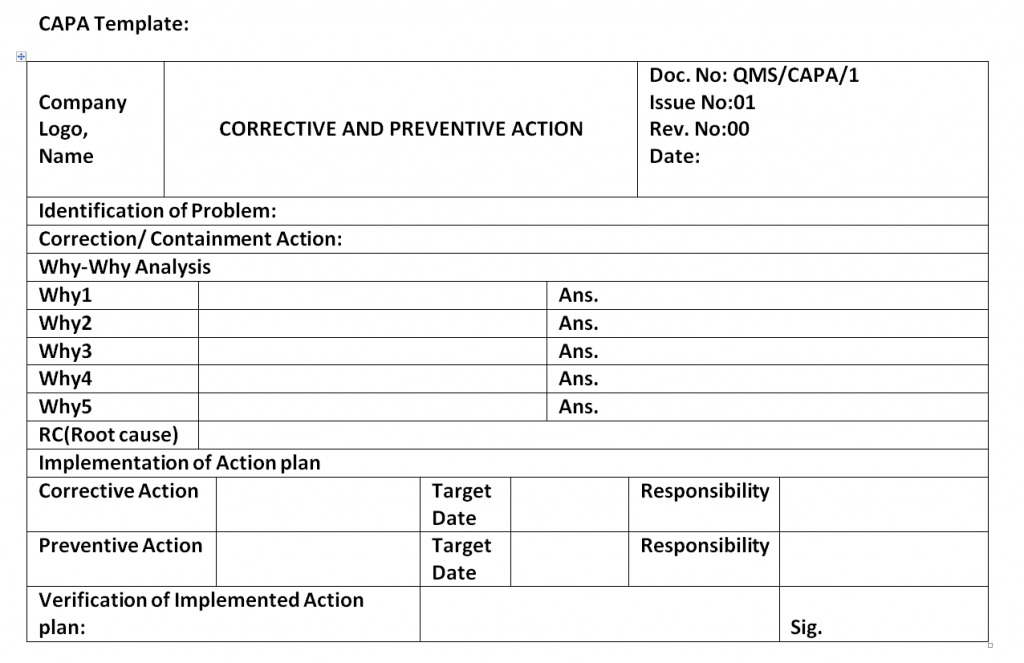
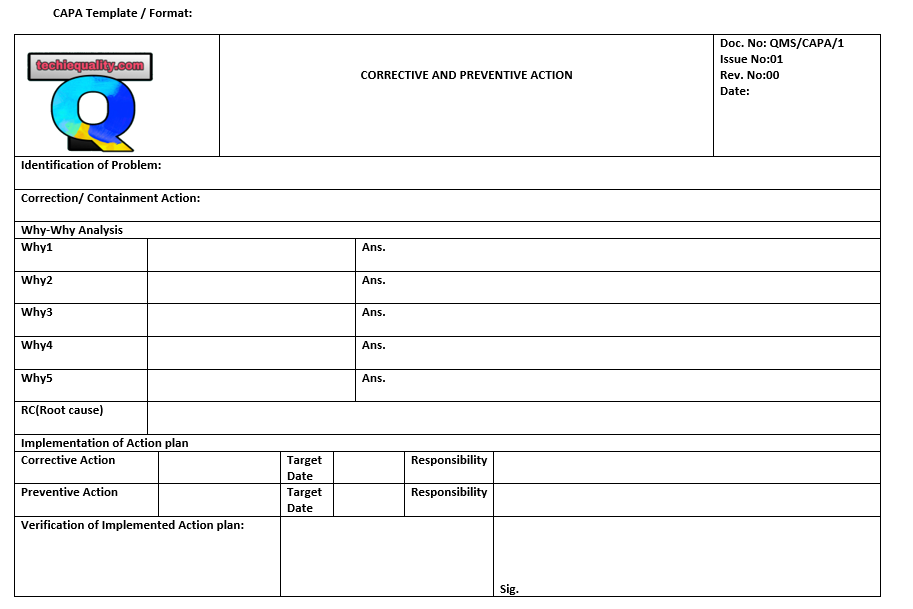
Corrective and Preventive Action Format / CAPA Format / CAPA Template in Word
Corrective and Preventive Action Format
Corrective and Preventive Action Format-DOWNLOAD

Use our approved simple & best formats or templates in your organization/ manufacturing units and provide us with your valuable feedback. DOWNLOAD-Template/ Format of 7QC tools, Cp & Cpk Calculation Sheet, FTA, 5W2H, 5W1H, SWOT Analysis format, Run Chart, 8D Format, Control Chart, OEE calculation excel sheet, CAPA Word format /Template, etc.

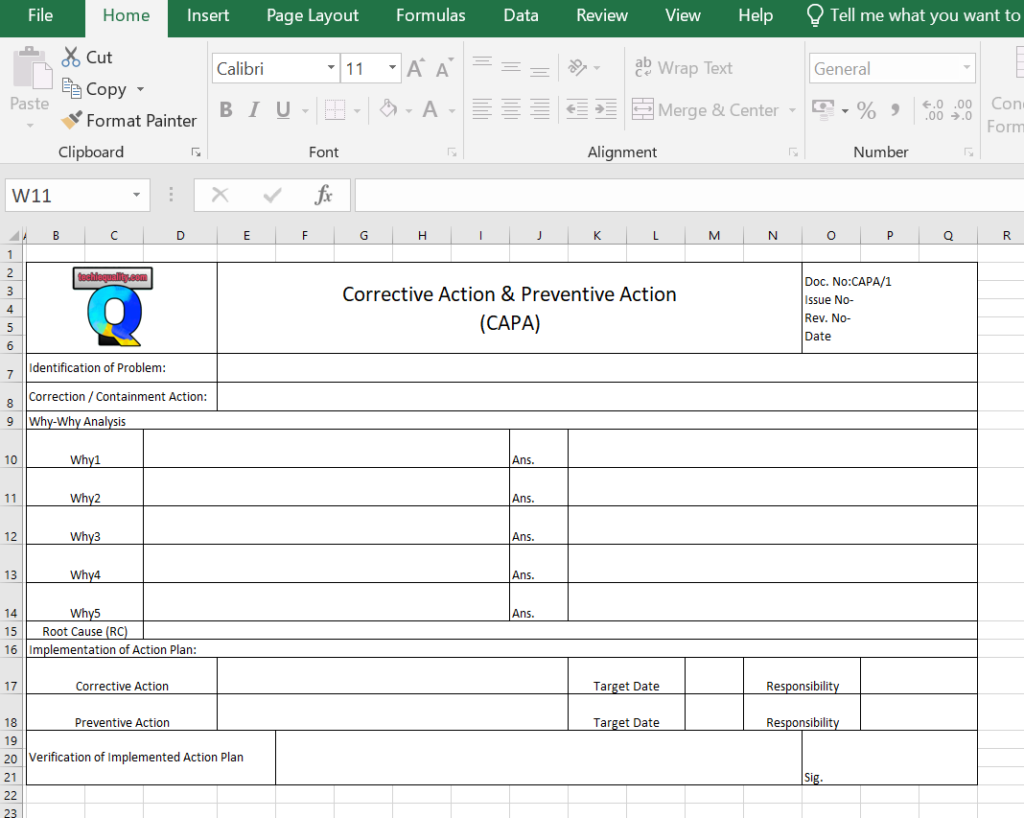
CAPA Format in Excel
capa format in excel
CAPA Format in Excel-DOWNLOAD
Corrective and Preventive Action Format filled up Example-1 :
Corrective and Preventive Action Format
Corrective and Preventive Action Format-DOWNLOAD

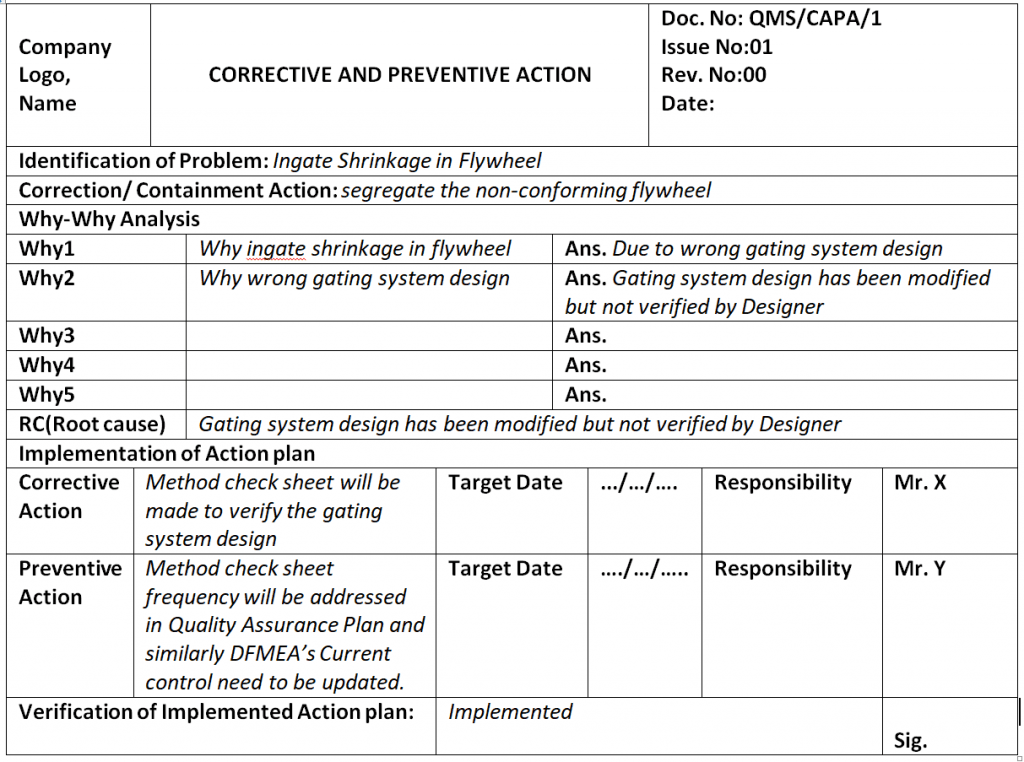
EXAMPLE-1: Shrinkage Defect

Identification of Problem: Ingate Shrinkage in Flywheel

Correction/ Containment Action: segregate the non-conforming flywheel.

Why-Why Analysis:

Why-1 Why Ingate shrinkage in a flywheel Ans. Due to the wrong gating system design
Why-2 Why the wrong gating system design Ans. The gating system design has been modified but not verified by the Designer
Why-Why Analysis.
RC(Root cause): The gating system design has been modified but not verified by the Designer
Root Cause.
Implementation of the Action plan:
Corrective Action A method check sheet will be made to verify the gating system design Target Date xx/yy/2020Responsibility Mr.Z
Preventive Action Method check sheet frequency will be addressed in the Quality Assurance Plan and similarly, DFMEA’s Current control needs to be updated. Target Datexx/yy/2020Responsibility Mr.Z
Action Plan Example.
Verification of Implemented Action Plan: Implemented.
[Verification]

EXAMPLE-2:

Details description of Example-2 (CAPA of Fire Incidents):

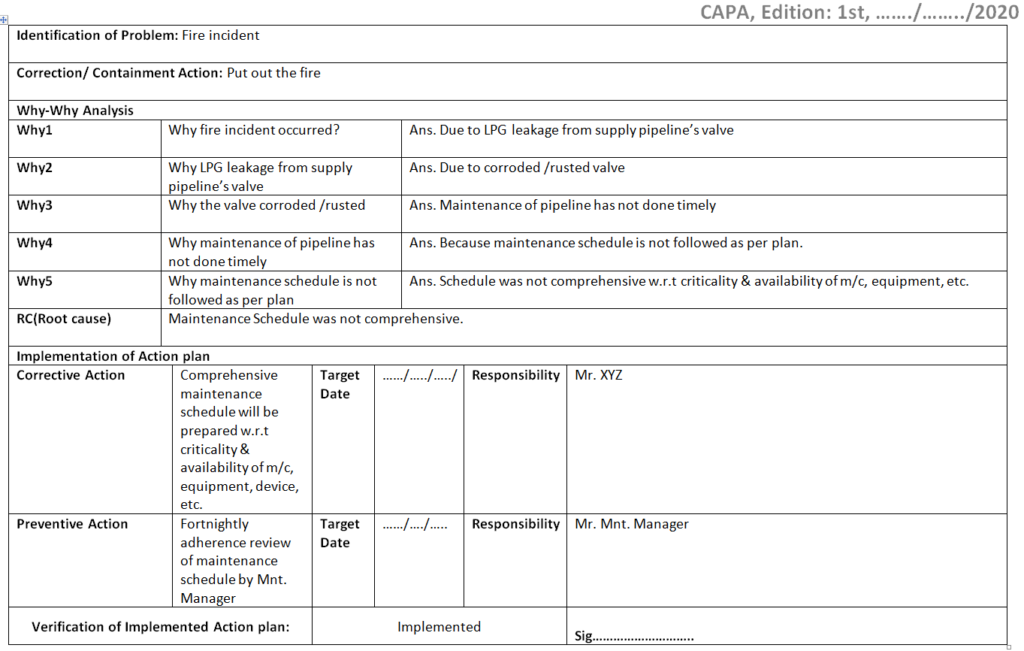
Identification of Problem: Fire incident.

Correction/ Containment Action: Put out the fire.

Why-Why Analysis of Fire Incident.
Why-1Why fire incidents occurred?Ans. Due to LPG leakage from the supply pipeline’s valve
Why-2Why LPG leakage from the supply pipeline’s valve?Ans. Due to a corroded /rusted valve
Why-3Why is the valve corroded /rusted?Ans. Maintenance of the pipeline has not been done timely
Why-4Why maintenance of the pipeline has not been done timely?Ans. Because the maintenance schedule is not followed as per plan.
Why-5Why maintenance schedule is not followed as per the plan?Ans. The schedule was not comprehensive w.r.t criticality & availability of m/c, equipment, etc.
5-W Analysis

RC (Root cause): The maintenance Schedule was not comprehensive.

Implementation of the Action Plan:
Corrective Action: A comprehensive maintenance schedule will be prepared w.r.t criticality & availability of m/c, equipment, device, etc.Responsibility: Mr. XYZ (Maintenance Engineer)
Preventive Action: Fortnightly adherence review of maintenance schedule by Mnt. Manager.Responsibility: Mr. PQR (Maintenance Manager)
Action Plan Example
Verification of Implemented Action plan: Implemented

Filled up CAPA Format in Word:

capa template
CAPA format filled up with examples of fire incidents

EXAMPLE-3:

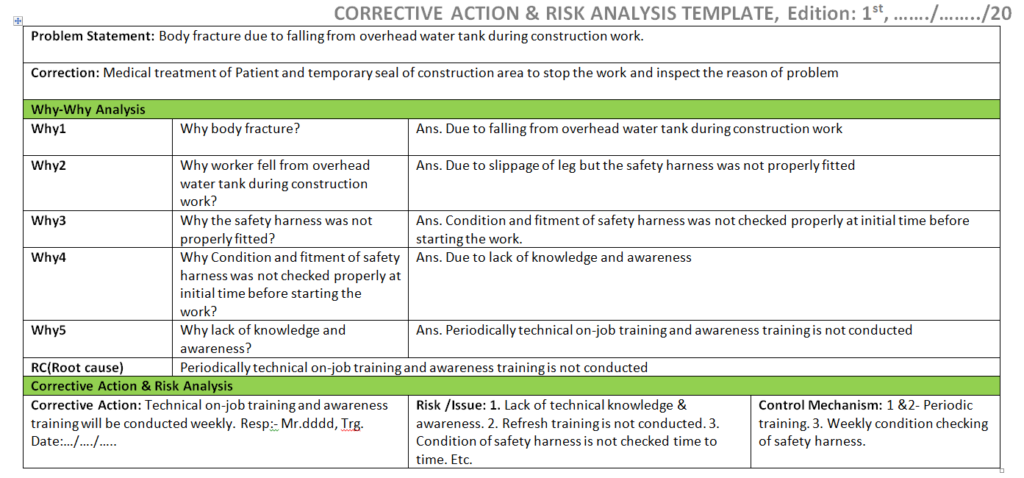
In this example-3, we will discuss the latest type of format or template of CAPA, as you know the preventive action part does not exist in ISO 9001:2015 standard, and the same was replaced by Risk, so we have to analyze the risk instead of preventive action. Hence considering with new ISO 9001:2015 standard we have prepared a new format/template called the Corrective action & risk analysis template and illustrated the same with simple examples.

CORRECTIVE ACTION & RISK ANALYSIS TEMPLATE

How to fill up the CARA Template /Format? (Illustrated with example):

Problem Statement: Body fracture due to falling from an overhead water tank during construction work.

Correction: Medical treatment of the Patient and temporary seal of the construction area to stop the work and inspect the reason for the problem.

Root Cause Analysis:

We have done the root cause analysis given below using the 5Whys tools.

Why-Why Analysis:
Why-1Why body fracture?Ans. Due to falling from an overhead water tank during construction work
Why-2Why worker fell from an overhead water tank during construction work?Ans. Due to slippage of the leg but the safety harness was not properly fitted
Why-3Why the safety harness was not properly fitted?Ans. The condition and fitment of the safety harness were not checked properly at an initial time before starting the work.
Why-4Why Condition and fitment of the safety harness were not checked properly at the initial time before starting the work?Ans. Due to a lack of knowledge and awareness
Why-5Why lack of knowledge and awareness?Ans. Periodically technical on-job training and awareness training is not conducted
5-Why Analysis

RC (Root cause): Periodically technical on-job training and awareness training are not conducted

Corrective Action & Risk Analysis:
Corrective Action: Technical on-job training and awareness training will be conducted weekly. Resp: – Mr.dddd, Trg. Date:…/…./…..Risk /Issue: 1. Lack of technical knowledge & awareness. 2. Refresh training is not conducted. 3. The Condition of the safety harness is not checked from time to time. Etc.Control Mechanism: 1 &2- Periodic training. 3. Weekly condition checking of safety harnesses.
CARA Report
capa format
CARA format
Example-4:

Here, we are going to discuss one example related to an accident and consider the same scenario for CAPA analysis. let’s say an accident occurred at a manufacturing unit while a man operating a machine. A CFT has been formed to analyze the accident and they prepared the CAPA report, which is mentioned below;

Correction: Medical treatment was provided to the patient and temporarily barricade the zone and machine for inspection purposes.

Root Cause: Lack of awareness

Corrective Action: Awareness training shall be provided to operators/workers

Preventive Action: Periodically awareness training needs shall be identified and the same to be imparted to concerned personnel.

FAQ1:
  • What ISO 9001:2015 Said about CAPA?
  • Ans: As you know the new ISO 9001:2015 standard asked about Correction, Corrective Action, and Risk & its mitigation plan. but not asked for preventive action. same mentioned in clause no.10.2 Nonconformity and corrective action in ISO 9001:2015 Standard. and for retained documented information, ISO 9001 asked for mandatory requirements as evidence of 1] the nature of the nonconformity and any subsequent actions taken. 2] the results of any corrective action.
  • What IATF 16949:2016 Said about CAPA?
  • Ans: The new IATF 16949 standard asked for Corrective action, Preventive action, and risk. In clause no 6.1.2.1, it’s said about Risk analysis, In 6.1.2.2-Preventive action and clause no. 10.2-Nonconformity & Corrective Action. After the incorporation of risk analysis in the IATF 16949 standard, still preventive action exists there.
FAQ2:
  • What is CAPA?
  • Ans: The full form of CAPA is Corrective Action & Preventive Action. corrective action eliminates the root cause of a non-conformity and PA eliminates the cause of potential non-conformity.
  • How to write corrective and preventive action reports?
  • Ans: We have already described at the top of this post with an example, simply go through it. Anyway, the most important part is the Root cause analysis and Why-Why analysis. Once you follow the right step to complete the RCA then, it will be very easy to write the CAPA in CAPA format /report, but in the new ISO 9001:2015 standard the preventive action has been replaced by Risk analysis, so when you write the CAPA, you have to cover the correction /containment action, corrective action then, you are supposed to identify the risk.

How to fill up the CAPA format quickly?

follow the below steps to fill up the CAPA format/template quickly;

  1. Identify the problem.
  2. Take containment action
  3. Do the RCA.
  4. Implement the CA & PA.
  5. Do the document changes
  6. Monitor the effectiveness

Corrective and Preventive action as per ISO 9001:2015 & IATF 16949:2016

CAPA (ISO 9001 v/s IATF 16949):
ISO 9001:2015IATF 16949:2016
Corrective ActionExist in the new standardExist
Preventive ActionNot Exist, replaced by Risk analysisExist
Risk AnalysisNew Requirement New Requirement
CAPA Comparison Table
More on TECHIEQUALITY

Why Why Analysis | Template | 5 Why Analysis Method with Manufacturing Examples

Why Why Analysis

Why Why Analysis | Excel Template | 5 Why Analysis Method with Manufacturing Examples

Hello readers! Today we are going to discuss and learn a popular topic, which is very useful and needful in the manufacturing industry to identify the root cause and to improve the operations. It’s nothing is called Why Why Analysis. In this topic, we are trying to cover the advanced concept and practical manufacturing examples for better understanding and easy implementation in operations. You can also download the Why Why Analysis excel template from the below given link.

Sample Why Why Analysis excel Template-DOWNLOAD.

5 Whys Excel Template

Why Why Analysis Format-Download

5 Whys Excel Template

5 Why Analysis Format-Download

5 Whys Excel Template

Why Why Analysis Concept:

A Why Why Analysis is a very useful problem-solving technique and that is also popularly known as the 5-Whys in process, service and manufacturing industries. The purpose of why why analysis is to identify the root cause of a particular problem, issue, defects, wastages, customer complaint, non-conformity, etc. by repeatedly asking the question “why”. The 5 Whys is a simple but effective technique, that is used in numerous areas, particularly in process improvement, Cost Reduction projects, and lean projects. The main aim is to get to the root cause of a problem, issues, defects, non-conformities, etc. so that we can take action to eliminate the root cause of the problem.

How to perform a Why Why Analysis or 5-Whys (Step by Step guide):

As we know that the concept itself indicating the 5 whys means we have to ask multiple times “why” to identify the root cause of a problem or issue. Below is the step-by-step guide on how to perform a why why analysis (5W / 5-whys analysis);

Team Creation:

You have to create a team in such a way that all required possible functions members should be present in the team, for example CFT team.

Problem Identification:

In this process, you have to identify the problem by using tools, techniques, and principles. we use many techniques and statistical tools in manufacturing industries to identify the problem, issue, potential causes, risk, defects, etc. The most popular and commonly used techniques, tools & methods in industries for the identification of problems, issues, defects, risk,s and non-conformity & gaps are inspection, SPC, QMS auditing, product testing, Process & product auditing, maintenance checking, layer auditing, etc. rather than these practices we also use many other methods to identify the risk, issue, problems through Risk and Issue identification, Data analysis, warranty analysis, customer complaint, field failure, etc.

Problem Statement:

Before defining the problem statement, if you have multiple problems then select the problem based on the criticality considering with severity, occurrence, and detection. Then next define the problem statement. The main purpose of the problem statement is to understand the depth and concept of the problem and, if possible represent it in a pictorial manner so that a complete idea will be developed on the problem statement. The importance of problem statement is very crucial in the time of brainstorming of problems for root cause identification. If the problem statement will not be cleared to all team members then, doing why why analysis will not be effective.

 Brainstorming of Why-Why Analysis (5 Whys):

Brainstorming on why why analysis is a creative problem-solving technique that is generally used to identify the root cause of a problem by multiple times asking of “why” and to generate a solution to the root cause. It’s a team activity in which all CFT members will ask why on problem until to get the root cause of the problem.

The effective and general rules for brainstorming of why why analysis are given below but these are not limited to.
  • Assemble the team members from different functions related to problematic areas.
  • Think about a comfortable and conducive environment.
  • Encourages the team members for open and free thinking about the brainstorming of problems.
  • Give always more focus on root cause identification and solution generation.
  • The mentor of the CFT team is supposed to set a specific time limit for the brainstorming section.
  • Record the Root cause and solution ideas.
  • Once you record the Root cause and ideas, if there is more than one solution idea then, prioritize the idea and develop the action plan (CAPA).
  • Validate the action plan by sample trial and if accepted then do the mass trial and after getting the effective result you can implement it as a full phase. In some cases, you can validate by ISIR report also.
  • Documentation: document the action plan, do the updation & standardize in relevant records or documents, for example, control plan, check sheet, FMEA, SOP, etc.
  • Effective monitoring and Measurement.
  • Horizontal deployment.

Steps of Why-Why analysis:

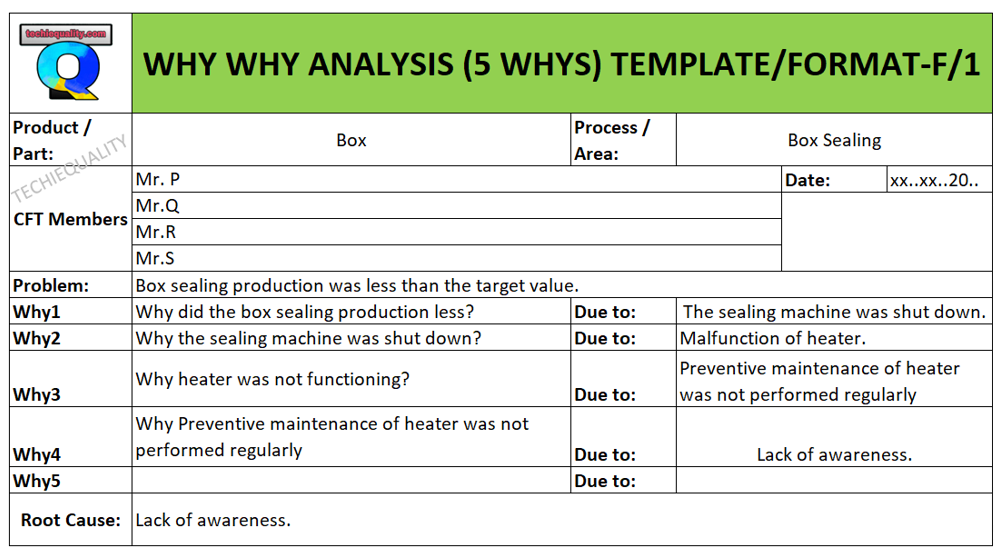
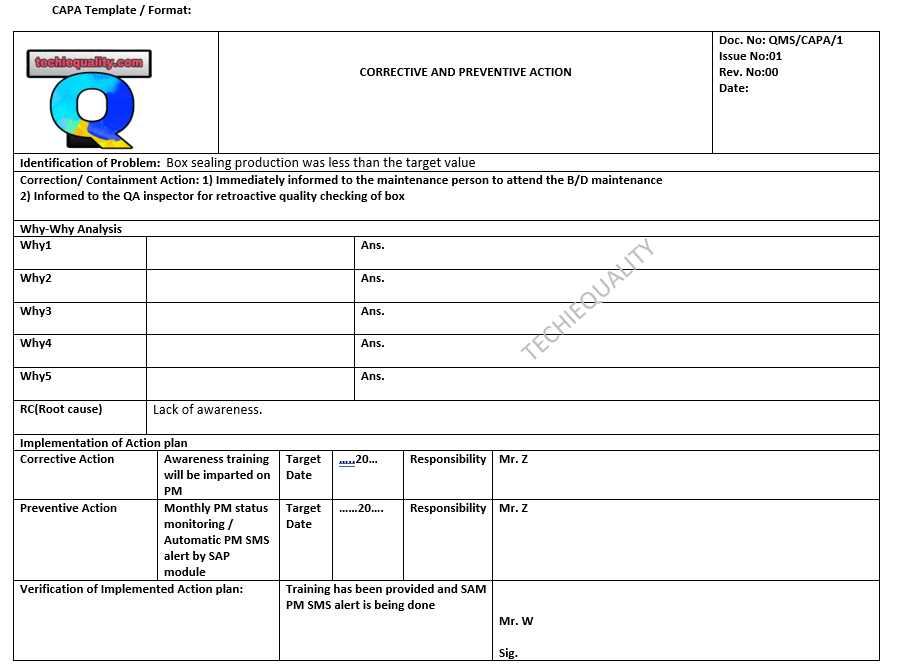
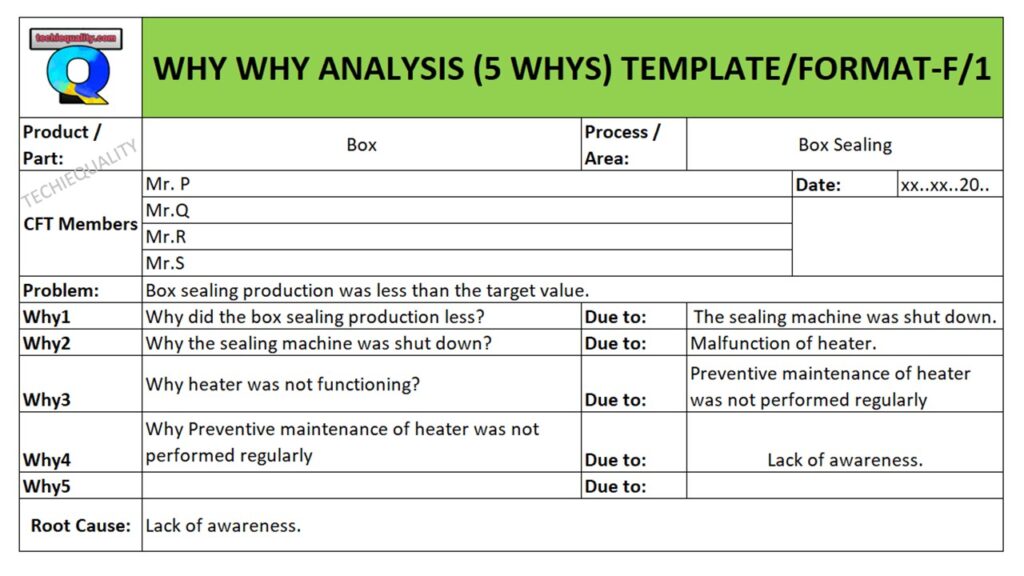
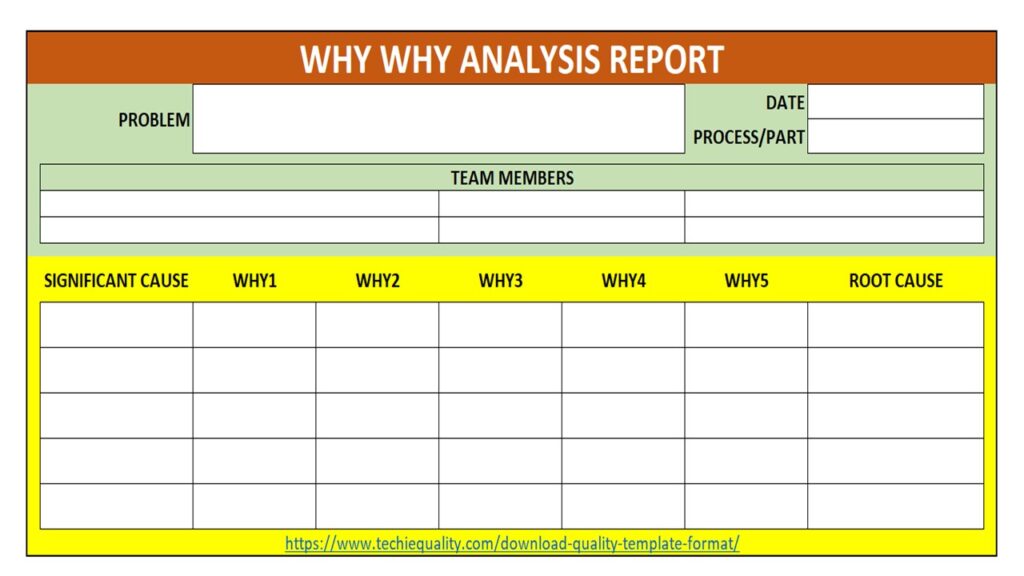
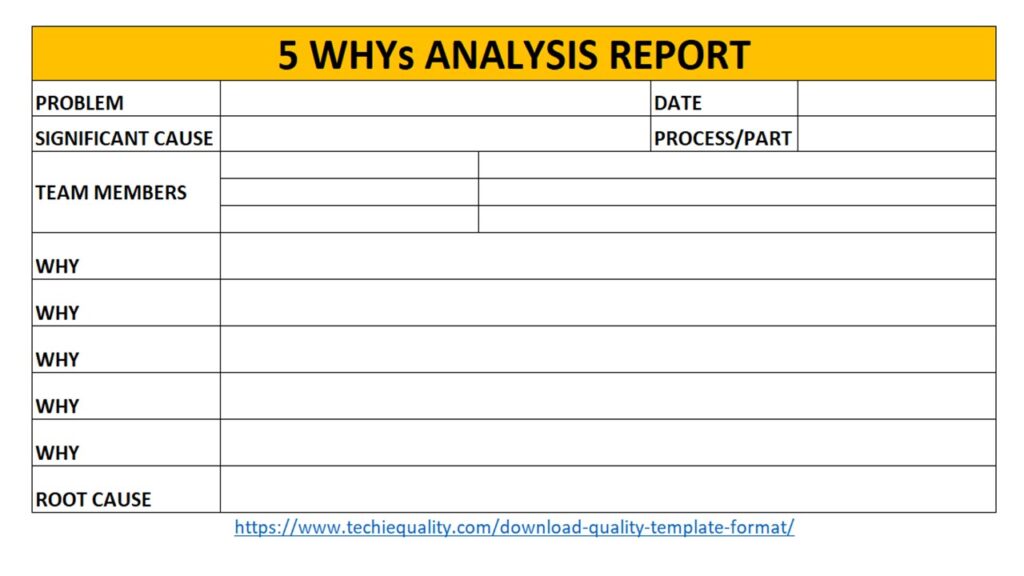
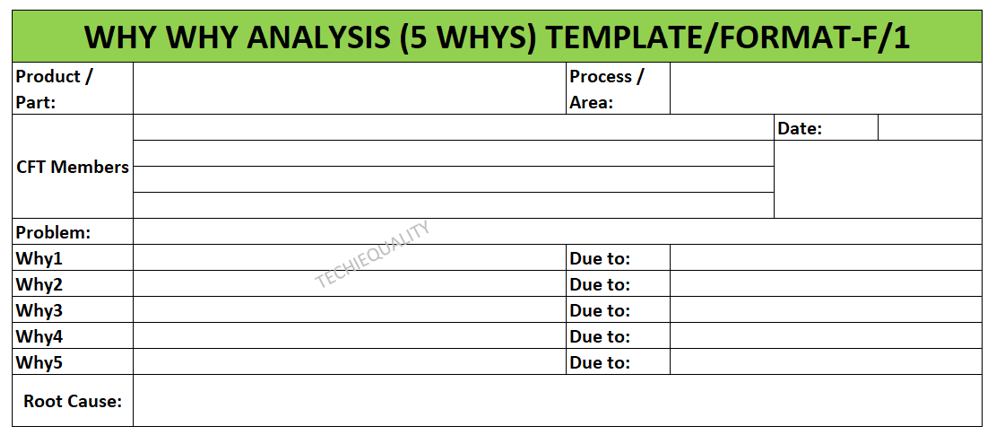
We have mentioned below two important templates or formats for both why why analysis and action plan formation in CAPA form. Let us learn the why why analysis first, as you can see in the first image (5 whys template) which is a very simple format where you have to write some basic information about the problem then you have to start asking “why” multiple times until find out the root cause. Once you identified the root cause then you should formulate a CAPA in CAPA format [see the second image in below].

Why Why Analysis
Why Why Analysis

[ DOWNLOAD – CAPA Format]

Steps of 5 whys analysis:

  • Ask the first “why” to the problem and record the potential cause in “due to” or “Ans.” Row in the above format.
  • Again ask “why” to the first potential cause and write down the “due to”.
  • Repeat the process by asking “why” for each “due to” until you find the root cause.

Once you find out the root cause then, develop actionable solutions in CAPA format.

capa

Manufacturing Example of Why Why Analysis:

Problem: Box sealing production was less than the target value.

Why1: Why did the box sealing production less?

Due to: the sealing machine was shut down.

Why2: why the sealing machine was shut down?

Due to: Malfunction of heater.

Why3: why the heater was not functioning?

Due to: Preventive maintenance of heater was not performed regularly

Why4: Why Preventive maintenance of the heater was not performed regularly

Due to: Lack of awareness.

Root Cause: Lack of awareness.

We have filled up why why analysis template or format of the above example, which is given below for your better understanding.

Why Why Analysis

Now the next process is the CAPA formation, we have already mentioned the CAPA format template in above, and same we are going to use it for action plan formation based on the above example, so let’s get started; if you would like to download the above template then click on the download link given in above.

CAPA Formation:

Problem: Box sealing production was less than the target value.

Root Cause: Lack of awareness.

Correction/ Containment Action: 1) Immediately inform to the maintenance person to attend the B/D maintenance. 2) Informed to the QA inspector for retroactive quality checking of the box.

Corrective Action: Awareness training will be imparted on PM (Preventive maintenance)

Preventive Action: Monthly PM status monitoring /Automatic PM SMS alert by SAP module

Go through the below filled-up format of CAPA format to understand the practical concept of Action plan formation.

corrective and preventive record

Benefits of 5 Why Analysis:

There are several benefits of 5 whys analysis but some important are listed below

  • To understand the issues/problems/ defects, etc.
  • Identify the root cause of a problem.
  • Prevent recurrence.
  • Continuous Improvement
  • Enhancing the innovation
  • Helps in decision-making
  • Helps in risk management
  • Enhance customer satisfaction
  • Effective problem solving
  • Process efficiency, etc.

Useful Post:

Normal Distribution Probability Formula, Calculation & Manufacturing Examples

SDCA Cycle understanding with Manufacturing Example | PDCA vs SDCA

Six Sigma Project Charter Template

CAPA Example | Manufacturing examples | CAPA Meaning

More on TECHIEQUALITY