3MU Check sheet | Details of MURA, MURI & MUDA | Download

3MU Check sheet

3MU Check sheet | Details of MURA, MURI & MUDA:

Hi Readers! Today we will discuss here details on MURA, MURI & MUDA. you can download our free template of the 3MU check sheet from the below links. The 3MU’s are MURA (Discrepancy), MURI (Strain), MUDA Waste).

DOWNLOAD-3MU Check Sheet. (MUDA).
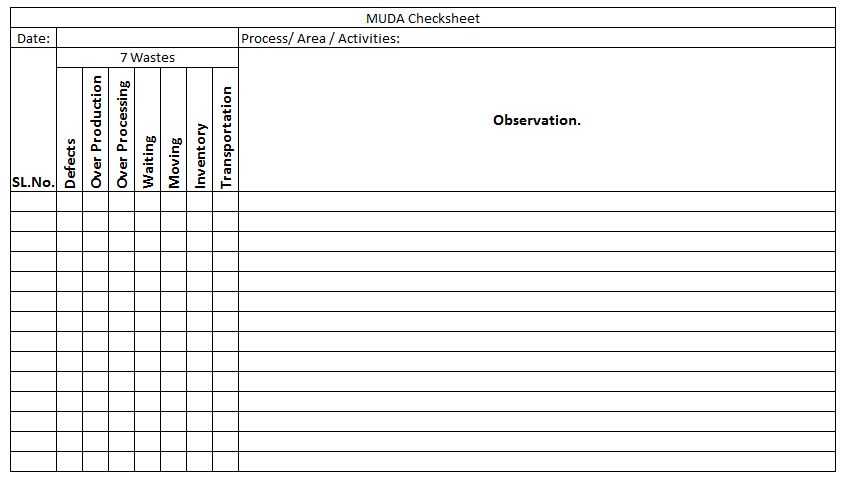
3MU Check sheet
3MU Check sheet- download

The 3MU can be applied in the below fields;

  • Method of operation.
  • Manpower.
  • Process involved.
  • Technique.
  • Facilities.
  • Time.
  • Jigs & Tools.
  • Materials.
  • Inventory.
  • Production Volume.
  • Place.
  • Way of thinking.

Details of MURA, MURI & MUDA:

MURA MURI MUDA
Unevenness, Discrepancy, Irregular Unreasonableness, Strain, Overdoing, Overburdened Unusefulness, Waste.
Any variation leading to unbalanced situations. A system, facility, or process designed beyond the physical capacities of equipment/ workforce Activities which does not add value.
MUDA: Waste, Unusefulness;

An any activities that do not add value w.r.t the customer perspective, presently in industry; elimination of waste (MUDA) is the big challenge. Many lean tools are there that you can implement it to deduce the MUDA. Value stream mapping is the one of the popular tools that basically used in many industries. But the identification of waste is a big job. The common 7 wastes are;

  1. Defects: The Defective product is total waste.
  2. Overproduction: Production more than demand or less than demand is a loss.
  3. Over Processing: Rework, Repair, Rechecking is a waste of time and money.
  4. Waiting: Waste of time, and money.
  5. Moving: The movement of goods within or outside is waste.
  6. Inventory: Unfinished goods, R/M, BOP add no value.
  7. Transportation: Unnecessary transfer of goods is waste.

Considering with above points we have prepared a sample MUDA Checklist for your ready reference. DOWNLOAD the MUDA Check sheet.

MURA: Unevenness, Discrepancy, Irregular;

MURA can exist when the workflow is out of balance.

MURI: Unreasonableness, Strain, Overdoing, Overburdened;

A system, facility, or process designed beyond the physical capacities of equipment/ workforces.

How to eliminate 3MUs?

The MURA (Unbalanced Process) can lead to an overburden on the workforce or equipment which may cause later on all kinds of non-value-added activities (MUDA). So to eliminate the 3MUs you have to give more focus on Value stream mapping, Process layout design, and 5’S, Visual standard, Kaizen, Process feasibility analysis, and Process variation.

Example:

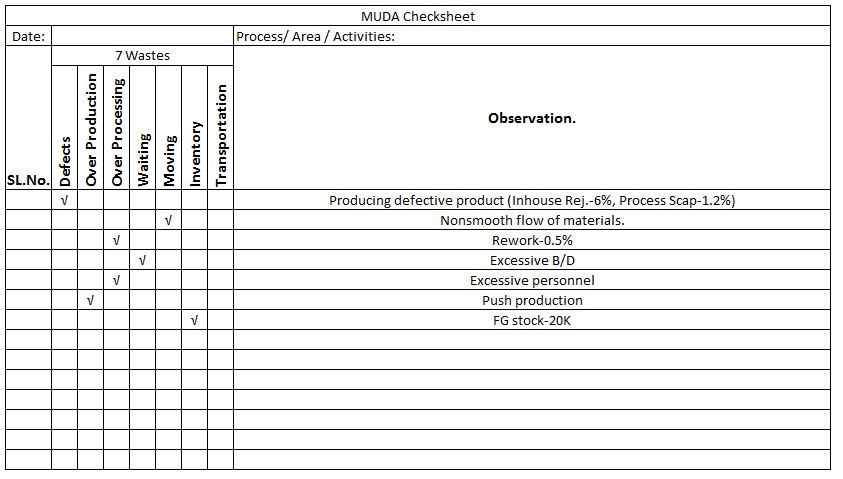
You can audit your respective area by using our 3MU-MUDA Check Sheet, Similarly, we have done this in the manufacturing unit and found some observations, same mentioned in below for your easy understanding.
3MU Check sheet
3MU Check sheetdownload

We have taken some initiatives against the above findings (Observation) to eliminate the MUDA in the process as;

Observations Management Initiative
Producing defective product TQM, QA
The Nonsmooth flow of materials KANBAN, JIT, PPC
Rework-0.5% TQM, QA
Excessive B/D TPM
Excess Production Pull Production, PPC
FG Stock-High Inventory Management, World class Supply chain Management
Useful Articles:

4M Checklist Template |Free Download Format

SPC Format |DOWNLOAD Excel Template of SPC Study

why why analysis methodology | 5-why analysis step by step guide

How to measure process capability (Cp & Cpk)? Download Excel Template

Error Proofing Understanding & Implementation of IATF 16949 Clauses 10.2.4

Pareto Chart Example of Manufacturing Units

Thank you for reading…keep visiting Techiequality.Com

Popular Post:

Kaizen vs Innovation | Key Differences between Kaizen and Innovation

Kaizen vs Innovation

Kaizen vs Innovation | Key Differences between Kaizen and Innovation

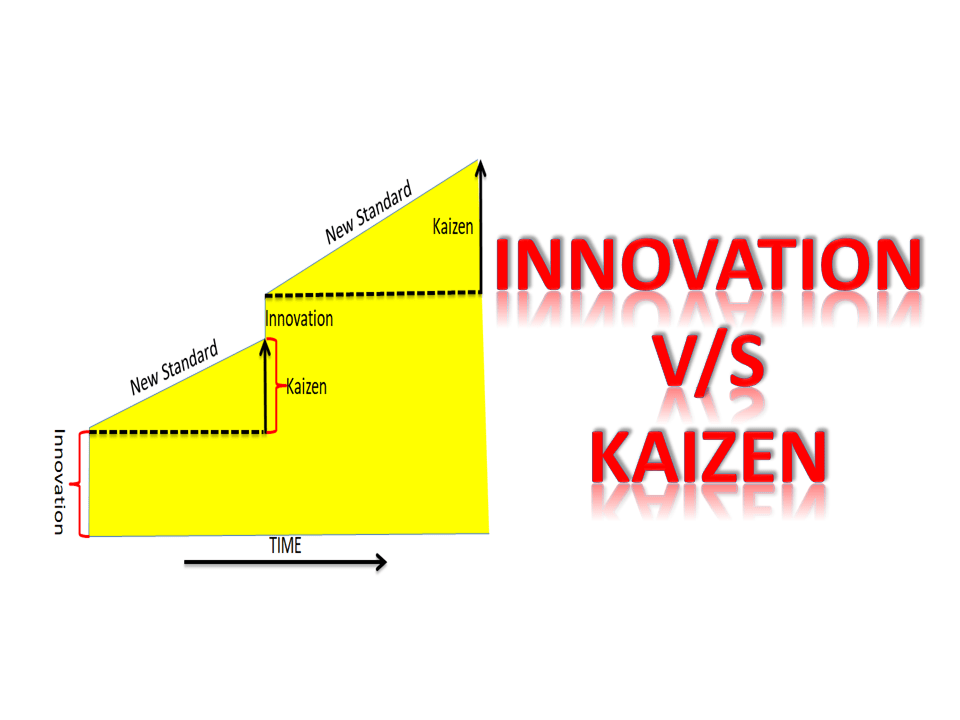
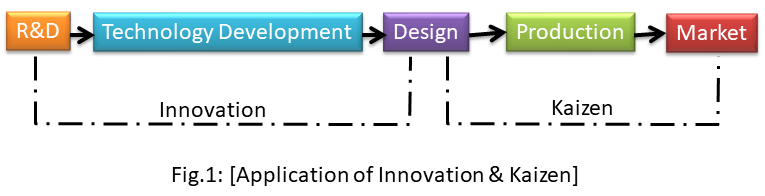
Kaizen vs Innovation: Both kaizen and Innovation can be applied at every stage in Manufacturing. But in normal circumstances, these two are applied in two different stages.

Kaizen vs Innovation

In the aforesaid figure, its clearly indicates that the Innovation phase can be started from scientific development i.e. R&D, and leads to new technology and later to design in this order. But the Kaizen phase is giving more emphasis on Gemba Kaizen (Work Place Kaizen).

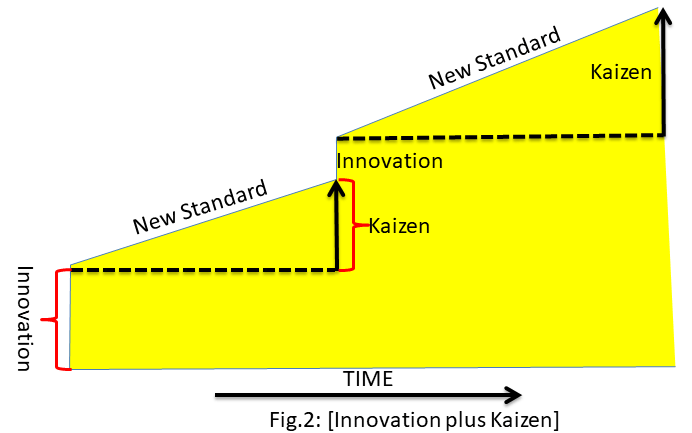
Diagrammatic Comparison Between Kaizen vs Innovation:

Kaizen vs Innovation

In the above Fig. 2, it clearly indicates that, if an organization starts both the innovation plus kaizen culture, then it will take very little time to achieve a high level of improvement in all aspects.

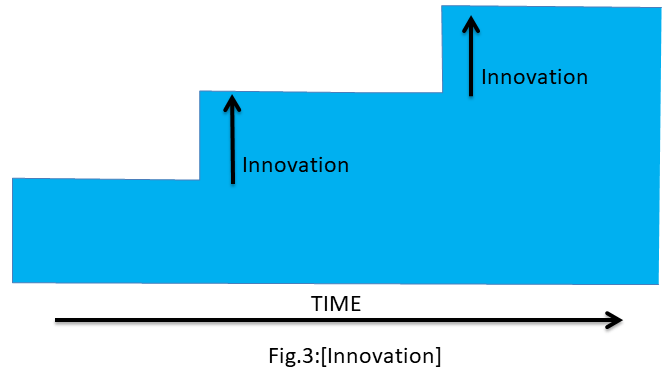
The organization has only innovation-oriented products that would cost more. Because the transformation of technology will cost high.

Kaizen vs Innovation

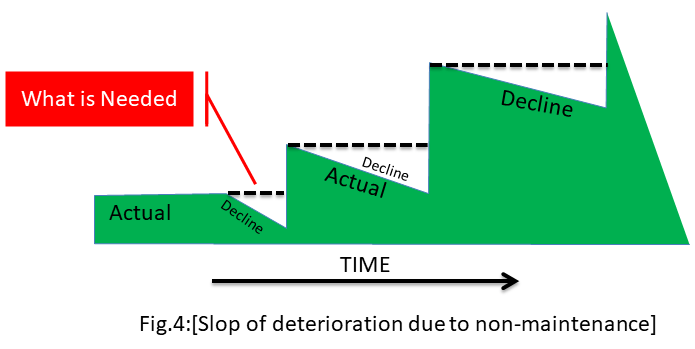
Only innovation-oriented organizations may often face the above situation (Decline) due to non-maintenance. So we have to sustain the new standard of innovation to prevent the declining situation.

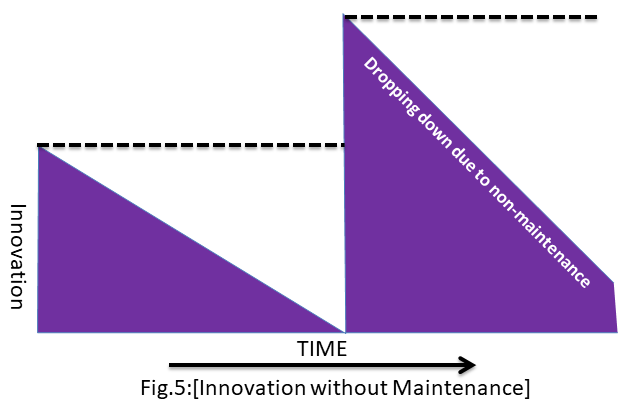
Innovation without maintenance:

Kaizen vs Innovation

Key Differences Between Kaizen and Innovation:

KAIZEN:
Elements of Comparison Kaizen
Approach More often collective, team Effort, and System oriented.
Method More often collective, Team Effort, and System oriented.
Idea Generation Flow from experience and Knowledge.
Involvement Through People
Maintenance Effort Whether effort put into process improvement gives better results.
Impact Long Term and Long Lasting.
Participation & Involvements Everybody.
Evaluation Whether effort put in process improvement gives better results.
Advantage Very well suitable for a slow-growth economy.
Effect Long term  and continuous but undramatic
Speed Small Steps
Timeframe Continuous and Rising
Changes of success Always on a high level.
Motto Preservation & Improvement
INNOVATION:
Elements of Comparison Innovation
Approach An Aggressive individual likes efforts from an individual.
Method Drastic Change of existing methods by discarding i.e. Creating a new process.
Idea Generation New Investment, Technology Transformation, R&D.
Involvement Investment in Equipment, Technology
Maintenance Effort Through technology
Impact Short -but dramatic change, yielding short-term gains.
Participation & Involvements Select a few.
Evaluation Whether Efforts put in results in profit.
Advantage Fast-growing economic.
Effect Short term but dramatic.
Speed Big Steps
Timeframe Interrupted and limited.
Changes of success Unsettled
Motto Reconstruction

Useful Articles:

Quality Template
DOWNLOAD

Thank you for Reading…. Keep visiting Techiequality.com

If you require any further information, let me know.

Popular Post:

Implementation of KAIZEN in Industry

Implementation of KAIZEN in Industry

Implementation of KAIZEN in Industry:

Implementation of KAIZEN in Industry is the most important key to the Industry for Continuous Improvement in any type of Loss or Waste. But the sustaining of any type of kaizen is the question mark for the industry. Many industries try their best to implement the kaizen at the initial stage is become successful. but sustaining the continuous improvement program is very difficult. Kaizen is the Key Input to all types of Business system standards. We will discuss here details about the comprehensive steps of the KAIZEN implementation program and its Sustainability.

Download the KAIZEN report template or format.

Step-1: Identify the Big Losses or Wastage in process or Areas

Based on the Historical data you have to select the higher contribution losses among the sets of different types of Losses in a particular process where you would like to Improve. Basically, the Pareto chart you can use to identify the Loss contribution among the sets of losses.

Step-2 Formation of Team

It is the same as what generally all types of project teams are made. The Process or Section In-charge will be the leader of the Kaizen Project.  and other team members should be from different functions such as production, quality, development, maintenance, etc. Now leader will give contributions to clarify the individual roles and responsibilities of each and every member. Responsibility and Activity Matrix need to be prepared before going to the next step. Here is one example of an Activity matrix.

Activity Matrix of Kaizen:

Activity Matrix is the helping tool for the successful Implementation of KAIZEN in Industry Download Activity Matrix of Kaizen.

Step-3 Collection of Data

Before collecting data, you have to identify the potential cause of the problem. Data need to be collected for a better understanding of the correlation between potential causes and problems.

Step-4 Analysis

This step is the most important step for action. Here you have to do a why-why analysis. And need to follow the narrow steps of Brainstorming to identify the Root cause through the involvement of each individual member of the team.

Step-5 Implementation of Project

Here aforesaid Kaizen Activity Matrix needs to be executed for the successful implementation of the Project or you can also be laid down the milestone chart or Gantt chart for the implementation of the project. During the Project implementation budget needs to be considered.

Step-6 Achievement of Kaizen Goal

Check up on the result of kaizen and also effectiveness. Address the Tangible and Intangible benefits.

Step-7 Standardization

The job is not over yet.  here you have to prepare the SOP, Fill up the Kaizen template, need to impart awareness about Kaizen’s benefits, etc. This will call for making those a working system.  Horizontal deployment over a similar area will give you the strength of the organization as cumulative tangible and intangible benefits.

Step-8 Sustenance

In step Sustenance, Sustainability Kaizen audit on a minimum monthly basis needs to be carried out.

Kaizen Examples:

as you know Kaizen is the best practice in the manufacturing industries for continuous improvement. I am sharing here my own experience that how I was identifying the kaizen idea in several operational areas.

when I was involved in shop floor manufacturing activities, every day on the morning shift I was analyzing the line rejection with details cause, and periodically did the Q component inspection. after doing the analysis and several types of Gemba auditing, finally, I was preparing problems identified report w.r.t man, machine, methods, material, and other factors for kaizen idea / continuous improvement purpose. discussed all problems related to the concerns department and collected their suggestions/improvement points. Given below is the kaizen methodology that you can follow to implement kaizen in your work zone.

  • List out the current problems, and issues in your work areas.
  • Find out the opportunities.
  • Categories the problems and find out which one is fit for Kaizen.
  • Do the Why-Why analysis.
  • Find out the Root causes
  • Take the Action Plan (CAPA).
  • Implement the action plan
  • Monitor the effectiveness.
  • Standardize the document
  • Visualize the data, SOP, OPL, etc.
  • Calculate the cost savings.
  • Do the periodic Kaizen sustenance audit to know the actual status or function of Kaizen.
ObjectivesHelping tools/techniques/methods for kaizen
KaizenTo eliminate waste, optimize productivity, and achieve continuous improvement.Engineering changes, Poka-yoke, SOP, OPL, PDCA, SDCA, Lean QC, QC, DMAIC, etc.

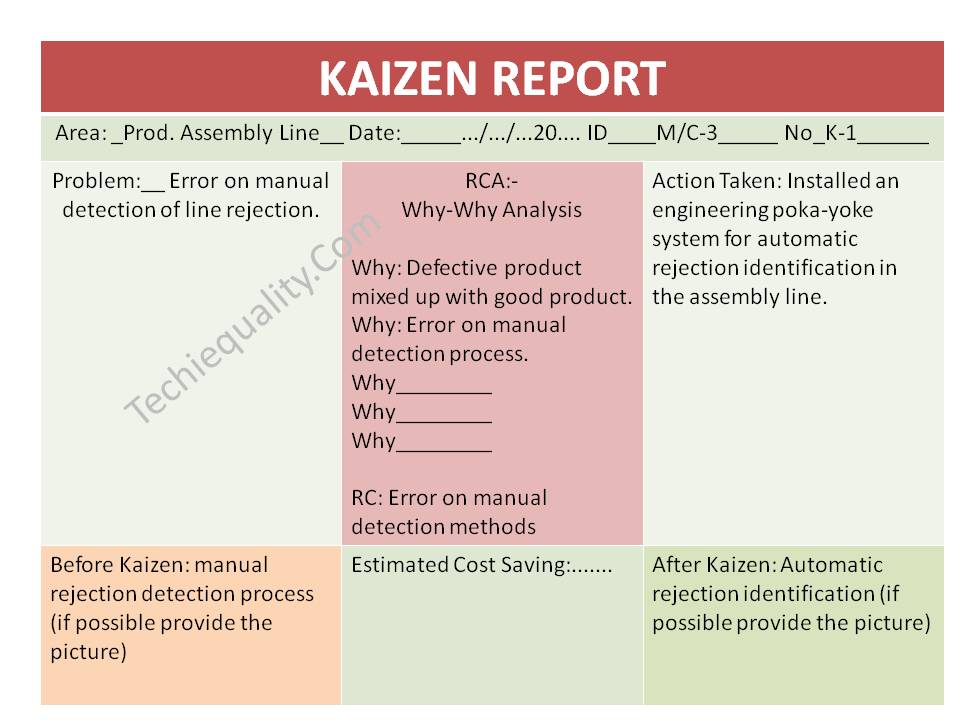
For kaizen examples, let’s say a company has a manual process for line rejection identification in the product assembly line, The engineering team developed a Kaizen idean and installed an engineering poka-yoke system for automatic rejection identification in the assembly line. we have prepared the same in the kaizen report, which is given below;

kaizen examples

Kaizen Template:

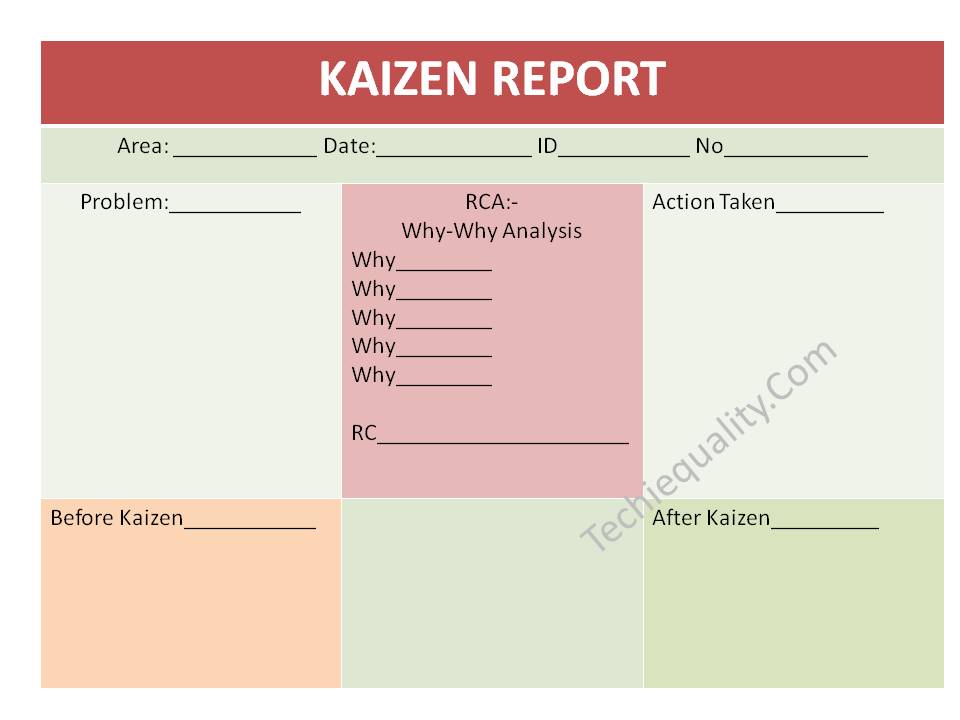
Below kaizen template is very simple to understand and easy to implement. this kaizen sheet has very simple nomenclature, those are normally used in manufacturing industries. for a better understanding, you can refer to the above filled-up kaizen sheet/ report.

kaizen template

Kaizen Sustenance Checking Methods:

Implementation of kaizen is important but sustenance of the kaizen is very important, so you can follow the below steps to check the sustenance of kaizen.

  • List out the monthly kaizen for your work zone.
  • create a Team.
  • Do at least half yearly kaizen sustenance audit
  • If possible then, link the kaizen with the daily manufacturing operation check sheet.
  • Incorporate the kaizen-poka yoke in the control plan and do the periodic test.

Thank you so much for visiting Techiequality.com

Popular Post: