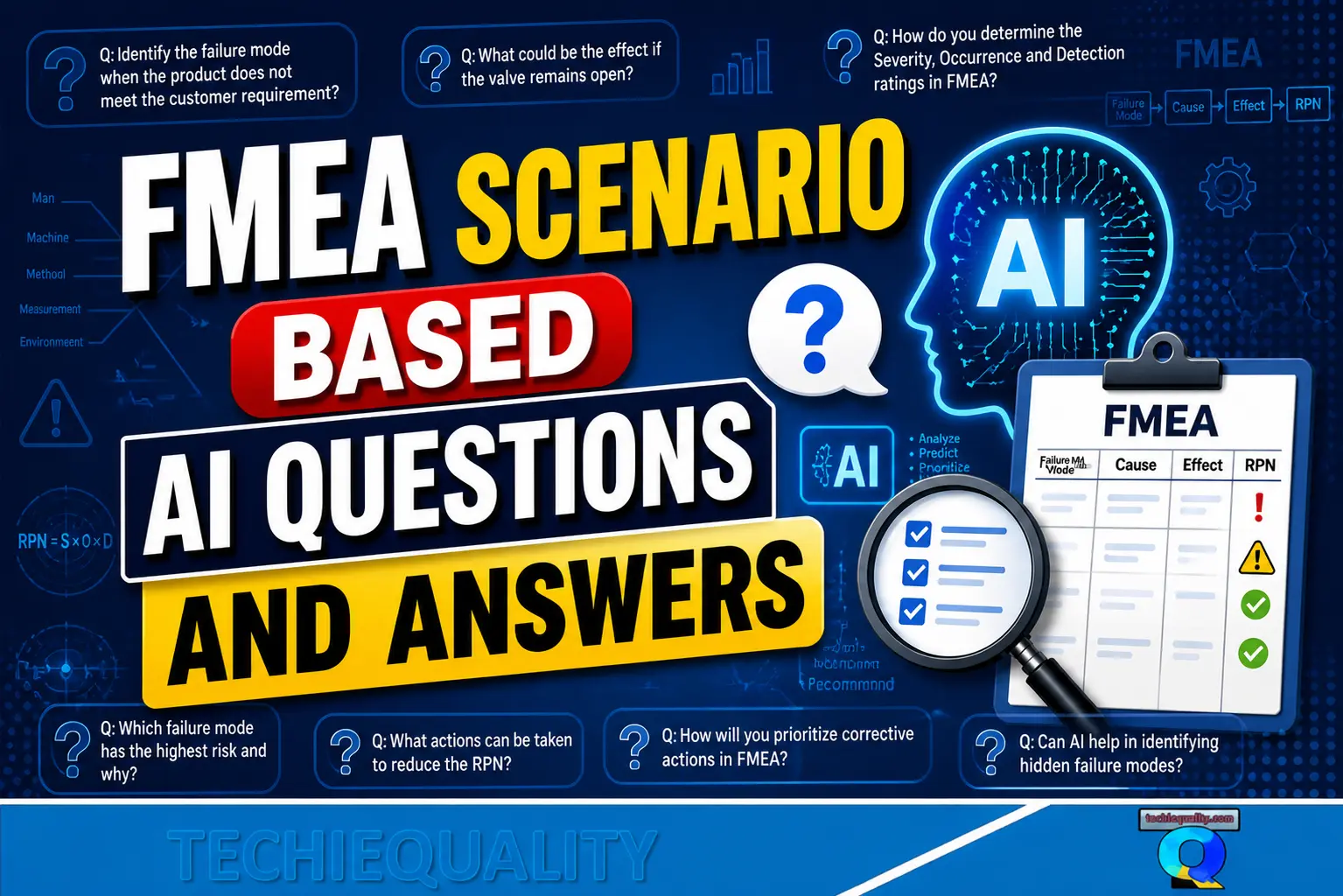
FMEA Scenario Based AI Questions and Answers
Hi Readers, Today, we will be discussing an important topic on FMEA Scenario Based AI Questions and Answers. Failure Mode and Effects Analysis (FMEA) is one of the most critical tools used in quality engineering, manufacturing, and product design to identify potential failures and prevent defects before they occur. Whether you are preparing for an interview or strengthening your practical knowledge, understanding FMEA deeply is essential.
Traditional FMEA is powerful, but often manual, time-consuming, and dependent on human judgment. With the rise of Artificial Intelligence (AI), organizations are now moving toward smart, data-driven FMEA that predicts failures before they even occur.
Understanding FMEA concepts is important, but applying them in real-life situations is what truly matters in interviews and on the job. In this section, we cover FMEA Scenario Based AI Questions that test your practical knowledge, decision-making, and problem-solving skills.
1. What is FMEA?
FMEA (Failure Mode and Effects Analysis) is a structured, systematic method used to identify potential failure modes & Design failure modes in a system, product, or process and analyse their effects on performance.
Key Objective:
- Identify risks before they occur
- Prioritize issues based on severity
- Take preventive actions
2. What are the types of FMEA?
There are mainly two types:
A. Design FMEA (DFMEA)
Focuses on product design-related failures.
B. Process FMEA (PFMEA)
Focuses on manufacturing or process-related failures.
3. What is a Failure Mode?
A failure mode is the way in which a process, product, or system can fail.
Example:
- Motor not starting
- Sensor malfunction
- Loose wiring
4. What is the difference between Failure Mode and Failure Effect?
| Aspect | Failure Mode | Failure Effect |
| Definition | What failed | Impact of failure |
| Example | Loose connector | System stops working |
5. What is Severity (S), Occurrence (O), and Detection (D)?
These are the three key factors used in FMEA:
Severity (S)
- Measures the impact of failure
- Scale: 1 (low) to 10 (high)
Occurrence (O)
- Frequency of failure
- Scale: 1 (rare) to 10 (frequent)
Detection (D)
- Ability to detect failure before it occurs
- Scale: 1 (high detection) to 10 (low detection)
6. What is RPN (Risk Priority Number)?
RPN is used to prioritize risks.
Formula:
RPN = Severity × Occurrence × Detection
Example:
- S = 8, O = 5, D = 4
- RPN = 8 × 5 × 4 = 160
Higher RPN means higher risk and priority.
7. What is the limitation of RPN?
- Different combinations can give the same RPN
- Does not always reflect true risk priority
- Modern systems sometimes use Action Priority (AP) instead
8. What is Action Priority (AP)?
Action Priority is a newer method (AIAG & VDA standard) used instead of RPN.
Categories:
- High Priority
- Medium Priority
- Low Priority
It focuses more on Severity first, rather than just multiplication.
9. What are the steps involved in FMEA?
- Define the process/system
- Identify failure modes
- Identify effects of failure
- Identify causes
- Assign S, O, D ratings
- Calculate RPN
- Define corrective actions
- Re-evaluate after actions
10. What is the role of FMEA in quality?
FMEA helps in:
- Preventing defects
- Reducing rework and scrap
- Improving product reliability
- Enhancing customer satisfaction
11. What is a Control Plan and its relation to FMEA?
A Control Plan is derived from FMEA.
Relationship:
- FMEA identifies risks
- Control Plan defines how to control those risks
12. What is Detection Control?
Detection control is a method used to identify a failure before it reaches the customer.
Examples:
- Inspection
- Testing
13. What is Prevention Control?
Prevention control eliminates the cause of failure.
Examples:
- Design change
- Process improvement
- Error-proofing (Poka-Yoke)
14. What is Poka-Yoke in FMEA?
Poka-Yoke is a mistake-proofing technique used to prevent errors.
Example:
- Connector that fits only one way
- Sensor to detect missing parts
15. What is the difference between PFMEA and DFMEA?
| Aspect | DFMEA | PFMEA |
| Focus | Design Issues | Process / potential issues |
| Stage | Product Development | manufacturing |
| Example | Material failure | Assembly error |
16. What is a real-life example of FMEA?
Example: Conveyor System
| Failure Mode | Failure Effect | Cause | Action |
| Belt slip | Production stop | Low tension | Adjust tension |
| Motor failure | System shutdown | overheating | Add cooling system |
17. When should FMEA be done?
- During product design
- Before process launch
- When changes occur
- After major failures
18. What are common mistakes in FMEA?
- Not updating FMEA regularly
- Incorrect rating (S, O, D)
- Treating it as documentation only
- Lack of cross-functional team involvement
19. What is the role of a Quality Engineer in FMEA?
- Lead FMEA discussions
- Identify risks
- Ensure proper ratings
- Drive corrective actions
- Link FMEA with control plan
20. How do you improve FMEA effectiveness?
- Use real data instead of assumptions
- Involve cross-functional teams
- Update continuously
- Focus on high severity issues
- Implement strong preventive controls
Scenario- Based Question:
21. High RPN but Low Severity: You found a failure mode with:
- Severity = 3
- Occurrence = 9
- Detection = 9
RPN = 243 (very high)
What will you prioritize, this or another failure with:
- Severity = 9
- Occurrence = 3
- Detection = 3 (RPN = 81)?
Answer:
The second case should be prioritized despite the lower RPN.
Reason:
- Severity is critical (9): impacts safety/customer
- Modern FMEA (AIAG & VDA) prioritizes Severity first, not just RPN
Action:
- Address high severity issues first
- Then work on high RPN items
22. Detection Control Exists but Failures Still Reach Customer: Even after 100% inspection, defects are escaping to customers. What does this indicate in FMEA?
Answer:
- Detection control is weak or ineffective
- Detection ranking should be high (poor detection)
Inspection does not guarantee detection.
Action:
- Improve detection method (automation, sensors)
- Focus on prevention rather than detection
23. Frequent Failure but Easy to Detect: A defect occurs frequently but is always detected before dispatch. How will you handle it?
Answer:
- Occurrence is high: needs action
- Detection is good, but not a permanent solution
Action:
- Reduce occurrence through root cause elimination
- Detection is only a temporary safeguard
New Process Launch:
24. You are launching a new production line. How will you start PFMEA?
Answer:
Steps:
- Understand process flow
- Break into operations
- Identify failure modes at each step
- Assign S, O, D
- Define controls
- Create Control Plan
Use past data, lessons learned, and similar processes
Same RPN, Different Risks: Two failure modes have same RPN = 120
- Case A: S=10, O=3, D=4
- Case B: S=5, O=6, D=4
Which one will you prioritize?
Answer: Case A.
Reason:
- Severity = 10 (critical risk, possibly safety issue)
- Always prioritize high severity
25. Customer Complaint Received: A field failure occurred that was not identified in PFMEA. What will you do?
Answer:
- Update PFMEA with new failure mode
- Re-evaluate S, O, D
- Add corrective actions
- Update Control Plan
- Implement containment action
FMEA is a living document, not static
No Failure History Available:
26. You are doing FMEA for a new product with no historical data. How will you assign Occurrence?
Answer: Use Similar product data, Engineering judgment, Supplier input & Testing results
Start with assumptions then refine after production data
27. Operator Error Causing Failures: Failure is caused by operator mistake. What type of control will you suggest?
Answer: Best solution: Poka-Yoke (Error Proofing)
Examples:
- Sensor-based detection
- Interlocks
- Fixtures that prevent wrong assembly
Avoid relying only on training.
28. Detection Rating Improvement: How can you reduce Detection rating from 8 to 3?
Answer:
- Introduce automated inspection
- Use sensors or vision systems
- Add real-time monitoring
Lower detection rating = better detection system
29. High Severity but No Control Possible: If Severity is 10 and cannot be reduced, what should you do?
Answer:
- Reduce Occurrence
- Improve Detection
Severity is usually fixed → focus on prevention
30. Supplier-Related Failure: Failure mode is due to supplier material variation. How will you handle it?
Answer:
- Add incoming inspection
- Develop supplier quality plan
- Conduct audits
- Define specifications clearly
Work on supplier process improvement
31. Repeated Failures Despite Actions: Even after corrective actions, failure is repeating. What does it mean?
Answer:
- Root cause not correctly identified
- Actions are not effective
Action:
- Re-do root cause analysis (5 Why)
- Update FMEA accordingly
Manual Inspection vs Automation:
32. Manual inspection is missing defects. What will you recommend?
Answer: Replace or support with automation
Reason:
- Manual inspection is error-prone
- Automation improves consistency
FMEA Not Updated:
33. Team is not updating FMEA after process changes. What is the risk?
Answer:
- New risks are not captured
- Control plan becomes outdated
- High chance of field failures
Action: Make FMEA update mandatory in change management
34. Low RPN but Critical Issue: A failure has low RPN but affects safety. Should you act?
Answer: YES
Reason: Safety issues always have top priority regardless of RPN
35. What is AI in FMEA?
AI in FMEA refers to the use of:
- Machine Learning (ML)
- Predictive Analytics
- Data Mining
- Automation tools
to improve how failure modes are identified, analysed, and prevented.
36. Why Traditional FMEA Needs AI
Challenges in Conventional FMEA:
- Subjective scoring (S, O, D)
- Static document (not updated frequently)
- Relies heavily on experience
- Misses hidden patterns in data
AI solves these by making FMEA:
- Data-driven
- Dynamic
- Predictive
37. How AI Enhances FMEA
1. Predictive Failure Identification
AI analyses historical data to predict potential failure modes.
Example:
AI detects that motor failures increase when temperature > 60°C; flags risk before failure occurs
2. Smart Occurrence Rating
Instead of guessing Occurrence (O), AI:
- Uses real production data
- Calculates actual failure probability
Result: More accurate risk prioritization
3. Automated Detection Analysis
AI can evaluate:
- Inspection effectiveness
- Sensor data
- False detection rates
Helps improve Detection (D) rating realistically
4. Real-Time FMEA Updates
Traditional FMEA = static
AI-based FMEA = live document
Automatically updates when:
- New defects occur
- Process changes happen
- Field failures are reported
5. Root Cause Prediction
AI models can identify hidden relationships between:
- Process parameters
- Machine conditions
- Failure patterns
Example: Combination of vibration + humidity: high failure probability
FMEA Scenario Based AI Questions
38. Problem: Frequent motor overheating in production
Traditional Approach:
- Manual FMEA
- Trial-and-error solution
AI-Based Approach:
- Analyse temperature, load, runtime data
- AI predicts overheating pattern
- Suggests preventive maintenance schedule
39. How does AI improve FMEA?
By making it predictive, data-driven, and automated instead of manual.
40. What is the biggest advantage of AI in FMEA?
Accurate Occurrence prediction using real data.
Comment below if you would like to hear more about FMEA Scenario Based AI Questions and insights.
Thanks for Reading… Keep visiting TECHIEQUALITY.

Shanti Gopal Pradhan is an experienced professional in Quality Management Systems, QA, Operations, Business Excellence, and Process Improvement. He has strong expertise in international standards including IATF 16949, ISO 9001, ISO 14001, ISO 45001, and ISO 17025, along with methodologies such as TQM, TPM, and Six Sigma.
He holds a degree in Mechanical Engineering along with an MBA, combining strong technical acumen with strategic business insight, he is a Certified Internal Auditor, Lead Auditor, and Six Sigma Black Belt, with a proven track record in driving quality transformation and operational excellence.